An attentive journey. With the 1920s Ukrainian novel that opens our eyes to landscape
Nearly a century ago, the Kharkiv-born Ukrainian modernist writer Maik Yohansen – who would tragically be executed by the Soviet regime in 1937 – published a novel that reinvented writing about nature, the steppes, and life that teems there. Framed as a “landscape novel”, Dr. Leonardo’s Journey is a playful experiment that invites the reader to look more closely at the world it constructs. Yohansen reimagined the relationship between author, landscape, and reader.
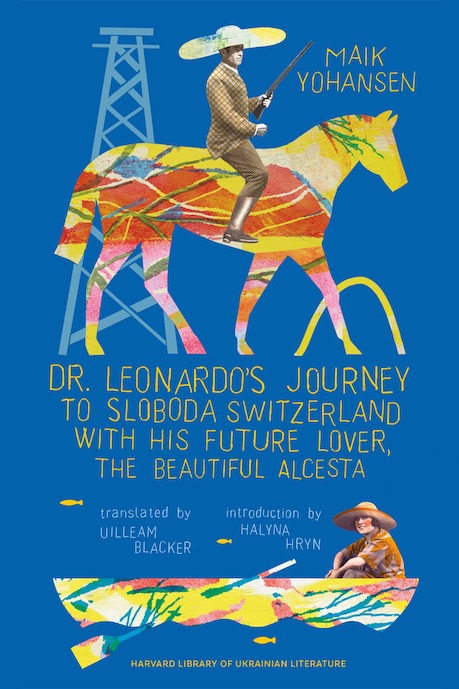
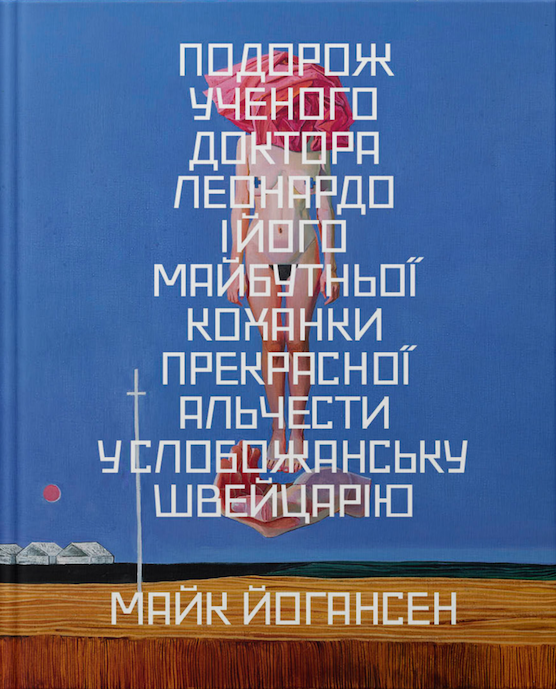
It begins with the title – Dr. Leonardo’s Journey to Sloboda Switzerland with his Future Lover, the Beautiful Alcesta. Maik Yohansen reveals right away what awaits the reader: an adventure novel, an over-the-top novel, a what-is-even-going-on-here novel. It is an invitation to enjoy thoroughly, but also to observe closely. Like an illusionist revealing the secret of a trick before performing it, the author announces in the epigraph: watch my hands, I’m about to attempt a “landscape novel”.
The first edition of Dr. Leonardo’s Journey came into the world in 1928, when Maik Yohansen was 33 years old. By then, the author had published a series of linguistic studies and translations, Ukrainian language textbooks, humorous short stories, collections of poetry, scripts for the film Zvenyhora, and a very practical Russian-Ukrainian dictionary. He co-authored the artistic manifesto Our Universal, contributed to the work of the literary associations Pluh (“Plough”), Hart, and VAPLITE, and edited the almanac Literary Fair. He studied classical literature, linguistics, philosophy, and epistemology in Poltava and Kharkiv.
Also in 1928, Yohansen published a guide for young writers, How One Constructs a Short Story. In it, the author cautioned against writing landscape into a novel thoughtlessly, as a mere backdrop devoid of narrative purpose. His argument is psychological rather than environmental: people, he observes, want to read about themselves, nothing to be ashamed about here. At the same time, for Yohansen as a writer, this anthropocentrism presented an obstacle he decided to overcome. How do I, Yohansen ponders, write about nature in a way that readers do not become bored “before reaching the shores of the third page”.
Dr. Leonardo’s Journey – distinctly geographical and phenomenological – is a portal of sorts. From the very first pages, we are spinning in a whirlwind of scents and images, across the Kherson steppes and the Switzerland of Slobozhanshchyna (a vernacular toponym, familiar to residents of the city of Kharkiv) – journeying down the lakes and floodplains of the Siverskyi Donets river near Zmiyiv, 30 kilometers south of Kharkiv. All this intermingles with a masquerade of real and fictitious characters, embarking on their real and fictitious adventures.
In the first part of the novel, the Kherson steppe transforms the Spanish freedom fighter Don José Pereira into a “stepovyk and member of the Steppe Regional Executive Committee,” named Danko Kharytonovych Pererva. Pereira ends up in the steppes because he had to go on one last hunt prior to killing a fascist dictator in his homeland. Pererva becomes a target himself – on the run from kurkuls because he killed a rabbit outside the hunting season. Yohansen’s cinematographic imagination is at its best here: a wander through the steppes that transforms suddenly into a chase through “lush regiments and divisions of buckwheat” would make a thrilling sequence in a fast-paced action film. Another author may have easily slipped into a tired metaphor of an “endless steppe” in narrating this landscape. But Yohansen’s steppe, reenchanted and “round as a disc”, catches the reader off guard:
There was a dum in the steppe. The dum hummed from beneath the earth, from among the roots of the dusty, sunburned plants, the dum fell out of the sky, raced against the sound of the grass, tumbled through the mist and the patches of sun, died down in the whisper of last year’s sawdust and then grew again: it glided through the grass, exploded into a wild, monotonous Mongolian symphony, howled and deafened those who heard it; it beat its wings madly against the intractable copper disc; it whistled, screeched, shrieked, and then again, falling still on the low lying ground, the dum scattered among the quiet sounds of the grass, faded, and disappeared into the earth, leaving behind it the dried-up tears of salty black earth.
Yohansen, the narrator, speaks to his reader whimsically, yet lovingly. He teases, but courteously. Literary modernism from the Soviet period is here still at its finest: it does not seek to shock or viciously mock, nor has it succumbed to Party directives to produce agitprop. Yohansen time and again pops “his own tousled head” into the story, begging the forgiveness of the reader for messing around with us. What he wants is for us all to have a really good time.
The story’s idiosyncratic plot owes a lot to the fact that Yohansen assembled it like a collage. Parts of the novel first came out as two novellas: the first is about Doctor Leonardo and Alceste in the Switzerland of Slobozhanshchyna in 1928, and the second about the “professional tyrant fighter” Don José Pereira and his Irish setter Rodolfo in the Kherson steppes in 1929. The following year, these stories came out as one work, united through the epilogue, where Yohansen peers ten years into the future of the protagonists’ lives.
The final version – with an added third book and an afterward – came out in 1932 into a radically different world: Stalin had firmly concentrated power in his hands; the radiant future promised in the first years of the Soviet Union was traded for forced collectivization and five-year plans; the Holodomor raged, and political repressions were gaining pace. The USSR was sliding steadily into totalitarianism, while artistic experiments were forced to yield to uncompromising glorification of party policy; otherwise – arrests, exile to Sandarmokh, executions, or being consigned to oblivion as an “enemy of the people.”
In that moment, ideas about what an artist should or should not do narrowed drastically. Artists had to create as real a version of reality as possible, which – by the party’s own determination – was an especially successful post-revolutionary achievement. Under these conditions, Yohansen’s ambiguous allegory in one of the final scenes of the novel was an extremely dangerous move. In it, the mechanic Sharaban – a vulgarized culmination of the proletarian ideal (“as concrete and materialist as a nail”) – quite literally takes apart the landscape and with it the entire plot. First, he unscrews the moon from the sky, then the stars – scrap metal for an open-hearth furnace. He does this all with such fervor that he nearly unscrews the sun, as it begins to rise. Yohansen’s portrayal of industrialization as feverish fanaticism, rendered as a literal deconstruction of the landscape, is a brilliant and innovative intervention.
Many who read Dr. Leonardo’s Journey interpret the narrative journey itself to be purely allegorical, positioning the novel as literature about literature. From this standpoint, Dr. Leonardo’s Journey lends itself to comparison with Don Quixote. Yohansen’s Don José Pereira is a similarly fumbling knight-errant, a failed revolutionary, who comes on a hunting trip to Ukraine and misses the revolution brewing in his native Spain, and ends up shooting a random general instead of the fascist dictator. But the historian, philosopher and critic Tsvetan Todorov has suggested taking seriously not only the pretexts and allegorical allusions of travel narratives, but also their material realities. Following the material reality of Dr. Leonardo’s Journey, one can see how Yohansen disrupts not so much the genre of the adventure novel, as the author–landscape–reader triangle.
Yohansen was up against readers accustomed to treating landscape as a meaningless backdrop. And so he devised Dr. Leonardo’s Journey to demonstrate that one can write differently, welcoming us into the vibrant ecological world elegantly, playfully, with a wink. Bringing these ideas to fruition, Yohansen built on his own critiques of Turgenev’s apolitically romanticizing landscapes, and of Nechuy-Levytsky's plotless glorification of agriculture and purely descriptive portrayal of rural poverty. He also fastidiously analyzed how landscape materializes in the works of foreign writers, singling out Flaubert and Maupassant for “maximum brevity and useful effect” in their “treatment of landscapes”.
Yohansen goes further, not only challenging but also debunking the concept of landscape. In How One Constructs a Short Story, he discloses his own theory of landscape: “The cow has its own real existence even without a human observer; landscape, however, does not enjoy that kind of existence. Landscape is a relationship between the human eye and inorganic nature.”
More contemporary theorists, such as the geographer Denis Cosgrove and the philosopher Donna Haraway, have similar views of landscape – and nature more generally – as signifiers. Yohansen convincingly demonstrates that landscape is both fiction and fact simultaneously. As soon as a landscape succumbs to attempts to narrate it, it instantly breaks down into its constituent actors – human and not only. The 150 pages of Dr. Leonardo’s Journey teem with creatures, and each one lives out its own adventure alongside humans: the red setter Rodolfo, parasitic worms, a fox, fog, pears, mosquitos, cows, ants, the horse Volodka, a wolf, an oxytropis, a plain of buckwheat, hog’s fennel, reeds, lilies, a blue dung beetle, and an array of birds Yohansen knew from hunting – the steppe eagle, the kingfisher (or blue fisherman), the bee-eater, wild ducks, the heron, the corncrake, the quail. And then there is “the great ash tree of Germanic mythology”, Yggdrasil, and the invisible lion with an audible roar.
Each of these travelers is headed somewhere on its own journey. Even the moss-covered stone that lies on the steep bank of the Donets between two ancient oaks, which “is hurtling at great speed in the direction of some distant god-knows-what,” has a role to play in the landscape and the plot. Yohansen’s landscape with all its inhabitants lives its own life, but it does not exist outside the realm of human adventure. It experiences radical transformations, including the dismantling of the sky, the end of peasanthood and the onset of proletarian industrial modernity, with which Dr. Leonardo’s Journey ultimately ends.
A century after the writing of Dr. Leonardo’s Journey, contemporary authors, such as Timothy Morton and Jeff VanderMeer have popularized the idea of a “weird nature”, deliberately “weirding” the world as a means of seeing it more fully and completely. Yohansen, in his own time, weirded, re-enchanted and chimerized the steppe and forest-steppes, so that it is impossible to this day to tear oneself away from them – not out of respect for the author himself, but out of an unwillingness to miss one second of the life that pulses through the novel’s pages. Dr. Leonardo’s Journey offers us fresh imaginaries of central and left-bank Ukraine – liberated from idealized village life, and from the pastoral settings of Turgenev and Nechuy-Levytsky. These are landscapes filled playfully with cardboard human figures that Yohansen “cheerfully [pulls] back and forth under the burning sun of the real, living steppe and underneath the damp eaves of the real sycamores of the Switzerland of Slobozhanshchyna."
Dr. Leonardo’s Journey is the most comprehensive, though not the only, example of what literary scholar Yaryna Tsymbal refers to as Yohansen’s “philosophy of movement”. In the last years of his life, the writer continued to closely observe industrialization, wondering whether he should travel to Kamianske “to live for a half a year at the factory there, or to try to take part in some northern expedition”. These journeys did not take place, but Yohansen left behind other texts that are today rightly understood to be among the first Ukrainian literary reportages, or exemplars of artistic documentary writing: about Jewish settlements near Nikopol, and Bulgarian ones near Melitopol, the seas and steppes of Dagestan, commercial fishing in the Dnipro-Buh estuary, and oil processing in the Caspian desert of Kazakhstan. These works are as generous as they are observant, overflowing with witty descriptions of peoples, adventures, and landscapes that are as ambivalent as they are contradictory. These are “attentive journeys” where we too can join Yohansen in taking a closer look at the surroundings.
Nearly a century after Dr. Leonardo’s Journey was published, most of the landscapes through which Yohansen’s heroes travel are either occupied by Russia or right on the front lines. The steppe eagle is on the brink of extinction, as are many other species whose habitats have been destroyed either by intensive agriculture or military operations. “Divisions of buckwheat” have long since been replaced by battalions of corn, sunflower, and rapeseed. Vast swaths of the Kherson steppes are mined, while the Donets river, which Yohansen’s lovers once rafted down to Lyman, is polluted with nitrate, phosphate, petroleum products, and heavy metals. Perhaps the least we can do is take a closer look at works that notice the living world, and imagine how one day a landscape full of life will feel in the body.
Until then, an invitation to enter into the steppes from Maik Yohansen:
And now we leave the bicycle in the village and leave the path. We move very slowly, all our plans are forgotten, and only the bodily life remains. Now my feet, and not wheels, trample the dust and grass, and my vision and hearing and sense of smell are so full of living life that I am simply unable to fully describe it. Slowly, slowly, we move through the steppe. We wander and sway and we lose our weight in the steppes. Slowly, freely we enter the great freedom of the steppes.
Translated from Ukrainian by Orysia Kulick