Clausewitz, Sun Tzu, and numbers in war
Numbers have always mattered in war, but they do not tell the full story. Nor are they ever truly abstract. This essay explores how, from the classical theories of Clausewitz and Sun Tzu to modern battlefields, numbers have shaped the logic of war. In Russia’s full-scale invasion of Ukraine, they have proved both decisive and deceptive.
Two weeks prior to the full-scale invasion of Ukraine, I was educating soldiers of the First Tank Division, at military barracks near Bielefeld, in Germany’s Westphalia. While I explained the aggressive nature of the Putin regime, rumors of imminent war against Ukraine began to spread on social media and among experts. At the time, German politicians remained in denial.
On my last day at the tank division, I had dinner at the officers's mess with their commander, a young colonel. Having read about the Russian deployment of roughly 200,000 men along the borders of Ukraine and in Belarus, I asked the Bundeswehr officer whether he thought that such a troop strength would be sufficient to invade a country the size of Ukraine. He clearly had not thought about that question before but his answer was swift: no, according to anything he had learned at the general staff course, that would not be enough troops. He reminded me that Nazi Germany had mobilized three army groups and around three million men in 1940 to invade France – a country smaller than Ukraine. If this was the case, I asked, how would this work out for the Russians. What was their plan? He replied that this war plan could only succeed if there was no Ukrainian resistance. Otherwise, the number of Russians would be far too small.
I left the barracks wondering about the numbers we had discussed, as well as the Russian plan. At this point, I was pretty sure that Putin intended to start a larger conflict with Ukraine – I had just written a piece analyzing his 2021 essay on the “Unity of Russians and Ukrainians” as a de-facto declaration of war. On 24 February 2022, Vladimir Putin did indeed launch his supposed Blitzkrieg against Ukraine,
While the history of warfare has seen battles where the smaller party won, both Chinese and Western theories of war stress the crucial role of numbers. In his treatise on The Art of War, Sun Tzu viewed numerical superiority as a tool rather than a decisive factor. While numerical superiority is paramount at the critical moment – deception, logistics and foreknowledge also matter – he stressed that much depends on the commander.
In On War the Prussian general Carl von Clausewitz put a much higher emphasis on numbers. Drawing from decades of experience during the Napoleonic wars, Clausewitz elevated numerical superiority – especially during critical moments in battle – as the most plausible principle of victory in war. He stated that “the greatest possible number of troops should be brought into action at the decisive point. […] This is the first principle in strategy.”
It seems neither the Kremlin nor many western governments were able to apply Clausewitz’ principles of modern war to the situation in Ukraine. If they had, neither the Russian leadership nor western intelligence would have predicted the collapse of Ukraine within days or weeks. They both believed in a Blitzkrieg that was numerically not feasible. The only scenario where a Russian victory was plausible would have been Czechoslovakia in 1968 or Crimea in 2014 – when there was little to no armed resistance to the invaders. After eight years of war in the east of Ukraine and the emergence of a battle-hardened Ukrainian army, this was not a plausible scenario.
Both the Russians and western observers had their numbers wrong. Both shared a mistaken picture of Ukraine as a weak, corrupt and divided nation. They were proven wrong by president Zelenskyy as well as by the Ukrainian bravery and ingenuity on the battlefield.
In 2022 the Russians planned to advance along seven axis, ignoring another Clauswitzian idea: that battles (and wars) are won by concentrating the attack on one decisive target. In the Ukrainian case, this would have been the capital, Kyiv. In none of their multiple lines of attack did the Russian outnumber the Ukrainian forces by three-to-one. The Russians, lacking the overwhelming force needed to attack successfully, had to withdraw after a few weeks. And the Ukrainians, numerically superior to the occupiers, also began a successful counter-attack in the Kharkiv region.
An additional factor that led to erroneous expectations that winter was the historical myth of the Russian “steamroller”. Basically, this idea links Russia’s military strength to the country’s enormous size. Historically, it is based on the assumption that the years 1812 or 1945 serve as benchmarks for Russian history. But these are arguably exceptions. In the 19th-century Crimean War, the 1905 Russo-Japanese war, the 1980s Soviet war in Afghanistan, and the 1990s Russian war in Chechnya, Moscow’s forces failed to steamroll. Rather, they suffered defeats, as they did in the Baltics after the 1917 revolution, in Poland in 1920 and in Finland in 1940. Soviet forces proved to be weak when not fighting on Russian soil.
The “steamroller”, if it existed at all, depended on full-scale mobilization for war – and even such a mobilization could go terribly wrong, as witnessed in 1917 when large numbers of peasant soldiers started the revolution in Petrograd which spread throughout the country.
In 2022, the Russians believed in their own myth of a “special military operation”, while some in the West expected them to march through the Ukrainian steppes as the Wehrmacht had done in 1941. Nothing of the sort happened. North of Kyiv, a city of four million, Ukrainian defenders prevailed because the attacking Russians simply did not have the numbers. In September 2022, due to that shortage of soldiers, the Putin regime briefly attempted a mobilization. While forced conscription brought thousands into the army, the cost was the departure from Russia of tens of thousands of educated young men. By the winter of 2022/23, the campaign against Ukraine went from a war of movement to a war of attrition.
Part of the Kremlin’s calculus for digging in was the idea that a war of attrition would in the end be won by the larger country, the state that could provide greater numbers of men and armor. On a smaller scale than Soviet operations in World War II, Moscow returned to the Russian way of war: sending in large numbers of conscripts, in waves of attacks. Apparently, the Russian general staff expected similar successes to those of 1942-43, when Soviet forces wore down the Wehrmacht. Yet, Russian society was unable to provide as many men as during Stalinism. And, slowly but surely, the Ukrainians learned to inflict high casualties on a numerically superior enemy.
In the course of 2025, the nature of the Russian war in Ukraine changed again. While a war of attrition continued in the East, the number of soldiers deployed at the frontline somewhat lost relevance. The new decisive number was the output of drones – for both, the front and longer distances in order to strike the hinterland. The war was now fought on a much larger territory – all of European Russia began to be targeted by Ukraine. On the frontline, the smart use of drones allowed Ukraine to partially escape the logic of the war of attrition imposed by Russia. Smarter drones enable asymmetrical warfare, creating spaces of superiority for Ukraine where they inflict heavier losses on the Russian troops.
Meanwhile, drone warfare has led to a new game of numbers in arms production. In the West, arms production has for decades been the domain of companies specialized in producing small numbers of highly customized weapons at very high costs. These tanks, airplanes, missiles or warships were deemed superior to mass-produced arms. Because of their high costs, they would only be produced in strictly limited numbers. The size of our western tank forces, air forces and navies is evidence of this development. The war fought in Ukraine, however, might well reverse this longstanding trend.
Numbers matter again. This first became evident with the lack of ammunition during the first year of the war. Slowly, the West learned to mass-produce artillery shells again. But the superiority of high output numbers became even more evident with the onset of the mass production of drones. In this area, you either outproduce the adversary or you get punished – both on the battlefield and in the hinterland. Drones have also been successfully used in the destruction of customized high-value materiel. Large numbers of them make it difficult even for state-of-the-art western tanks or ships to freely move. Additionally, most western states lack the capabilities to successfully fight drones. Ukraine has arguably become the world’s leading nation both in terms of numbers and technological advancement. This may well go down as one of its main achievements in this war.
Every war is a numbers game. This has been well known since the days of Sun Tzu. In the 19th century, Carl von Clausewitz emphasized the role of numbers for modern war. The ongoing war offers its own phenomena of numbers. To interpret figures correctly by using a historical as well as a contemporary perspective can help better understand the conflict as a whole. Still, many of the numbers Clausewitz talks about, just as the ones we observe in the current war, cannot be reduced to abstractions. They, in the end, relate to human lives, to the fate of individuals thrown into the meat grinder of this conflict. The victims and the costs of this war must be documented and calculated, but we can’t overlook the individual tragedies hidden behind those numerics.
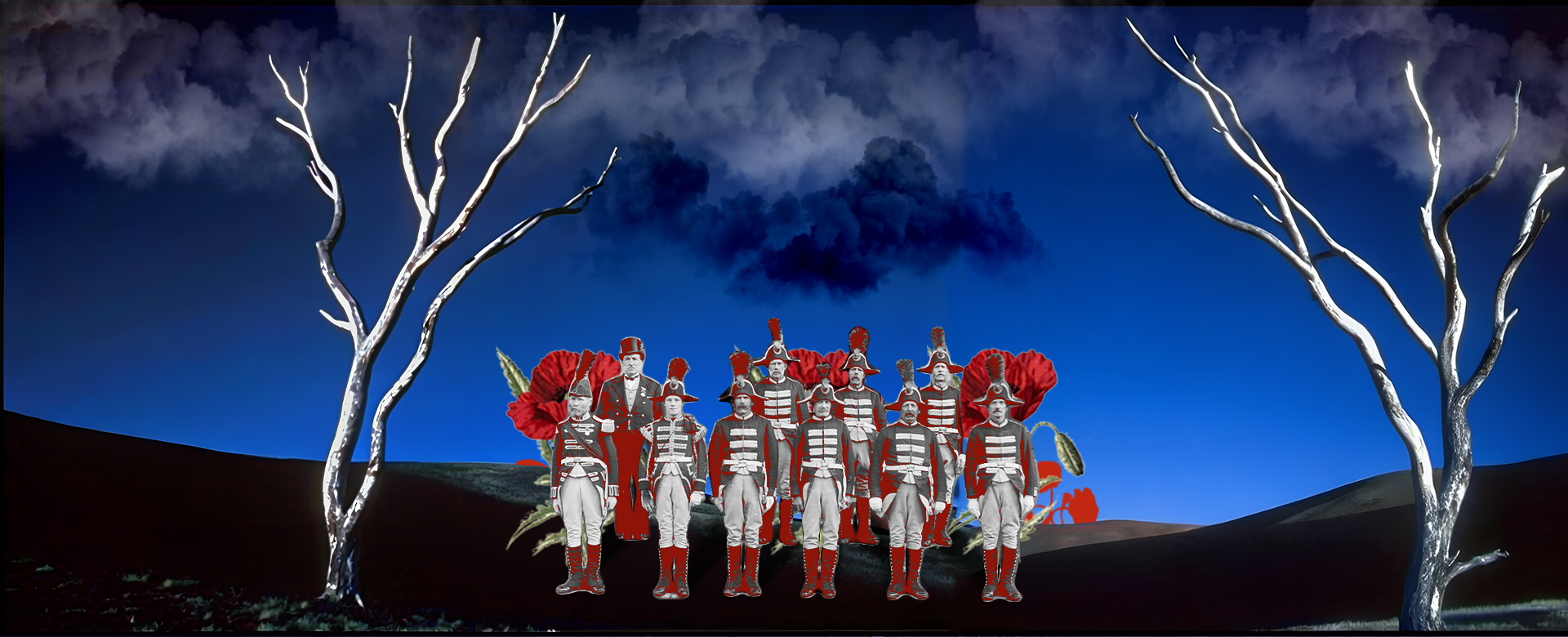
Illustration: Victoria Boyko