Fields of perception: war in Mstyslav Chernov’s films
The way we think about filming war has drastically changed. Since 2014 and the return of war on the European continent, new gazes and formats have emerged. The Oscar-winning documentary film 20 Days in Mariupol, as well as its follow-up 2000 Meters to Andriivka, by the war reporter and writer Mstyslav Chernov, demonstrate these changes. We asked the German film critic Bert Rebhandl to reflect on these cinematic explorations.
When the Russian Federation occupied the Crimean peninsula in 2014 and launched its war in the eastern Ukrainian regions of Donetsk and Luhansk, war returned to a European context that had considered itself thoroughly postwar. War had long become a distant experience, mostly seen through television images coming “live” from distant lands.
The French film critic Serge Daney saw the Gulf War of 1991 as a turning point in the history of film and television: the complex “image” of cinema got lost in “the visual” of a perpetual live stream that had no counter-shot.
When NATO intervened against Serbia in 1999, this logic of a superpower and its allies correcting a local genocidal constellation from above appeared to provide a model for the looming geopolitical order. In that particular case cinema actually brought a counterimage in Goran Rebic’s documentary The Punishment (1999) which shows how people on the ground in Belgrade lived through the war and the bombings.
When Putin ordered the full-scale invasion of Ukraine in 2022, he supposedly did so under an illusion of total dominance: he expected a brief operation and a quick eradication of Ukrainian sovereignty. Instead, he caused a war that soon drew many comparisons to the battlefields of World War I, at least in its first two years. It is also a war that, as a side effect, created unexpected challenges for reporting: was there still a place for war correspondents in a battle whose conditions changed comprehensively with the increasingly sophisticated use of drones?
The war against Ukraine has, so far, validated Paul Virilio’s classical 1988 notion: “The history of battle is primarily the history of radically changing fields of perception.” Perception is usually understood as the activity of a sentient being. Virilio, however, charted a history in which technologically enhanced perception expands beyond the limits of the natural field of vision.
With his films and media work, Mstyslav Chernov tries to delineate specific fields or perception in a war that somehow had to find its own dispositifs — to use the broad French term for constellations of visibility and apparatus. He clearly earns the professional title of a somewhat classical war correspondent. His two films about the war against Ukraine can be seen as exemplary attempts to chart different fields of perception — the besieged city of Mariupol from within in 2022, the depopulated village of Andriivka from the outside in 2023.
If you also take into account his novel The Dreamtime — based on a 2020 multimedia project, with a storyline that starts in 2014 and includes many aspects of (post-) Soviet longue durée — it is possible to see Chernov almost as a historian. His attempt is to write a real-time historiography of unfolding events, using different media.
20 Days in Mariupol combines aspects of live coverage (showing the increasingly impossible situation soldiers and civilians find themselves in) with a chronicle of events as they happen. It starts with smoke on the horizon (from the shelling on the urban periphery), and follows the encircling of a central hospital, where the Chernov’s media unit had established its operational base.
The last-minute escape is also documentary material: the journalists have to leave the city in order to preserve important proof of the events. This brings to mind the case of the Lithuanian filmmaker and anthropologist Mantas Kvedaravicius, who was killed in Mariupol on April 2, 2022. His project was quite similar to Chernov’s and got edited after his death, leading to the film Mariupolis 2.
Chernov films evacuations, shelters in basements, and the victims of the Z military machine. Heartbreaking and gruesome scenes in the hospital’s trauma department bear witness to the physical impact of war. Although there is a constant danger of strikes, the city remains under Ukrainian control, and Chernov and his team work within the perimeters of this free zone.
After the fall of Mariupol and Melitopol, the liberation of Kherson, and with the ongoing resistance of Kharkiv, the frontline was established. By and large, it did not change much from 2023 onwards. It became the topic of Chernov‘s next film. 2000 Meters to Andriivka refers to the context of the “counteroffensive”, the moment when, in the second year of the big war, the hope was that a strong Ukrainian attack would push the Russians out of territory they’d seized, predominantly in the Southeast.
When Chernov describes what he sought to achieve with his film, he explicitly speaks of “Russian defenses”: the enemy is now entrenched, and it is Ukraine that’s on the offensive. A narrow strip of forest “between two minefields” leads to the small village of Andriivka, in areas south of Bakhmut that had been fought over intensely for a long period of time, which eventually fell to the Russian forces in early 2023.
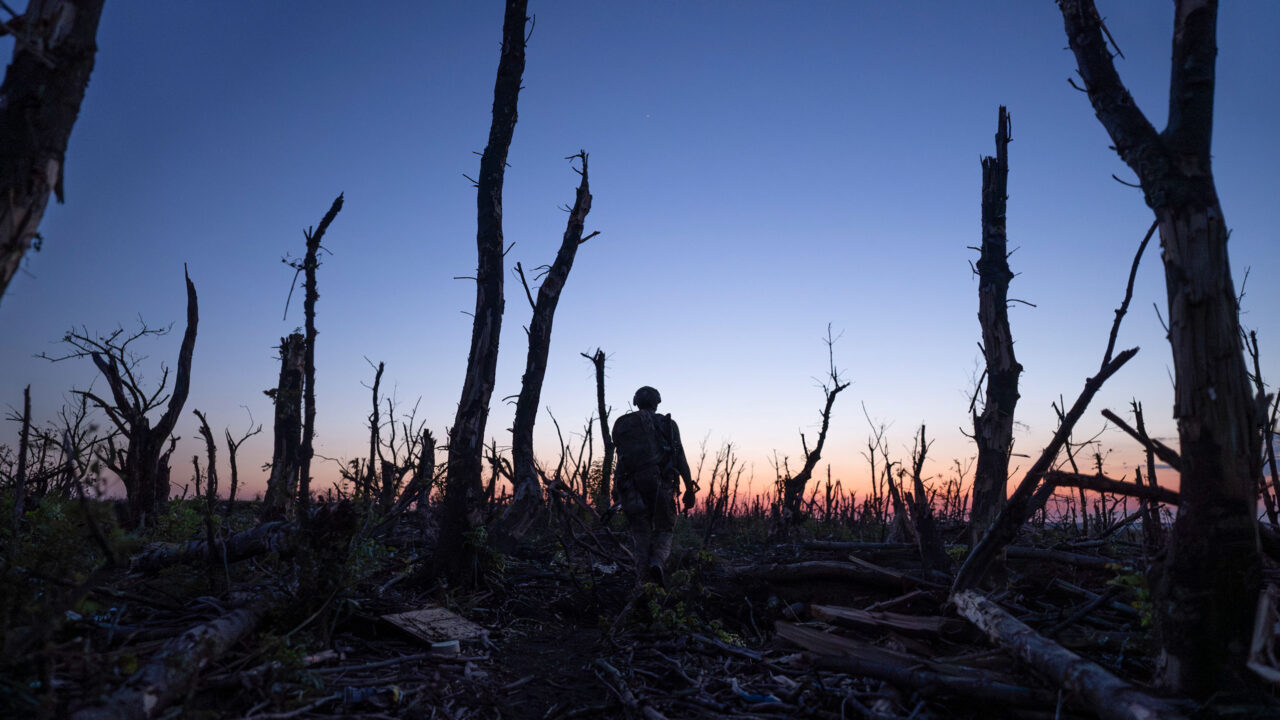
The 3rd Assault Brigade prepares its mission to reach Andriivka and “cut the supply road to occupied Bakhmut”. Chernov will be embedded with the brigade. His goal is to make use of the forest as a field of perception, to offer an immersive understanding of the war on the ground. Drones feature only marginally in the film, which makes it “historical” (related to the past) in a very particular sense. The 2000-meter stretch of forest obviously serves as a metonymical reference to the counteroffensive, which soon stalled and brought no significant changes to the front line. Roughly 20% of Ukrainian territory remains under occupation.
Chernov’s presence during the retaking of Andriivka makes him a direct witness. He is not strictly indispensable as a filmmaker at that point, because the work of collecting footage is basically done by the soldiers themselves, using their helmet cams. (The end credits of the film will mention them as “directors of photography”, with their military code names).
The field of perception which Chernov chooses to present is not entirely limited to the view from the ground. He also includes footage from the command post, and aerial shots that actually demonstrates how Ukrainian forces had an upper hand in that area in the fall of 2023. The Ukrainian flag is eventually raised over a destroyed place. There is nothing left of Andriivka to recapture.
With his narrator’s voice, Chernov repeatedly mentions the fate of the fighters we see in action. Several will be killed within five months, early 2024, during other operations carried out by the 3rd Assault Brigade. The film at once asserts its immediacy with footage of live fighting, and deploys its complicated temporality alongside the rapidly evolving war. It exists in its own dream time, with elements coming from the battleground, from abroad (the film was produced in the US for National Public Broadcasting), and from the transformation of a previous media project Chernov had undertaken.
Chernov’s two films represent an attempt to uphold the claims of classical television reporting in a situation where such reporting has become increasingly impossible. It worked somehow, as long as an area of civilian life under siege could still exist, like in Mariupol. But it becomes almost impossible when the fighting produces a grey zone of territorial ambiguity (when areas are occupied and liberated several times in quick succession), and when everyone is under the constant threat of artillery and drones.
No protocol exists for news media to be present in such a situation, other than being on a suicide mission. That’s why the war against Ukraine has mostly been filmed “in the rearview”, like in the eponymous film showing war strictly through the lens of evacuees on the backseats of a car. That “rearview” is also found in Yevhen Titarenko’s and Vitaly Mansky’s 2013 film Eastern Front about medical teams operating just behind the front line.
Chernov provides insight into the actual immediacy of the fighting (where reaction time is very often close to zero). Unsurprisingly, the result can look like a staged operation. While there are actually victims along the way (a soldier called Gagarin, and several faceless “motherfuckers“), a nagging suspicion remains: the feeling is that this is not entirely the real war, but an sequence specifically made for television.
By sticking to the conventions of television reporting, 2000 Meters to Andriivka offers a narrative in which a classical, external spectator is taken into a situation that is otherwise inaccessible. Chernov insists on an author-driven mode of storytelling, and ends up with an edit that comes close to a ritual of affirmation. It culminates in a final scene that incorporates elements of collective mourning, when tribute is paid to the fallen.
The novelty in how the war in Ukraine has been mediated gets lost in Chernov’s approach. Instead of “producing” a war reporting situation that maintains the relations of embeddedness, Chernov, in his novel The Dreamtime, hints at other possibilities. His lead character, K., is a doctor who acts “between” the warring sides or, as seen from a Ukrainian perspective, “behind” the lines. With this written story, Chernov points to the fact that the war starting in 2014 created new lines, more blurry than before.
A 2018 online video, watching the war. a film, found on the internet, appeared with clips “from 443 filmmakers”: a huge montage effort conveyed the image of the attack on Ukraine. This video, which is basically a film distributed outside the official channels of cinema, provides an idea of how the current war, now in its fifth year, could be depicted in cinema: using countless clips circulating in digital media and editing them in a forensic way.
In the Russian documentary Russians at War, director Anastasia Trofimova apparently used drone footage originating from Ukrainian sources, to show a young Russian soldier dying. It is an obscene image, in all its straightforwardness: footage of a man getting killed by a machine from above. Yet it also seeks to manipulate the field of perception: it depicts a Russian soldier as a victim, as someone being attacked.
2000 Meters to Andriivka can be read as an attempt to restore the archetypical logic of ground combat, if only in the context of a single, emblematic military operation: man against man, (automated) gun against gun, and a level battlefield as a level field of perception.
With his two films, Chernov took stock of the implosion of war cinema within a single year. 20 Days in Mariupol belongs to the canon of great humanist documentaries, testifying to a defeat in which the survival of the reporter, of the evacuees, and the existence of footage, all sustain hopes for reversal one day.
2000 Meters to Andriivka, in turn, unwittingly testifies to a rupture: this war has destroyed its own fields of perception. Perception can only be reconstructed from fragments that are uploaded daily, and separately shared on Telegram or other channels. No space is left for a multimedia storyteller to be present in the midst of events. From this moment onward, war cinema can only exist as a postproduction, in the literal sense of the word.