In defense of reading for pleasure
Reading for pleasure in a world that chases performance metrics can easily be seen as a luxury. Marcel Proust once complained to his brother that in order to read his works, a person would have to either fall ill or break their leg. Reading requires quiet time, not time filled with tasks. But when we sit with a book, we don’t just return to ourselves, we also build bridges to others.
Access to books, just like access to free time, is a luxury that not everyone has. This is why reclaiming time for yourself, especially time for reading, can be a revolutionary act.
In late 2025, I had the chance to attend the exhibition Reclaiming My Time at the National Museum of African American History and Culture in Washington, DC. Books made up a significant part of the exhibition. They were on shelves, coffee tables, the floor, giving off a sense of freedom, abundance, and the availability of time.
The books spread out around a room embodied the theme of the exhibition—reclaiming one’s free time. And the chair that was also part of the exhibition was supposed to remind us that the simple act of sitting and reading for pleasure can become a form of resistance; after all, not everyone automatically has the right to relax. A featured poster by Trisha Hersey, the founder of the art project The Nap Ministry, reminds us that for centuries the Black community did not have the right to its own time.
The exhibition brought back memories of how reading became an act of resistance for me, too, and in the most unexpected place – in university. This place that seems made for reading became the epicenter of forces that tried to get me to turn away from reading. When I started my PhD program, I continued reading books unrelated to my dissertation topic, and I shared my impressions on social media.
I think it was the fact that I didn’t just read, but also shared what I had read, that caught people’s attention: my colleagues began commenting on my habit. Some asked where I found the time to read (and then to write about it in addition!). Others asked how all this reading was supposed to help my career. The most interesting comments came from people who truly wished me well and encouraged me not to post anything online that would suggest I had free time outside of writing my dissertation. Rebel as I am, I did as I pleased: I kept reading and didn’t hide it.
But I realized that the absolutely innocent act of reading could be a true challenge, provoking endless reactions and interpretations. Even more, these reactions and interpretations say less about individual people, including my colleagues or myself, than they do about the culture of academia, which demands total submission and service to the university as a cult. The imperative to publish or perish hangs above you like the sword of Damocles and any step in the wrong direction can reveal your insufficient loyalty.
People who are seen to be reading can lead others to believe that they have too much free time. Books are a trigger because they are a reminder that there exists another world outside of the requirements to relentlessly write and publish. I have more than once been saddled with extra work assignments right after posting about a book I’ve read: to review an article or academic volume, or read someone’s manuscript, anything at all as long as it filled my overly free schedule. Showing off that I was reading served as a call to action: if someone has free time, you can make a claim on it!
As a historian, I am inclined to view everything in the long perspective of history. Treating reading as entertainment, as an activity that could bring pleasure, is relatively new.
The idea that reading could be not just for study or benefit, but for pleasure only began to spread across Europe in the 18th century. It was during the Enlightenment that consumer culture was born, in which books (mostly novels) became a mass commodity, and reading, a typical activity of the middle class as it gained increasing political power.
Today we decry the fact that, thanks to social media, people have stopped reading and only post pretty pictures of books and bookstores. But, in fact, this phenomenon is not all that new. Of course there were no social networks three hundred years ago, but what we now call “conspicuous reading” did exist: having a home library and showing off your literary treasures was a matter of prestige. Although, for a long time, wealthy families’ home libraries weren’t just for home use. They were often used by a wide circle of neighbors, friends, and members of the extended family. Meanwhile, women were often excluded from the practice of pleasure reading, since men controlled what women could read.
So reading has never been limited to reading itself, but always encompassed something more: politics, resistance, community-building (as well as the process of being either included or excluded), access to knowledge and control over that access.
Of course, in a system designed to produce results and enforce productivity, reading others’ articles and manuscripts is valued more highly than the time that I spend reading books for pleasure, that is, unproductive pleasure. I should note here that I defended my dissertation on time, despite constantly reading what I wanted when I wanted. A miracle took place – my reading did not lead me to professional decay.
Reading for pleasure in a culture that chases performance metrics truly is a luxury. Sometimes this luxury is promoted by mass culture. There is a tradition on Swedish television where every January 6, famous authors and actors spend the whole day reading a book out loud, usually one of the classics. In this way, reading becomes a topic of “slow TV,” which has long been popular in Scandinavia. In Norway, people watch moose wander through the forest, and in Sweden you can watch people calmly reading by a fireplace from morning to night. This is how I expand my reading list for the country I live in.
This year, they read Sara Lidman’s novel, The Cloudberry Field. The book from 1955 is written partially in the dialect that is spoken in the Västerbotten region of northern Sweden. It tells a story about the 1920s, about working-class people from deep in the provinces who have few books written about them. It is these people who built the Sweden we know today. In a culture of achievement, Swedish television sets aside a dozen hours of airtime so viewers can listen to a book with no rush. Of course, I don’t know if anyone sits there for the whole day. I, for one, only listened to five chapters while I cleaned and cooked (in other words, my reading experience was, in fact, tied to results).
Marcel Proust once complained to his brother that in order to read his works, a person would have to either fall ill or break their leg, because otherwise the frantic pace of life wouldn’t let them dedicate enough time to searching for the protagonist’s lost time. Even writers understand that in the pursuit of readers, they lose out to other activities that provide our daily bread. So why do we still read if it brings us neither material benefit nor concrete results? Where is the pleasure in this?
So much has been written about reading that I’m only summarizing what resonates with my own experience. Pleasure is always an individual experience. I’m wholly convinced that reading brings people together, forms community, offers everyone a chance to live a thousand lives, and, therefore, the opportunity to understand the Other, to live in someone else’s skin. Just like art, reading builds bridges that connect thousands of people, no matter their political views, religious beliefs, or cultural experiences.
I’ve lived outside of Ukraine for almost twenty years, but by following what’s happening in literature, I feel an uninterrupted connection to Ukrainian society. And reading Swedish literature, which I dove into as soon as I arrived, helps me understand the people around me. There’s not a single historical non-fiction or guide to living in a country that helps you understand a culture as well as works of fiction.
For me, to understand the world, it has always been important to read not only my country’s literature, but also translations. This is why, despite all my academic work and endless tasks, I try to find time to translate books that have spoken to me and that I simply must see available in Ukrainian editions. I also strive to spread knowledge of Ukrainian literature in Sweden, so that it can be translated and our culture put on the world’s mental map.
Reading is also an opportunity to form small communities. The first years I lived abroad, I organized book clubs to find like-minded people and feel a little less alone. I think my desire to share what I read still helps me maintain a connection with people who are now scattered around the world. In my personal summary of 2025, I noted that a book club organized by my friend and colleague, Oksana Dudko, a historian from the University of Manitoba, was a source of guaranteed joy throughout the whole year.
Sitting at home on different couches on different continents, we don’t only discuss books, but also nurture a community of mutual support. After the full-scale invasion of Ukraine, this book club became a space where I could think and feel with others. Now I can’t imagine my life without it.
I’m such a devoted fan of book clubs, that a few years ago I started a new tradition of meeting to discuss books in my own family. My daughter loved these meetings, especially because we included a lot of rituals. We always buy some cookies, light candles, steep an herbal tea, and talk about what we read. In book clubs, the conversation only starts with what we read, but then it unfolds in unpredictable directions that lead us through the labyrinths of memory and spark unexpected recollections.
What starts as a conversation about literature ends up as an exchange of diverse experiences and increased intergenerational understanding. Our family book club is yet another way to remain connected to a teenager who is spending more and more time away from us. My daughter’s participation in the club makes me happy, and it is an additional pleasure to see how she talks about books with my friends’ children, how they exchange lists of what they’ve read, and share their favorite works.
Books create connections and relationships in different dimensions: when I read, I form a connection to the author and the text, and when I talk about reading, I foster relationships with others (if not for this primacy of human contact, I’d never write about books). And then, on top of all of it, reading is the most effective instrument for staying in contact with yourself.
There are authors I return to time and time again, reading every one of their books: Deborah Levy, Ann Patchett, Elizabeth Strout, Lina Wolff, Elena Ferrante, Rachel Cusk, Haska Shyyan, Yevhenia Kuznietsova, Iryna Tsilyk, Anna Gruver. This list is endless. Sometimes it seems like the world of small towns in Maine that Strout created in her works is as dear to me as Stockholm or Kyiv. Some of her heroines, like Olive Kitteridge, I take to be distant relatives that somehow ended up on the other side of the Atlantic ocean. Through her Olive, Strout taught me that you can be loved even if you’re not all that sweet or nice.
There are writers who have defined entire epochs of my life, yet remain in the past. At one time I read everything Liane Moriarty wrote. Her novel What Alice Forgot helped me get through a very difficult period. I think of Liane as if she were an old friend: with gratitude for standing by my side and the awareness that our paths have diverged. We all change and I have learned not to waste my time on what does not grab me (anymore). After almost thirty years of being a voracious reader, I finally let myself put a book down if I don’t want to finish it, just as I can let go of the people whose journeys no longer coincide with my own. I have learned to value my time and hold onto it for myself.
Reading is of course connected to writing, even – in my case – with purely scholarly writing. Fiction helps me find the analytical framework that puts everything in my research in place. When I have the bare bones of an article, I set it aside for a few days or weeks and read something completely unrelated to my research. Suddenly a plan pops into my head so that I don’t just offer a retelling of someone else’s previous research. If this doesn’t work, I see no point in publishing the article. Now, if I ever have to justify my reading, I’ll say, “I read in order to write.”
Some topics weave something like a red thread through my experience as a reader: women’s creativity and mother-daughter relationships. If you gathered up all my books (not an easy task since they are scattered in various apartments, offices, and basements in two countries), you could put together an entire library of memoirs, biographies, and fiction on these topics. Another library would be dedicated to essays and autobiographies by women: Deborah Levy, Elisa Gabbert, Joan Didion, Rebecca Solnit, Siri Hustvedt, Elena Ferrante, Miranda July, Iryna Slavinska, and Victoria Amelina.
I’m especially drawn to women who have children and write. How do they do it all? How to find “a room of one’s own”? Sarah Manguso best captured how I felt on maternity leave: “In my experience nursing is waiting. The mother becomes the background against which the baby lives, becomes time. I used to exist against the continuity of time. Then I became the baby’s continuity, a background of ongoing time for him to live against.” Good luck with coming up with a better description of the total loss of control over your time when a child arrives. Where else can you find such a complete reproduction of your own experience if not in literature? The women of my library are my literary milieu. They teach me to be honest with myself.
The psychoanalytical and redemptive functions of reading are obvious. If a week goes by and, in the mess of everyday life, I don’t pick up a book, I feel I’ve lost my connection with myself. Reading makes me into a person filled with reflections, desires, and energy. It not only offers me enjoyment and entertainment, but also usefulness in the most unexpected way.
It’s not results, not “faster, higher, stronger,” that are most important in reading; it’s your connection to yourself and others. I don’t record everything I read on Goodreads, because it started feeling like just another way of participating in the rat race. Still, I love to see what others are reading and add something to my own reading list. I aim for a balance: not looking to set any records and still not feeling any pangs of doubt when I read for pleasure.
The most important thing we can give ourselves and our loved ones is time. Time for pleasure reading is time for ourselves in its most radical form. Which, if we want, we can share with others.
Translated from Ukrainian by Ali Kinsella.
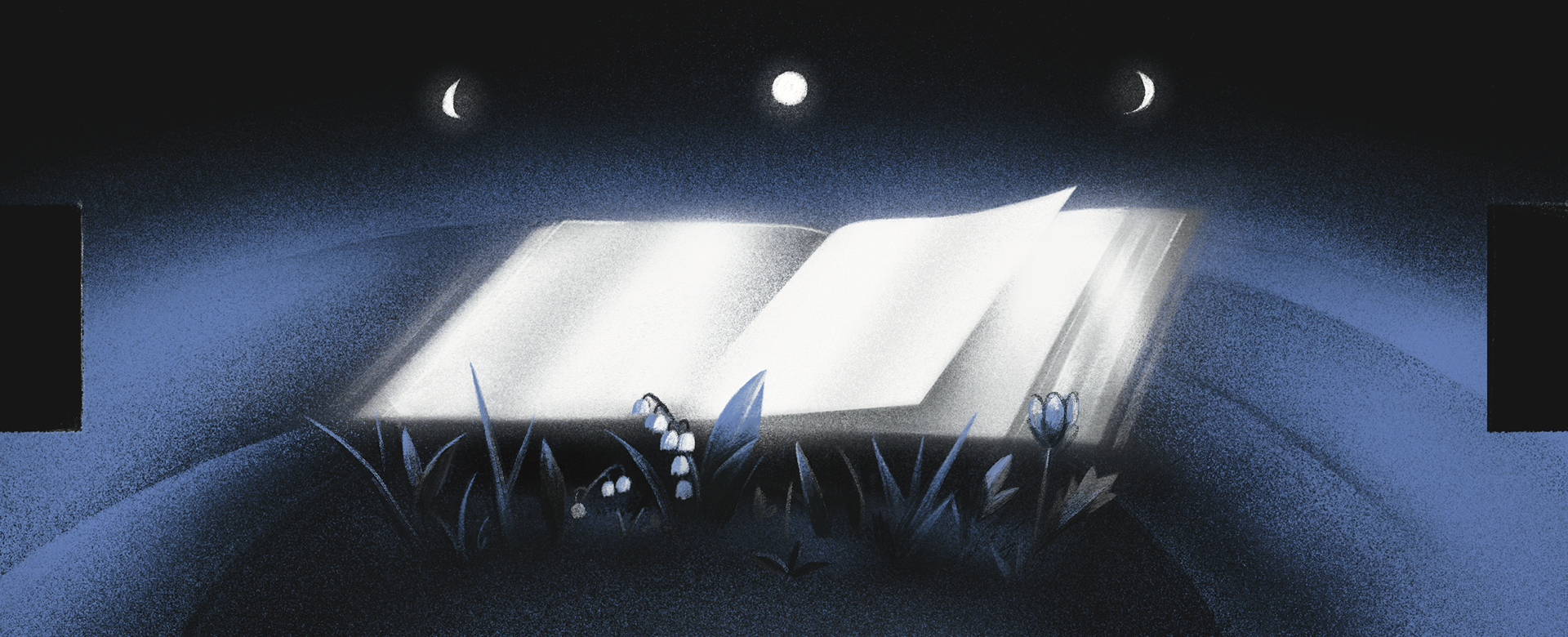
Illustration: Nika Aheyeva