Swan Lake on Soviet TV in 1991: a failed ideological attempt
This image shows what Soviet citizens could watch on state television during the August 1991 coup attempt by communist hardliners in Moscow: an archival recording of the ballet Swan Lake, broadcast continuously. What explained that choice of images, and what message were they meant to convey? This essay unpacks how Swan Lake in the end failed to mask realities.
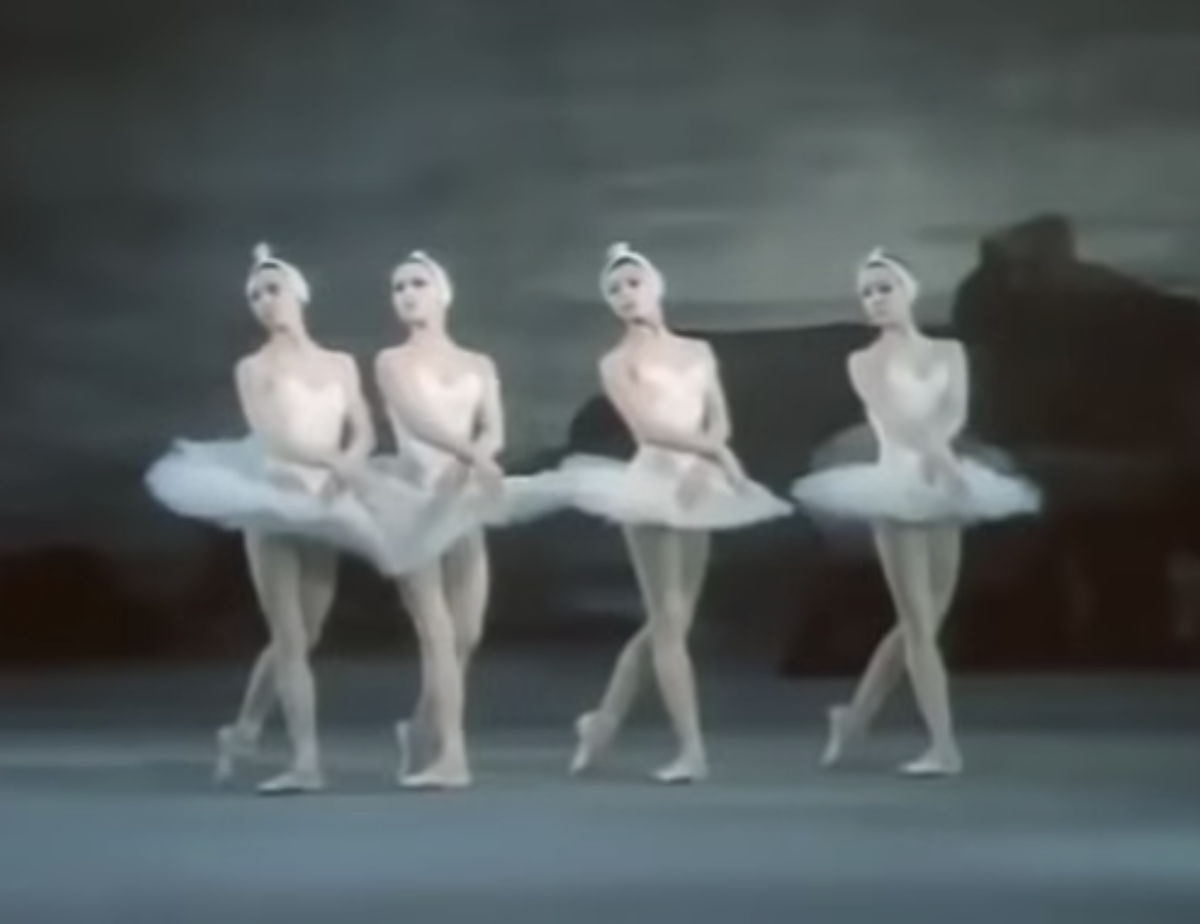
The Soviet regime loved ballet. Swan Lake ballets, especially, were part of a ritual: they were often shown on television, particularly after the deaths of high-ranking officials. Swan Lake aired after the deaths of Brezhnev, Andropov, Chernenko; for the Soviet viewer this signaled that something is not right, that something is happening behind the scenes.
During the 19-22 August 1991 coup attempt in Moscow, the hardliners created a State Committee for Emergency Situations, which took under its control all of the central state media. Journalists were forbidden from reporting on what was happening in the country, regular programming was put on hold, political pronouncements of any kind were not aired – the one exception being announcements from the committee itself. These putschists had to find another way to fill the airwaves with media content that would be lengthy, not news, apolitical and widely acceptable. An archival recording of Swan Lake seemed ideal; it would function as a mask of banalities that could conceal the collapse of the entire system. Yet the appearance of the ballet on the screen was both familiar and ominous.
There is another version of this story in which airing the ballet simply happened to coincide with the coup attempt in 1991, having already been scheduled two weeks earlier.
During the coup they aired a recording from 1983, where the main role was played by the renowned Soviet ballerina Natalia Bessmertnova; the television directors were Felix Slidovker and Inessa Selezniova. It was this recording that was prepared for airing on Soviet state TV on the occasion of Bessmertnova’s 50th birthday in July 1991; today it’s difficult to determine who decided to air the ballet during the decisive days of the August coup. People say that all the artists involved with this production were surprised by such a senseless juxtaposition of ballet with this politically historical moment in 1991.
Broadcasting Swan Lake can be understood as a revealing paradigmatic moment, when representation not only distorted reality, but also worked to prevent Soviet subjects from colliding with the very real trauma of political collapse. In other words, ballet was less a symptom of ordinary confusion, but rather an expression of late Soviet ideology.
The coup leaders – the KGB’s old guard, generals, conservative party elites – wanted to freeze time, to stop reforms, to reestablish the Soviet order that existed before 1985. Swan Lake was for these people the embodiment of a completely controlled, idealized, classical and “timeless” aesthetic that symbolized the order, discipline, and stability of a frozen and entirely unchanged Soviet empire. Aestheticized imperial pride as the ideological fantasy of mutineers. Showing the ballet was not just a practical solution, but a symbolic return to “eternal” Soviet culture, which existed far from political chaos and media dialog.
This was a peculiar tactic of neutralizing the senses. Paul Verilio theorizes that, in a moment of crisis, it is possible to either stun the viewer (shock strategy) or anesthetize them (calming strategy). The coup plotters chose anesthesia: a slow, hypnotic, apolitical spectacle that dulled the perception of danger in real time.
Ideology can be thought of not as a set of manifested beliefs or doctrines (as it normally is understood), but rather as a kind of imaginary framework through which individuals experience social reality. Here Jacques Lacan’s theory might be of use, where ideology operates through emptiness rather than content, structuring that which we see, how we interpret it, and, most importantly, that with which we cannot cope (following Lacan, this is the Real). The role of ideology from this perspective lies not in deception, but in the organization of one’s relationship to the Real – that dimension of lived experience that is intolerable, incomprehensible or destabilizing.
The Soviet coup attempt in 1991 was precisely such a moment of rupture: the foundations of the state were decaying, the party’s authority was disintegrating, and the symbolic order was ceasing to function. In that situation, Soviet ideology offered no explanations; instead, it provided screens for viewers.
The televised recording of the ballet Swan Lake played the role of the screen, creating a smooth aesthetic surface, which gave viewers a way of avoiding a traumatic confrontation with the system, which was collapsing at that very moment.
So even if the choice of ballet was accidental, it was not random. Swan Lake became the canonical soundtrack of the Soviet Union’s political death, an audiovisual ritual that signified not only mourning but also continuity. Slavoj Žižek might call this “the unknown known”: a symbolic code that everyone recognized, but that no one directly acknowledged. Ballet on television screens during the attempted coup created two ideological pathways: on the one hand, the “neutral” broadcast masked the coup’s violence; at another level, quite familiar to viewers, it subtly communicated that something catastrophic was unfolding behind the scenes. The Soviet citizen knew that “the Gorbachev government had lost control”, but ideology indicated that they should act as if they did not know this truth. A televised ballet in a time of mutiny, instead of explaining reality, supports the space of “as if”: as if order still existed, as if the state remained whole, as if time itself can be frozen.
What, in the end, makes the 1991 TV broadcast so significant? The ideological gesture failed. Instead of buttressing the state’s legitimacy, Swan Lake exposed the emptiness of its symbolic order. The refusal to show its political reality did not protect the system, but rather revealed the system had nothing left to say: the ideological apparatus had degraded to pure form without content. This was the moment when ideology became visible as ideology, when the screen, designed to mask the Real, itself became a sign of disintegration. The Communists tried to maintain the continuity of power and the system, but the never-ending repetition of ballet on the television emphasized rupture more vividly than any news report could.
Translated from Ukrainian by Orysia Kulick