Tender noise, or the limits of transmission
Shame shapes how memories are passed on, limiting what can be spoken openly and what remains hidden between languages. Moving with trains through wartime Ukraine, as well as across borders and time, this essay explores family memories, displacement, and the fragmented transmission of histories. It comes accompanied by some of the author’s own artwork.
I travel by train a lot.
Sometimes the journey to Ukraine exceeds the time I spend there. The tempo of the train cannot be accelerated. In wartime, movement yields to checkpoints and waiting zones; infrastructures of mobility are reorganized to fit military conditions, and the temporalities of transport are reshaped. This happened during a research trip I made, on the way to Zaporizhzhia. The route itself followed the sedimented traces of military and industrial spatial orders. These infrastructures were historically built to organize the flow of resources, labor, and people.
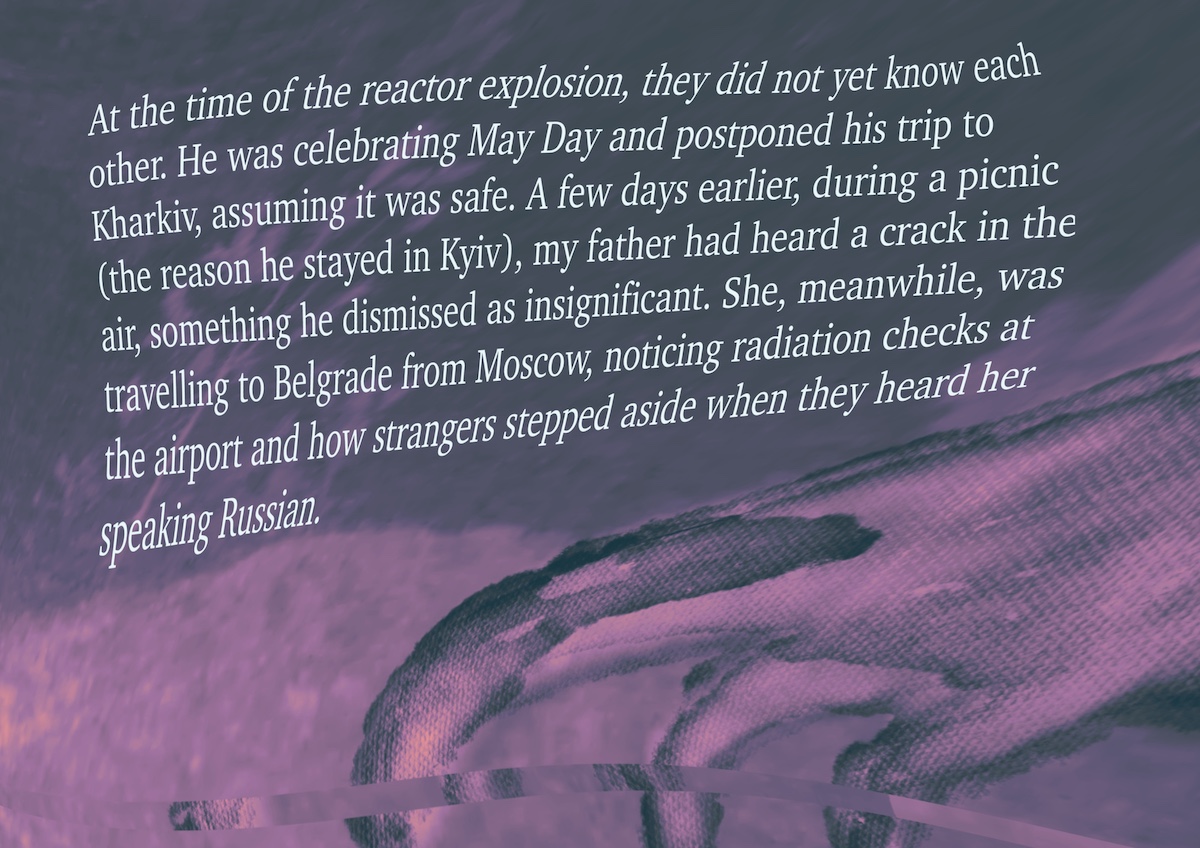
Looking out of the window, I watch us pass through stations where waiting stretches far and long. I think about those who moved along similar lines before me: my uncle and aunt, who left Pripyat after the Chornobyl disaster. My uncle was working at the third reactor, it was his morning shift on 26 April 1986, after the nighttime explosion. They left days later, when the air was already thick with particles, and were relocated to Elektrėnai, in Lithuania, where he continued working at a thermal power plant.
My parents met on a train a year later, their trajectories crossing within the logistics of a Soviet system that distributed people, labor, and lives according to its opaque bureaucratic logic. My mother was traveling from Vilnius to Tiraspol to visit her friend, with a transfer in Kyiv. My father was returning from Elektrėnai. He helped her buy a ticket. They left their bags at the station and spent the day walking through the city.
Months later, she called his workplace, mispronouncing his surname, clearly Ukrainian in its form. He did not correct her. She returned. Said she had never seen chestnut trees in bloom, and came back in May to see them. He proposed to her, and she stayed, eventually leaving Cherepovets, where she had been working as an engineer.
My grandfathers: my maternal one reached Berlin during World War II and spent five years in Germany, later returning as a tourist, always fascinated by the country; and my paternal grandfather survived the Holodomor through relocation to Georgia. Those parts of his family who refused to leave did not survive. The route itself remained unspoken. The only trace of it that reached me is that he called me “Lera jan.”
Movement makes these lines appear connected, but what it produces is noise. It breaks under the pressure of shame, and my face flushes as I approach the edge of reasoning my own movement.
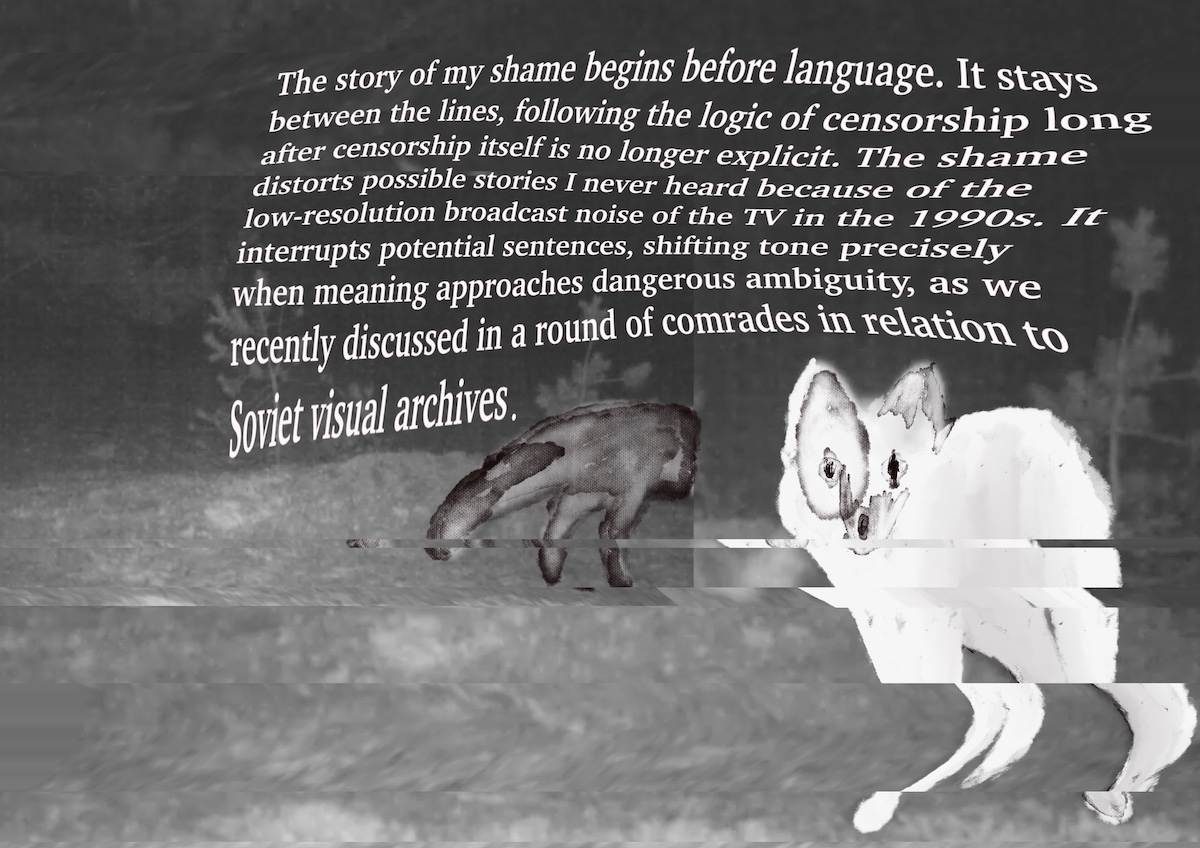
My parents and grandparents were not silent. But what they shared rarely held together and wasn’t graspable for me. Stories would dissolve into anecdotes about the uncertain origin of my mother as a Siberian Indigenous person, then slip into nostalgia.
Shame operated there as a form of internal interference, guiding what could be said and how far a sentence could go. I learned to follow this modulation, to adjust my own speech to it, to remain within the range where meaning had to be hidden (between the lines).
I was born several years after the Chornobyl disaster, but its toxic aftermath had already shaped the atmosphere through which memory circulated across generations. As Olga Kuchinskaya suggests, knowledge, after Chornobyl, emerges under partial visibility and restricted access. Histories of Chornobyl, war, famine, deportations, and collectivization, are often transmitted partially, through interruptions and hesitations. One can approach only up to a point.
My train’s movement does not connect these lines. It produces the conditions in which their noise becomes perceptible. As Michel Serres reminds us, noise is a condition of communication. What reaches me is a field of partial transmissions, shaped as much by interruption as by what is said. Here, shame binds with fear and defines the limits of proximity to what cannot be fully spoken. Language is where these hesitations become perceptible. How close one can come, how long one can remain, how much can be said. Language is where this becomes audible.
What is my mother tongue? Ukrainian, Russian, surzhyk?
These are not equal frequencies. Inherited shame often modulates belonging through the uneven conditions of articulation rather than absence. Ukrainian carries the intimacy of my childhood, but persists under pressure: interrupted, displaced, yet returning with force. It used to hold this intimacy without the structures that stabilize and legitimize speech. Russian, in turn, carries intimacy, but also the forms through which imperial power organized perception and articulation. It occupied the space in which meaning could stabilize, shaping what could be said and what remained unsaid.
I used to move between them as between frequencies, switching mid-sentence, interrupting myself, falling silent. Ukrainian does not arrive as a clear signal. It resonates through noise, with breaks and gaps. Even the most tender memories remain slightly displaced, as if something alien, shameless persists within them.
Today, this displacement becomes perceptible as vibration, as noise. And it is precisely there, within this distortion, that another form of relation becomes possible: a form of being-with that holds at the limit of exposure.
The author acknowledges the support of the Centre for Advanced Study inHerit, at Berlin’s Humboldt University. This text and its illustrations grew from conversations and seminars held with the inHerit team, fellows, and colleagues, and in particular from exchanges with Simone Toji on shame and inherited histories. This shaped the dialogue between our respective contributions to this issue of re/visions.