We'll wait, and do it our way
How can a human rights defender steeped in international law react when a victim of war crimes cries out for revenge? In this essay, Anya Neistat draws on two decades of work documenting atrocities, from Chechnya to Ukraine. She reflects on the tension between justice and revenge. She argues that when courts fail, revenge becomes a tragic resort. As a lawyer, she makes the case for universal jurisdiction — the power of national courts to prosecute war crimes anywhere — as a mechanism to break endless cycles of violence.
Ruslan’s eyes were dark. Not just the deep brown color of his irises — but something behind them, unhurried, pained, and implacable.
We sat in a small kitchen with windows taped where the glass had gone, in a village outside of Grozny, and I scribbled in my notebook as he spoke. His brother was gone. “Disappeared,” like thousands of other Chechens at the time. The term referred to people being picked up from their homes at night, at checkpoints, or on the roads, by masked men driving around in cars without license plates and taken to one of the many secret detention facilities – to never be seen again. Relatives would go and ask the authorities, make quiet inquiries through their connections, pay, search the mass graves. Mostly, in vain.
And then they would talk to people like me – investigators, human rights lawyers, and we would tell them that the world needs to know, and that we would do everything possible to find the perpetrators and bring them to account.
While working in Chechnya in my 20s, I deeply believed it. I was passionate and naïve, perhaps, but there were also practical reasons for my confidence – back then, the world did not seem to look completely the other way as atrocities were being committed. The Yugoslavia tribunal was going full-speed, and the Rome Statute creating the International Criminal Court had just been adopted.
Ruslan was a good witness. He gave me dates, details, descriptions, patiently and emotionlessly. He listened respectfully as I explained what we would do with the information – a report, a submission, a court case, the eventual and inevitable accountability. And then, as we were saying good-byes, he nodded again, and said, “Thank you. You do that. We'll wait. And if nothing comes of it, we'll do it our way.”
I heard a version of that closing line over the following two decades, in Sri Lanka, Afghanistan, Syria, Ukraine, and too many other places to name. People who lost their loved ones, survived torture, were forced to leave their homes, and witnessed unimaginable atrocities, told me their stories and were willing to wait and put their trust in the abstract system of justice we were trying to use to correct the harm done to them.
But I knew that “the other way” was always there, on their mind. They kept the score, and as the systems meant to restore justice continued to fail them, the temptation to take justice into their own hands grew stronger.
They waited in corridors, showed photographs, gave accounts, talked to the media, staged protests – and, in too many cases, were either left in limbo, told outright that no crime had been committed against them, or worse, were threatened into silence. When they sought revenge, it was not only against the perpetrators themselves. It was a desperate attempt to set the moral universe right, made by people who have just been informed that nobody else intends to do it.
I had no right to dissuade them. But I was a young, earnest human rights lawyer, and everything in me protested against this notion. Not even out of a moral or legal propriety, but mainly because I knew, and have seen that revenge is fast, and it is certain, but it never closes. It doesn’t end after a shot is fired or a knife is drawn. I have sat in enough kitchens on enough sides of enough conflicts to know that the second conversation would be identical to the first. Only the names would move.
Revenge converts a finite crime into an unbounded obligation and hands that obligation down to people who were children when it was incurred. Justice, whatever else is wrong with it, was invented to offer an end-point.
Interestingly, the story of modern international justice, one could argue, began with a story of revenge. In 1921, on a Berlin street, a young Armenian named Soghomon Tehlirian shot and killed Talaat Pasha, the former Ottoman interior minister and a principal architect of the destruction of Tehlirian's people. Tehlirian had lost nearly his entire family. A German jury, having heard what had been done to the Armenians, acquitted him in about an hour.
Following that trial was a Polish law student named Raphael Lemkin, who could not get past the logic of it. One man kills one man, and the full machinery of the state descends — trial, jury, judgment. A government kills a million and there is no machinery at all; there is only a young man with a pistol, doing privately what no court in the world had been organized to do publicly. This, Lemkin wrote, “is most inconsistent.”
He spent the rest of his life on that inconsistency. He gave us the word genocide, and as early as 1933 proposed that the most heinous crimes be prosecutable by any state, anywhere, regardless of where they were committed or by whom. That later became known as a principle of universal jurisdiction: a notion of humanity’s shared commitment to justice and accountability.
The ancient Greeks worked this out long before anyone had a word for it. In Aeschylus’ trilogy Oresteia, three generations are engaged in a revenge spiral, each killing entirely justified by the one before it, and with no way out – because every single death in the sequence is an answer to a real crime.
That is when the Furies, the goddesses of blood vengeance, arrive. Their function is to hunt a killer to the end of his life without rest and without pity. They are not the villains of the story – they are simply what exists when there is no court.
But then Athena seats a jury of citizens to hear the case – and when their votes split exactly evenly, she casts the one that acquits. The Furies are enraged: their entire purpose has just been abolished. And she does not defeat them, banish them, nor inform them that their rage was shameful. She bargains with them. She offers them a permanent home beneath the city, honor, sacrifice, a standing place in Athens forever, if they will agree to stop hunting.
That has been the founding trade of every justice system ever since, and it is a trade, not a victory. Not the denial of rage, but the channeling of it into something that does not require more blood.
We cannot ask survivors to move on, to reconcile, to forgive while offering no closure. Moving on becomes possible only after the harm has been named and judged and placed on a record. Without that, what we call reconciliation is usually just exhaustion, not an end, but intermission.
But I have to confess – this rock-solid argument I built my career on gets harder to make as time goes by. Cases take decades. Witnesses die before they have a chance to even testify, let alone see any form of redress. Commanders whose names I first wrote down as a young woman are now old men with gardens and grandchildren, and some have died comfortably in their beds, never once asked a question under oath. Meanwhile politics moves on, and a file that was a priority under one government becomes an inconvenience to the next, and you are told – courteously, by people who are not villains – that the timing is difficult.
And so the thought comes back. It arrives at around two in the morning after a bad day, usually in the voice of that man in the kitchen, and it says something very simple: you've had twenty years. How is your way going?
I force that thought back. Not out of squeamishness, and not because I imagine I am better than the families I work with – I have no idea what I would do in their place, and I am suspicious of anyone who is certain. I force it back for three reasons that have survived every bad night I have had.
The first is that revenge produces no record. It kills a man and establishes nothing. Ten years on, what he did is a contested rumor, his supporters call him a martyr, and there is no transcript and no judgment anyone can point to. Justice is slow partly because it attempts something revenge does not: a durable, public, adversarially tested account of what happened – the only thing that has ever reliably outlasted a propaganda campaign.
The second is that revenge cannot tell people apart, and telling people apart is the whole moral point of accountability. A court establishes that this man did this thing, and that his brother and his neighbors and his children did not. Revenge has no such instrument: it reaches whoever can be reached.
The third keeps me going back to documenting atrocities, to speaking to people who lived through the worst moments of their lives, to collecting evidence and building cases, against all odds. Revenge protects nobody. It is entirely retrospective, and does nothing at all for the next family and the next village. A functioning justice system is the only mechanism we have ever devised that reaches forward – that changes what a commander thinks about before he gives an order.
In the early days of the International Criminal Court I used to tell militia commanders, with considerably more bravado than evidence, that I would “take them to The Hague.” And they thought I might. And it visibly changed the conversation in the room. They should believe it – and we should be giving them every reason to.
Which brings me to why I now spend my days on something as unglamorous as making the existing systems work.
The organization I lead, InterJust, exists on the premise that the institutions and systems necessary to deliver meaningful justice for atrocities already exist. We don’t need to spend billions on another tribunal or decades negotiating another treaty. Most countries in the world already have laws enabling them to investigate and prosecute war crimes, crimes against humanity and genocide, regardless of where those crimes occurred or who committed them.
Lemkin's idea is alive, and implemented on paper, but is largely underused. Only 27 countries so far have prosecuted cases under the principle of universal jurisdiction – this is less than 20 percent of all that could. There are many reasons for this, including lack of capacity, poor coordination, systemic inertia, and political constraints. But also - simple lack of knowledge that such a process is available, or how it is meant to work.
If your car is stolen, you expect the police to look for it. Nobody gasps when a burglar goes to prison. Yet when the crime and its consequences are dramatically larger – thousands killed, entire communities erased – the expectation, paradoxically, flips. There is an unspoken assumption that the perpetrators, and especially those who gave the orders would get away with it. When one of them doesn't, it is news. That is Lemkin's inconsistency, a century on, still standing.
The only way justice ever wins over vengeance is by becoming something survivors could actually count on: routine, systematic, unremarkable, not dependent on whether a particular case captures the world's attention or suits a political calculation.
I think about what I would say to Ruslan now, if I could go back to that kitchen knowing what I know. Not that justice is morally superior to revenge – he understood the moral argument better than I did, and it was not what he was implying. What I would want to be able to tell him is: don't wait for a chance to settle the scores your way. There is a prosecutor, in a country you have never been to, who is required to open this file, who knows how, who has done it before, who will hear your testimony, issue a warrant, and bring those responsible for your brother’s “disappearance” to trial. Those who did it and those who supervised them.
We are not there yet. But being able to say those exact words, to promise, with conviction, that justice will be sought is the whole mission. And it is what separates a wound that closes from one that is inherited.
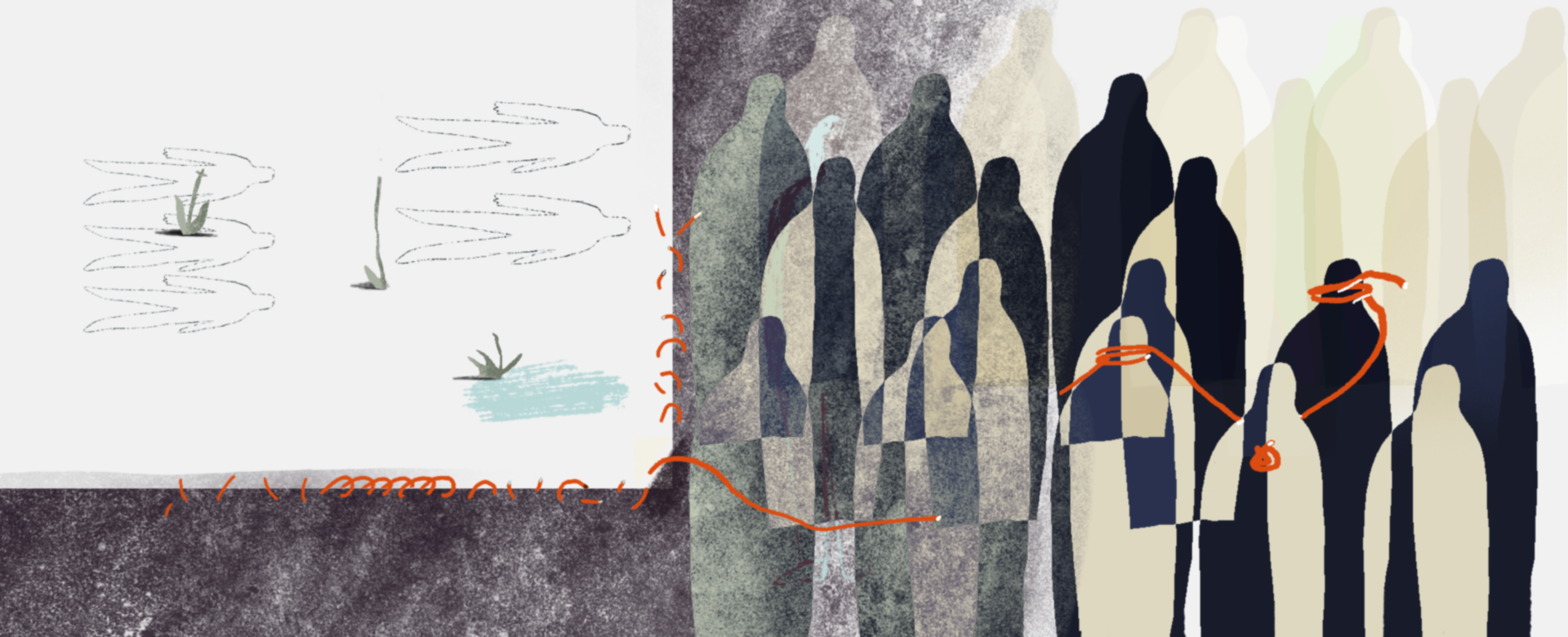
Illustration: Bogdana Davydiuk