What is hope, anyway?
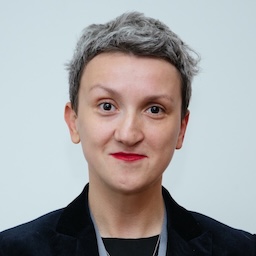
As our journal marks its first anniversary, we are publishing a speech our editor-in-chief Daria delivered at the recent Power of Storytelling conference in Bucharest. In it, she reflects on the experience of creating re/visions in wartime Ukraine. Launching the journal has been an act of care, of questioning, and of nurturing hope.
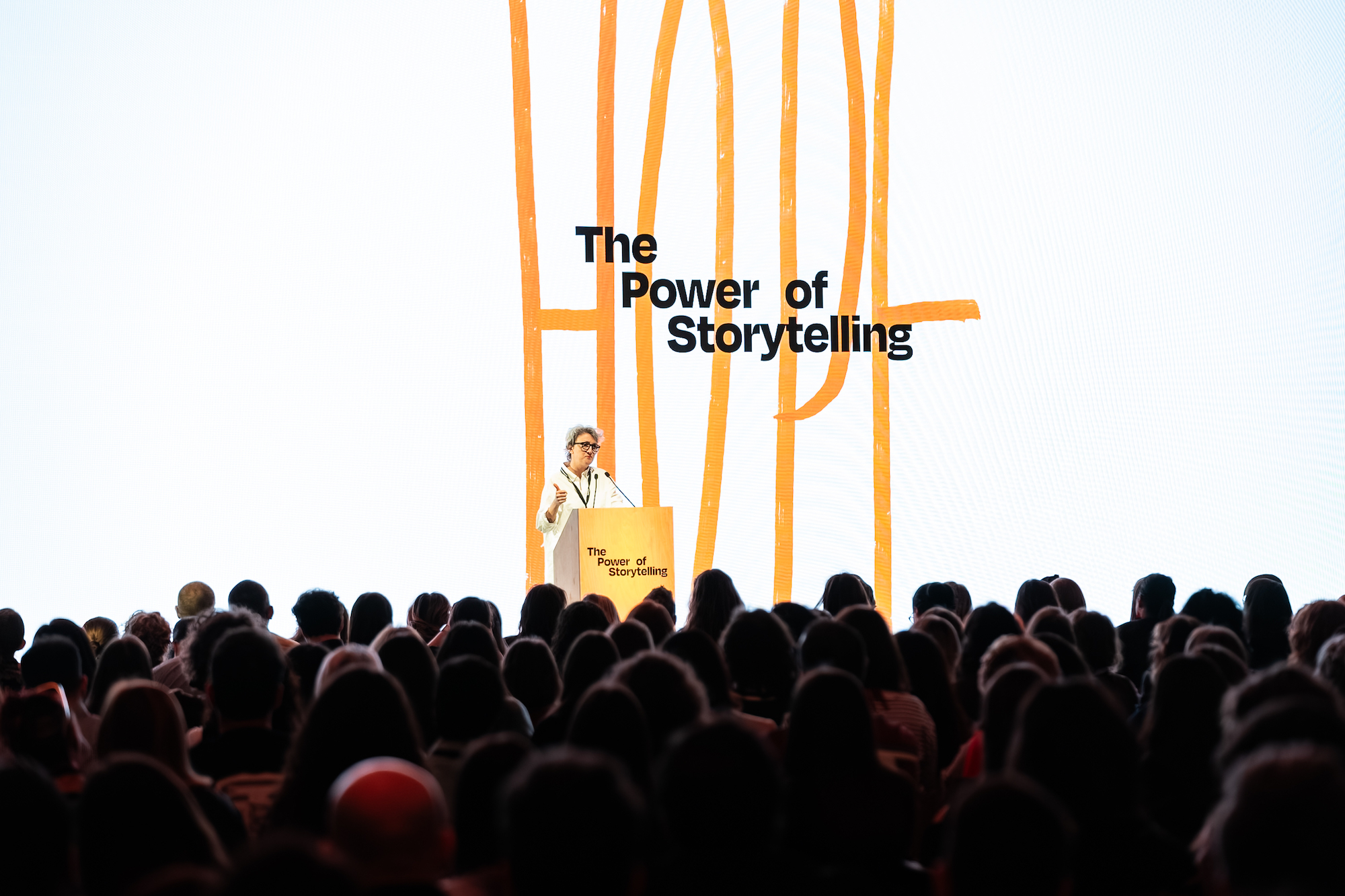
When Cristian invited me to take part in this year’s conference and told me that the topic was hope, I was surprised, to say the least. Me and hope are from different planets.
I am a) depressed, b) a journalist, c) a philosopher by training, and d) from Ukraine. No hope for me, thank you very much.
***
I am based in Kyiv, the capital, as you know, and in Lviv, a city 512 kilometers further to the western border; or, to be more precise, in trains between Kyiv and Lviv and other cities and countries.
Four years ago, I was a burned-out cultural journalist: in a previous year, I quit my job after nine years of work in total, six of them – as an editor of the Culture section, which we revived at my media outlet in 2015. To take my writing challenges to a new level, I decided to write a book. So I went to Kharkiv for a writing residency, located in the apartment of the prominent 20th-century Ukrainian intellectual and essayist Yuriy Shevelyov. It was February 2022.
So, on the first day of the Russian full-scale invasion of Ukraine, I was in Kharkiv, a large city 40 kilometers from the Russian border. At that writing residency, I was doing everything people usually do there: drinking wine, procrastinating, whining about my writer’s block.
I slept through all of the explosions and air alerts that marked the beginning of the Russian invasion at 5 am on February 24, as well as over forty phone calls from friends and family.
When I finally called my parents, who live in Kyiv, I heard, “Thank God, you're alive.” Then I bought the last ticket for the 13:05 intercity train to Kyiv (first class!), and left behind most of my fancy stuff – a cashmere sweater, nice cosmetics, books, and favorite pajamas – as I headed to the train station. It wasn’t too crowded; the smell of gunpowder floated over the city, but people weren't panicking. As we waited for our trains, people helped each other – placing a clumsy, overweight French bulldog in a carrier, holding a cage with a huge white parrot in it, and figuring out what kind of tank just crossed the bridge near the station.
The train I’d decided to get on pulled into Kharkiv station three hours late. By the end of the day, I was brought home to Kyiv, around midnight, way after curfew time, the first of 1,486 curfews.
That’s how 24 February 2022 ended for me. Or as I call it, “one of the worst hangovers of my life.”
***
The next morning I left for Lviv with my then-partner, our dog, a friend with her five-year-old son, and a bunch of weird things we packed in the car thinking we would be back in a week or so. I tried to remember what those things were, but I failed: my mind remembers the day I left Kyiv without many details.
The road to Lviv which usually takes seven hours took forty-eight hours, with an overnight stay in the middle. I remember it being one constant traffic jam. From the car window I saw people building checkpoints out of sandbags, and a beautiful, surreal sunset at the end of our road trip.
In Lviv, I found myself among the many culture makers who crowded the western Ukrainian city in those first days of the full-scale invasion. Lviv was buzzing, fueled with anxiety, anger, and adrenaline.
One friend, an ex-auction house owner, was figuring out how to make anti-tank obstacles from old train rails.
Another, a former deputy minister of culture, was buying bulletproof vests.
A research center, whose main focus is urban history, transformed its conference room into a shelter for refugees.
Museum professionals were helping their colleagues in the east and south of the country to evacuate.
Filmmakers and journalists were turning into local producers for international media.
In other words, everyone was busy.
I felt lost, however. I couldn't find myself anywhere among those reinventions. As I already mentioned, I am a journalist, a cultural one (a.k.a. the most useless sort), a film critic and curator, an editor, and – overall – a person who asks annoying questions about the meaning of things. It’s the most inappropriate set of skills during an apocalypse.
My writer’s block was gone, though. High on adrenaline, I wrote a couple of opinion pieces where I couldn’t help but wonder about the connection between culture and war: how come international cultural institutions turned a blind eye to the aggressor country waging a war in the middle of Europe? Back then, for me, culture, arts, and reckless fascination for beautiful ballet or cinema had to be somehow connected with human rights violations, devastation, and decades of warmongering – and not seen as if they’d been created in a vacuum. In 2022, for me, culture stopped being inspiring and unifying. It became toxic. I was stunned by this arrogance of cultural milieux, and became bitter, reacting to the reality of war being waged against my country. It was cortisol-induced, critical writing. Once I realized this, I stopped writing. Again, a writer’s block.
Cultural criticism, and thinking itself, require distance, a state of calmness, well-adjusted breathing, good sleep, and, above all, a feeling of safety. We did not have that in 2022.
We still don’t.
But many things have changed.
***
Our lives will never be the same.
For four years, we've been experiencing grief that is multi-layered. For a while, we were mourning our past lives – it was both delusional and hopeful.
My generation – millennials, who in luckier countries are on TikTok, joking about various hobbies as a coping mechanism for middle-age crisis – is dying in this war. Sometimes you attend a funeral and a wedding on the same day. We hold dancing parties to pay our respects, commemorate and celebrate at the same time. We honor the courage of our friends killed in action, protecting us while we were writing articles, taking trains to international conferences, asking questions, and demanding answers.
2022 was a year full of adrenaline and cortisol. It felt like you were drinking coffee, were punched in the face, and were running a thousand sprints, all at the same time.
2023 was a year of losing hope. A large Ukrainian counteroffensive failed, and was watched elsewhere as if it were a reality TV show. There seemed to be no good news in 2023. We were slowly sliding into the abyss of understanding that this war would not end soon. It will still last for a while yet, maybe even our entire lives (which can come to an end next week, you know).
In 2024, our jokes were as dark as coal and became completely untranslatable to our foreign friends and colleagues.
By 2025, everyone claimed to have completely adapted and to have learned how to identify – by the sound they make – the different types of Russian and Iranian drones flying over their neighborhood.
By 2026, many of my friends had started taking prescription anti-anxiety or antidepressant medication. Me included.
***
What is hope, anyway?
The Cambridge dictionary offers a slightly passive-aggressive definition. I like it: “to hope is to want something to happen or to be true, and usually have a good reason to think that it might.”
I like it also because it is about hope as a verb.
***
Somewhere between the end of the world and coming here to Bucharest, I started brewing a journal and returning to my professional identity as an editor, a job I loved but found difficult to combine with a writer’s ambitions.
It happened in the good company of friends – Sofia Dyak, a historian, director of the Center for Urban History in Lviv, which I’ve mentioned earlier, and Natalie Nougayrède, a French journalist and editor. We started asking ourselves: how do we grieve and heal if a process of mourning seems endless? Is there any sense in considering the future? What is a state? Was there ever a postwar? With everything that’s happened, will we ever get proper rest? How does water circulate in wartime? And many more such questions.
It seemed that while the world crumbled around us, the meaning of words started crystallizing. All of a sudden, poetry started to make more sense than any other form of writing. It seemed that words, terms, concepts, pronounced and written, needed to be given the most possible clarity.
I allow myself to quote the Ukrainian poet Iya Kiva, who wrote an essay for our journal last year: “In wartime, a person is a verb. In wartime, everything’s a verb.”
That’s why and how we came up with re/visions.
“We are preparing an issue on Grief and Healing. Will you write about your garden for us?” I asked a friend.
“Are you a war reporter? Tell us how you swam in Iraq.”
“You said that the neighborhood is an empty concept. Could you elaborate on that?”
These are some of the strange and wonderful conversations we have with our authors, all of them resulting in beautiful essays we’ve published since the journal’s launch in May 2025.
As we prepare our tenth issue, due in April, I am thinking about the sheer intellectual privilege it is to produce a journal in times of war. A journal that tries to not be only about the war itself, but of course, revolves around it, inherently, unavoidably.
Asking questions in wartime is challenging.
When the war is waged against your own country and you are defending yourself, and that makes you overprotective of boundaries, roots, a pantheons of heroes, stories, and narratives. That’s natural, because they’re being violated in the most brutal way. Any expression of doubt (hello, René Descartes), even in its most gentle form, can be perceived as an act of destruction. The fragile structures of our lives are shaken, they require precision and care.
So how do you build a decent conversation, how do you explore the very architecture of thinking and, therefore, living, in such circumstances?
In re/visions, we came up with a few rules:
- We want to slow down, step back a bit, take time. We are a slow media.
- No exclamation points! We don’t shout at people.
- We want a gentle design and beautiful illustrations. Yes, we’ll talk about death and gardening, about the shuttering of democracy, about non-linear time flow, but we’ll do that in a calm space.
- We are very attentive to words and syntax – that's what we’re here for, in the first place. Ukraine and Europe? No. Ukraine comma Europe. Eastern European? No. Just European: enough with this division; it doesn’t work.
- We carefully revise our own vocabulary with each new issue.
- We are bilingual, so we search for the right words, to translate thoughts not only from Ukrainian to English and vice versa, but from one context to another, build this conversation together.
All of it requires high expectations that don’t always match reality. A bit of delusion, of course.
So, after all, Cristian, you and the team behind the Power of Storytelling 2026 were right. All we do is hope.
Hope that we’ll be asking the right question, and that someone will start looking in a new direction, helping prepare a fairer future.
Hope that those tiny pieces we put together in the jewelry box of a journal’s issue – a book, a podcast, a life story – will inspire someone, or protect them from falling into despair.
Hope that a decent conversation can indeed heal.
Let’s have those conversations, all.
Thank you.