A moment of erasure: Pavlo Kovach’s video Threshold
In Threshhold, a 10-minute video, the Ukrainian artist and soldier Pavlo Kovach cleans a refrigerated truck. The vehicle transports fallen soldiers. Filmed in Druzhkivka, in the Donetsk region, the piece turns a dark chore into a solemn ritual. The video brings to mind Francis Bacon’s haunting paintings.
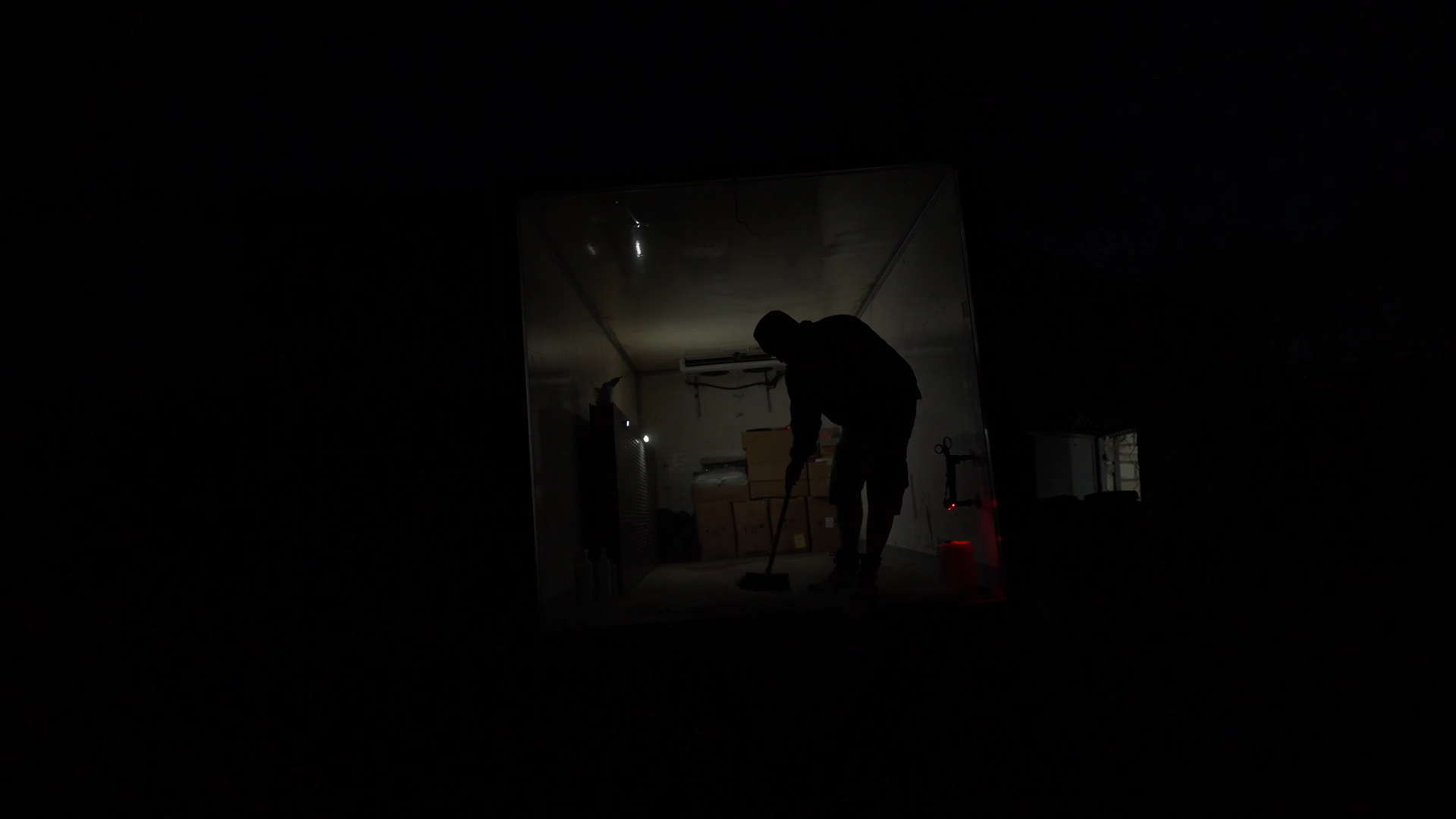
The video is 10 minutes and 53 seconds long. The camera focuses on a truck with its doors open, parked next to a building. The faintly lit rectangle of the window and several LEDs inside the truck: all white, with one red. Now and then, a flashlight beam moves, guided by a human hand. For a few moments, a speck of cigarette flame appears. Depending on where you view this artwork — at an art center or on a laptop — its visibility varies. Projections and screens also serve as thresholds into this video piece made by Pavlo Kovach (junior), an artist and soldier in Ukraine’s armed forces, filmed in 2025 in Druzhkivka, in the Donetsk region.
I first saw it in Ivano-Frankivsk in 2025 at the Asortymentna Kimnata gallery during the Where it all goes exhibition. Threshold was exhibited as a collaborative two-part piece by Pavlo and his brother Danylo Kovach, who lives and works in Austria. The video here is one of the rectangles in a larger installation. It is framed by eighteen doormats from Austrian homes. On the nineteenth mat, in the center, the moving image is projected. Such a display amplifies the meaning of the threshold: as a domestic, everyday, and sometimes festive space (some mats wish viewers a Merry Christmas); a threshold able to welcome forced migrants. At the same time, it is the threshold of a refrigerated truck — the entrance to a temporary wheeled workspace equipped for the examination, storage, and transportation of the bodies of fallen fighters.
There is too much light in the exhibition room, and it takes time to discern the image. Videos at exhibitions are usually reproduced on repeat, so viewers can start watching at any point. A man in the video (the artist himself) sweeps and mops the floor of the truck. Pavlo Kovach describes these actions as monotonous and methodical work, a repeated gesture: “The act of cleaning here is not a hygienic procedure. It is a ritual — an attempt to return a space to its previous state. But the traces do not disappear entirely. They simply become invisible. The work documents this moment of erasure as something fundamentally unfinished.”
Perhaps because I was focused on the impenetrable image, the barely discernible geometry of light, and the movements of the human figure, I found myself lingering on a single random detail that, at that moment, seemed perfectly natural. This becomes my punctum. It catches my eye and shapes my impression of the piece, one that will stay with me for a while: the truck is parked slightly tilted. Because of the tilt, the blood-cleaning solution flows in a controlled manner beyond the truck’s edge, into the left corner of the frame. Only later would Pavlo tell me that this was a feature of the terrain where the vehicle was parked, not a concept. My civilian perspective had exaggerated the orderliness of this ritual.
The first edit is at 4:54. I totally forgot that, apart from the wide shot, there’s also a close-up. Twice, the camera shows the floor across which the liquid is moving. The artist sprays the solution, then uses a mop. So, the interpretation of Threshold is an interpretation of the shot and editing.
The truck’s outline follows the proportions of an old television aspect ratio, close to 3:4, while the frame itself is widescreen. These two frames — the narrow one and the wide one — interpenetrate and create various kinds of thresholds between one another. Within the wider frame: the barking dogs, a phone notification, and a war-torn landscape covered in night. Within the narrower frame: monotonous action and the body performing it.
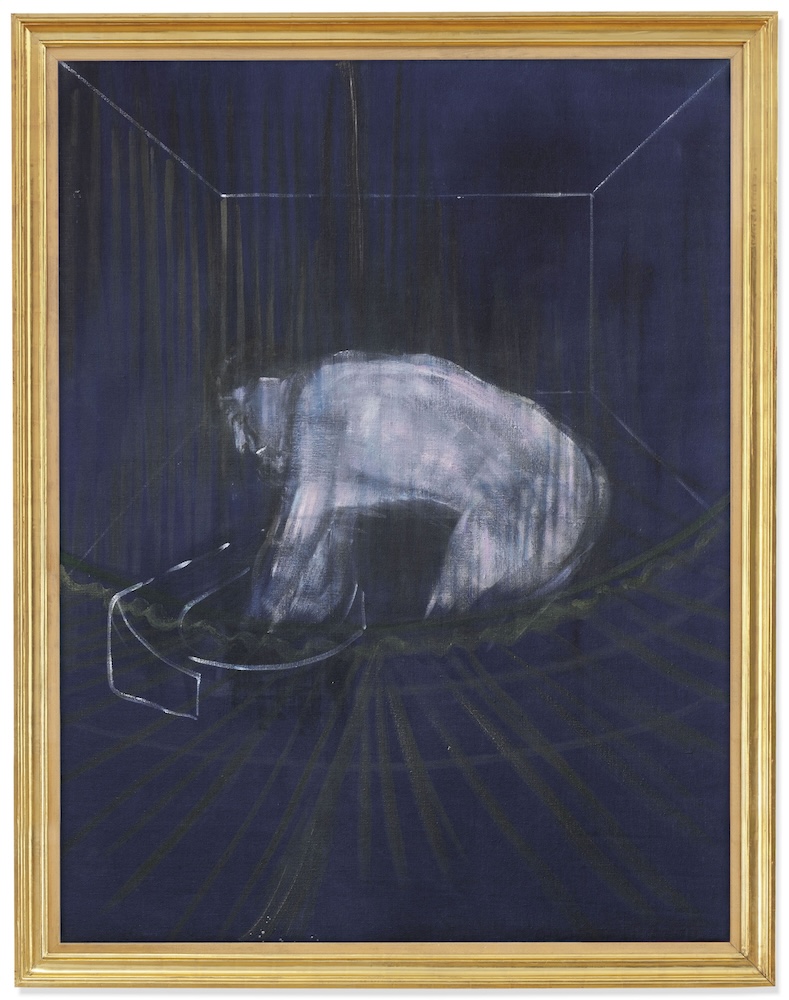
The human figure enters the space of a smaller frame, and thus into the iconographic dimension created by the British painter Francis Bacon. The bodies in his paintings are contained within defined spaces, enclosed in cage-like structures. Bacon transforms the symbol of perspective — the key artistic achievement of the Renaissance — into a moving sight, an omnipresent trap that always finds a body to hold captive. The most relevant artwork for a dialogue with Kovach’s Threshold might be Bacon’s Man at a Washbasin (1954).
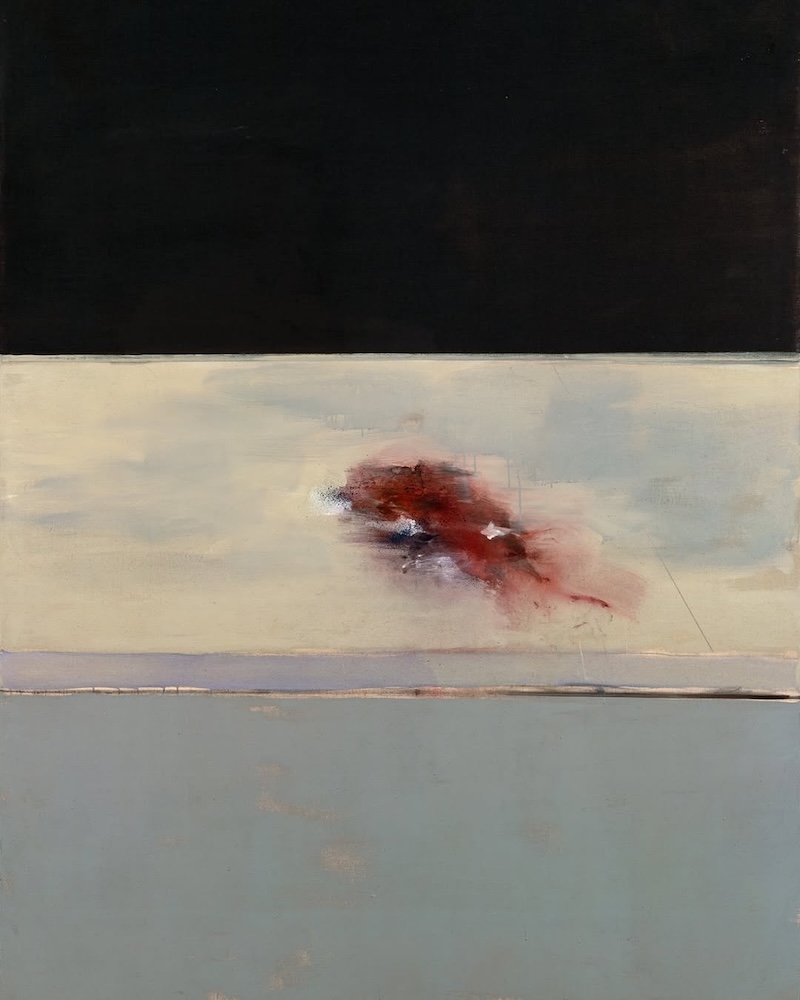
Also, Blood on Pavement (1984). This is an almost abstract piece. Mark Rothko’s iconic composition and color palette, whose metaphysical balance is disrupted by a red-and-black pool of blood. Bacon saw one like this in London’s East End while returning home from a pub one night. As his friend John Edwards recounted, the bloody trail stirred the artist, bringing back memories. Specifically, it brought back memories of his experience of serving as a rescue worker during World War II. At that time, Bacon pulled people and animals — as well as the bodies of the dead — from beneath bombed-out buildings. Art critic Mark Stevens wrote that Blood on Pavement “seems to remember — not just recall — what came before.”
It seems that Threshold also remembers what came before. Kovach used to work with seconds, centimeters, and kilograms — but only to avoid reducing them to a clock face, a ruler, or a set of scales. He created paradoxical objects, pointing to the thresholds between one way of relating to the world and another. He contrasted the practices of measurement and calculation with the duration of a life immersed in the world. Time is not on a clock, but in the fluidity of wax, which melts and hardens under varying temperatures. Distance is not on a ruler, but in the notches carved into wood that measure a child’s height. Mass is not that of formed objects, but of dust scattered throughout space and time. Some of those pieces, along with Threshold, were shown at Pavlo Kovach’s solo exhibition at the Labirynt Gallery in Lublin in the spring of 2026. The exhibition was titled Hoc Est Corpus Meum — “This is my body” in Latin, the phrase from which “hocus pocus” is believed to derive.
The human being remains the focus of Threshold even in their absence. “The truck is simultaneously a technical object and a place where time used to stop — where a body was still present, but the person was already gone,” writes Kovach. In the final scene, the artist steps out of the truck, from the confined space into the wider world, and disappears into the darkness.
Translated from Ukrainian by Tanya Rodionova