Beyond revenge: Gentileschi’s Judith Beheading Holofernes
For centuries, Artemisia Gentileschi’s 1620 painting Judith Beheading Holofernes was locked away in Florence, considered too shocking to display. Many have viewed this artwork as motivated by personal revenge. Yet its real power is arguably a bold display of female solidarity.
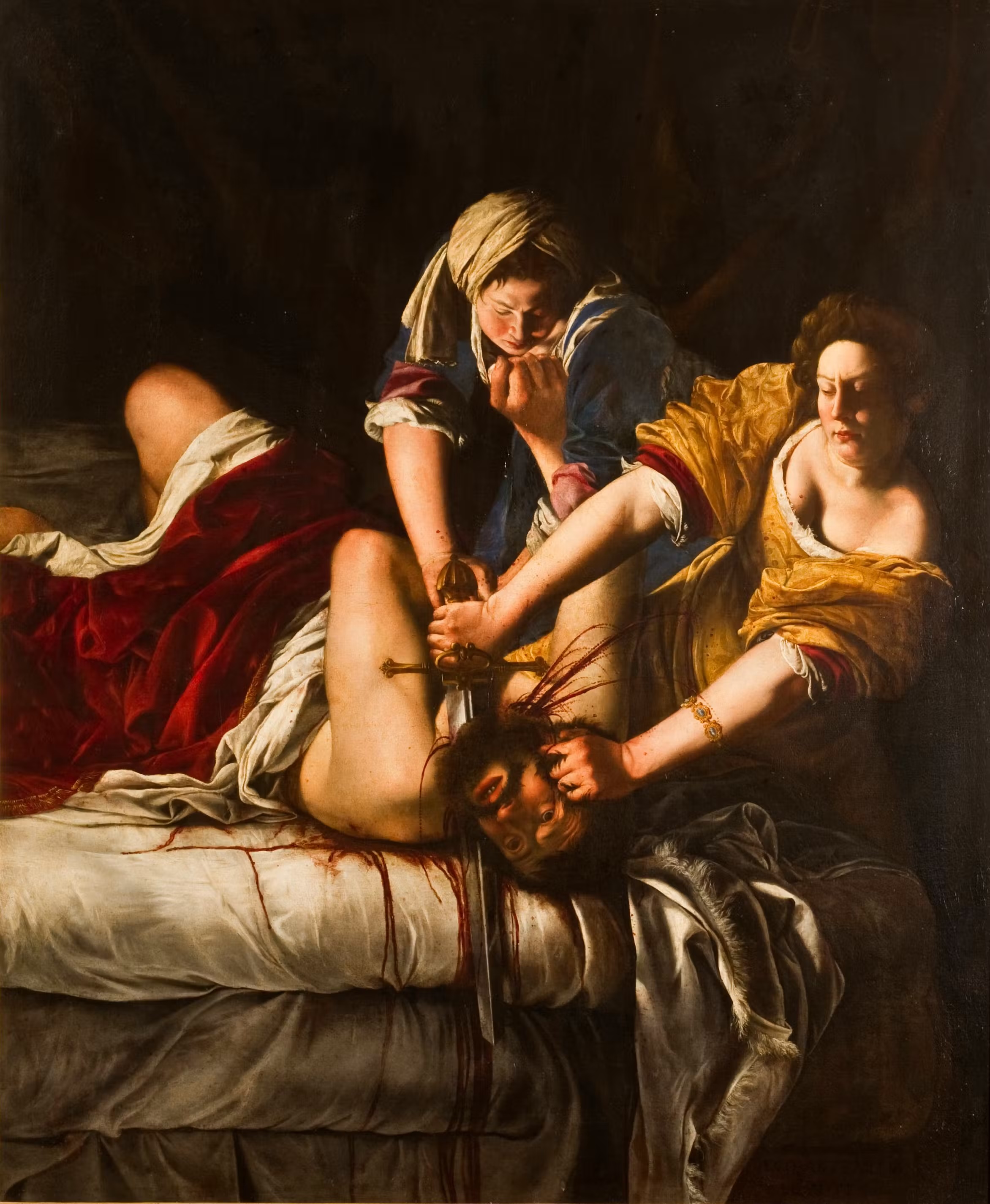
Artemisia Gentileschi finished her Judith Beheading Holofernes in 1620. Until the late 20th century, the painting remained hidden, in a section of the Uffizi Gallery in Florence that was closed to visitors. It has been on public display only since the 1990s.
So what is the story behind this famous piece of art?
In 1616, Artemisia was the first woman to be admitted to Florence’s Accademia delle Arti, winning the right to buy paints and sign contracts without her husband’s consent. A few years later, Grand Duke of Tuscany Cosimo II de’ Medici commissioned Judith Beheading Holofernes from her, as a gift for his wife Maria Maddalena of Austria.
This wasn’t the first time the painter turned to this subject. Artemisia’s initial rendition of the theme was painted in 1612–1613, following the trial of her rapist, Agostino Tassi, who had been tutoring her. In 1611, Artemisia’s father, Orazio Gentileschi, a renowned painter from Rome, sued Tassi, initiating a trial in which his daughter was subjected to a humiliating medical examination in public and even to torture. Tassi was convicted; Artemisia got happily married, pursued her art studies, and made influential friends. Her first interpretation of the popular subject did not create much of a stir at the time.
The duke’s representatives in Florence who inspected Artemisia’s 1620 version of the painting refused to pay her the fee she had been promised, 50 scudi (equivalent to 165 grams of gold). The artist asked her friend Galileo Galilei to put in a word directly with the duke and eventually got paid what she was owed, although with a delay. The painting joined a private collection depicting other biblical heroines at the Palazzo Pitti. In the mid-18th century, Anna Maria Luisa de’ Medici, the last of her bloodline, ordered that it be kept separately from the others. Museum staff followed these instructions right up until the second half of the 20th century.
It was then that feminist critics began to interpret this version, rather than the earlier one painted after the trial, as an “act of revenge.” So what was it about the second painting that stirred such deep emotion in its owners and still resonates with viewers today?
The symbolic tale of Judith, the pious widow, found in an apocryphal book of the Old Testament, became rather popular. She seduced Holofernes, the enemy general, got him drunk, and killed him to save her hometown of Bethulia, besieged by Nebuchadnezzar’s army. During the Renaissance and Mannerism eras, it aptly complemented the heroic narrative of David and Goliath, where the enemy was also defeated through the beheading of its leader. For artists, the story of Judith was an opportunity to demonstrate their skill in showing the beauty of the body, clothes, and the hair of the heroine who accomplishes her mission, preserving her honor, remaining “pure” in the company of an inebriated man.
Among those who painted Judith’s feat were Sandro Botticelli, Andrea Mantegna, Giorgione, Paolo Veronese, Alessandro Allori, and Lucas Cranach the Elder. Other female artists also took up the theme before Gentileschi. In the late 16th century, Fede Galizia of Milan created several renditions of the scene with the general’s severed head on a tray held by Judith. In 1600, Lavinia Fontana painted Judith lavishly dressed, holding a sword and Holofernes’s head. These commissioned works were appreciated, but even researchers specializing in “women’s art” rarely mention them, whereas Gentileschi’s painting is to this day often compared to Michelangelo Merisi da Caravaggio’s 1599 version. Most likely, Artemisia had not only seen this artwork but borrowed from it. For this reason, she is often referred to as a Caravaggista.
In his Judith Beheading Holofernes, Caravaggio highlights the moment he would have witnessed repeatedly at public executions, which were common in his day: the moment when the victim’s head is partially severed from the body, but the person is still alive. The effect, first tested in his Medusa, becomes far more pronounced in this multi-figure composition, focusing the viewer’s attention on the characters’ eyes. Owing to the contrasting lighting, our gaze is first drawn to the look of disgust and determination on young Judith’s gracious face, and then to the wide eyes of the old and wrinkled-faced maid, staring at the blade that slices through Holofernes’s neck.
The victim’s mouth, vividly rendered, is wide open in a scream; his eyes are bulging. Caravaggio turns the composition into a closed loop, prolonging the moment of the murder to turn it into a theatrical spectacle. The blood, spurting from the wound in an unnatural way, is almost the last thing the viewer notices.
Gentileschi employs the same composition, adding something of her own to the horror of the stares. She brings together the energy of the two young women, the mistress and the maid, who stand united against the man’s resistance: Holofernes’s mighty fist raised toward Abra the maid’s face. In similar, almost unadorned attire, with their sleeves rolled up, the two women are slaughtering the man together, as if he were an animal on a kitchen table. The artist meticulously renders streams of blood, flowing onto the bed, congealing, and soaking into the fabric. Blood heavily splatters Judith’s bare arms and the bodice of her golden-yellow dress.
The heroine plunges a sword resembling a cross into Holofernes’s neck with great ardor. She is, of course, Artemisia Gentileschi herself, in the fashion of her own time, divine justice personified. At the same time, the blood splatter emphasizes that in this act she remains neither pure nor beautiful. Despite the stress put on Judith’s physical appeal, this isn’t the artist’s attempt to justify herself using the Old Testament story. Flecked with blood, she celebrates the cruel and treacherous reprisal against an unarmed man.
Does Judith (with whom the artist identifies) savor this killing, committed together with her confidante? Here, Abra the female slave acts less as an assistant than as an accomplice. In my view, this is the primary reason why the painting produces such a strong impression: it offers the doubled image of a female slayer. It is not so much hypothetical revenge (her convicted rapist could never have seen the painting, Holofernes bears no resemblance to him, and the legendary Judith was never raped) as a precedent, albeit fantastical, for women joining forces to kill in cold blood. This is what, for so long, made Gentileschi’s painting too disturbing to display.
Artemisia makes use of a traditional plot to mask an example of female solidarity working to decide a man’s fate; solidarity that is dangerous precisely because it triumphs. Just how much sadistic pleasure both women, and not only Judith, take in the process is for the viewer to judge.
Translated from Ukrainian by Maryna Zamyatina