Harun Farocki: the last Renaissance man
A prolific and influential film director, Harun Farocki (1944-2014) emerged from postwar West Germany’s left-wing intellectual ferment and transformed cinema into a form of political and social inquiry. He spent his childhood in Asia before settling in Berlin. He worked across documentary cinema, criticism, television, and video installations. He devoted himself to interrogating images as instruments of power and memory.
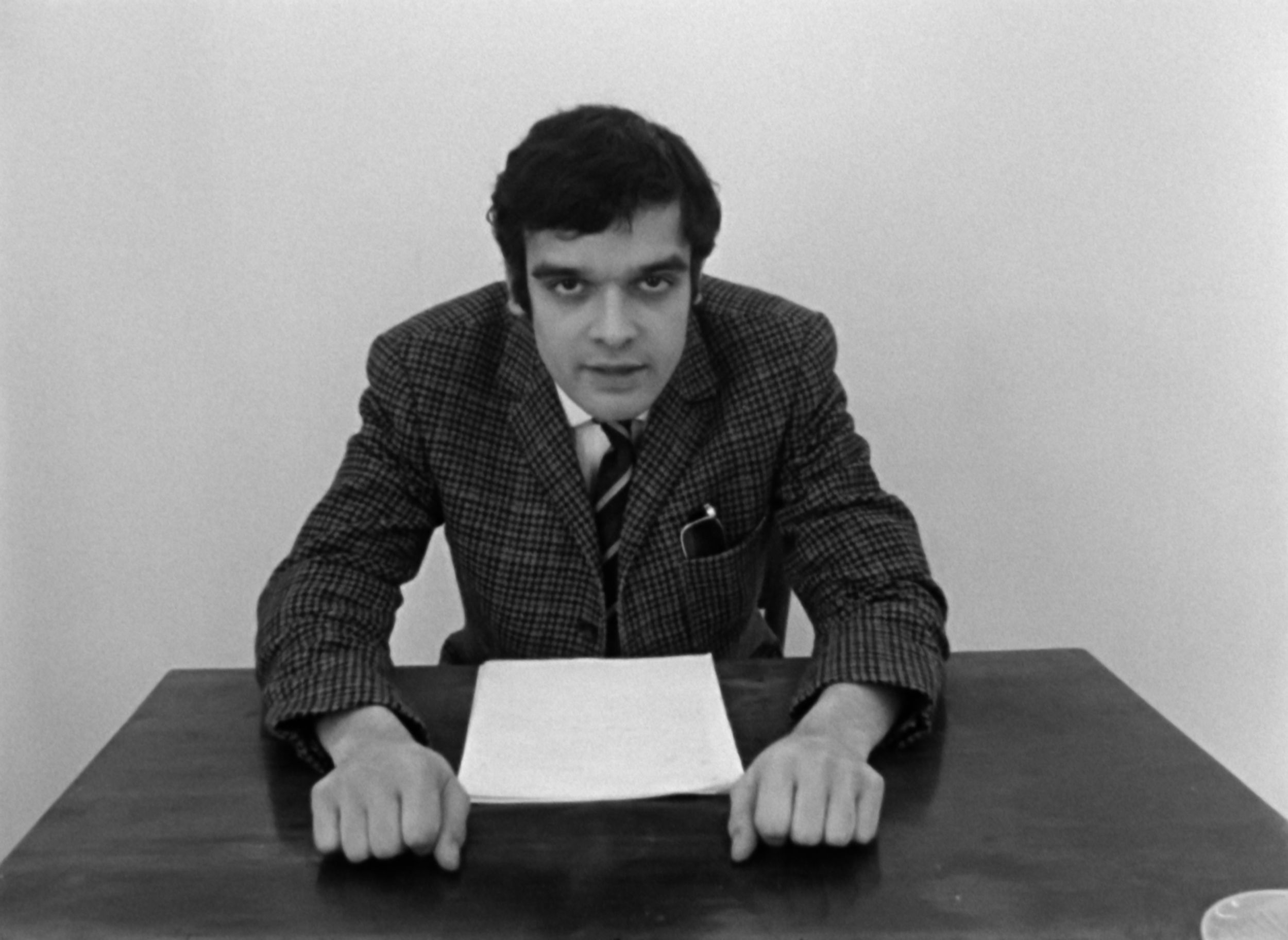
Harun Farocki is the director of over a hundred films, an author, a film critic… Hold on. Yes, in part. But more so, he is the last Renaissance man, acting as a mediator between images, as well as sand in the gears of established systems.
An article about a director isn’t complete without biographical information, but Farocki’s story is mostly one of ideas. Harun el Osman Faroqhi, the son of an Indian doctor and a German journalist, born in the annexed Sudetenland in 1944, spent his childhood in India and Indonesia, and all of his subsequent life in Berlin.
Farocki is best known for his cinematic essays of the 1980s and 1990s, but his understanding of the world and cinema has its roots in discussions among West German leftist activists and theoreticians that took place in the 1960s and 1970s. In his early films, we see attempts to escape the dogmatism of workers’ cinema, an activist genre that involved little participation of workers themselves.
One of Farocki’s first projects, Something Self-Explanatory (1971), is a screen adaptation of Marx’s Kapital, undertaken before he had finished reading it. Returning to the times of the Weimar Republic, the director tries to reenact the intellectual and political conflicts that led to the rise of the Third Reich. Farocki’s entire generation would join in similar efforts. Having made one promising short, Farocki’s film school friend Holger Meins would disappear into the terrorist underground of the Red Army Faction, to appear on camera again only as a dead body after a hunger strike in prison. Another friend, Kristian Zelmer, would lay the foundations for Farocki’s approach to film criticism, focused not just on the action depicted in a film, but the ideology behind it. Zemler would later become the co-founder of the German Communist Party, the most dogmatic organization on the post-war left in Western Germany.
Farocki was self-taught, a master at synthesizing exotic knowledge and contradictory elements. Like nearly every autodidact, his thoughts and deeds were marked by excessiveness, harshness, and self-assurance. Expelled twice, in 1967 and 1969, from the newly established German Film and Television Academy for political activities, he would return in the late 1970s as a teacher. All of the materials collected in his many notebooks would be used in his films, as if he were running a waste-free production line at a factory (another source of fascination for Farocki).
Living on the island that was West Berlin, surrounded by the wall, Farocki belonged for most of his life to the artistic precariat, dependent on odd jobs and the good will of media editors. While he polemicized constantly about television as a form, it was the channels Westdeutscher Rundfunk, Südwestrundfunk, and 3sat that, under the leadership of giants of German post-war cinephilia like Werner Dütsch, enabled the production of most of Farocki’s films in the 1980s and 1990s. No influence on content, no influence on form.
With the end of the welfare state and a generational shift among editors, this period too would wind down. Television became a bit more beholden to quotas and program editors’ preferences, and a bit less accommodating to work that, in Farocki’s words, spoke of the places where modernity is born.
***
The first film Farocki shot outside the academy, Inextinguishable Fire (1969), about the military-industrial complex and the Vietnam War, begins with the director looking into the camera and saying,
How can we show you napalm in action? And how can we show you the injuries caused by napalm? If we show you pictures of napalm burns, you’ll close your eyes. First you’ll close your eyes to the pictures. Then you’ll close your eyes to the memory. Then you’ll close your eyes to the facts. Then you’ll close your eyes to the entire context. If we show you someone with napalm burns, we will hurt your feelings. If we hurt your feelings, you will feel like we’ve tried napalm out on you, at your expense. We can give you only a hint of an idea of how napalm works.
Farocki then puts a cigarette out on his arm. “A cigarette burns at 400 degrees,” says the voiceover. “Napalm burns at 3000 degrees.”
This scene contains almost everything that would prove important for Farocki in cinema: the rift and space between the image and the world, the idea and the body, experience and the impossibility of conveying it.
“When I watch the films I shot in 1967-1970, I ask myself where that all came from. When I watch films made in 1970-1977, I ask myself where it all went.” 1970 was a watershed year for Western post-war reality; the beginning of solitude and atomization. “We lost politically, but we won culturally,” Farocki said of that period.
In 1973 Farocki became an editor at Filmkritik, the essential magazine for West German cinephiles. By the mid-1980s he would write an enormous number of texts on the works of other filmmakers, making no distinction between his roles as a director and a critic. The magazine was shut down because of financial difficulties – a result of efforts to “write about film without telling the viewer what they ought to think about it.”
***
Despite constantly being broke, in 1980 Farocki began making Before Your Eyes - Vietnam, a partially staged film about depictions of the Vietnam War and the anti-war resistance. Two weeks before filming was due to start, he decided to completely rewrite the screenplay, realizing he had glossed over the crimes of the Vietcong. The rewrite would take a year, and the film would be shot on 35mm film over fifty days. It’s hard to imagine a creator who can allow themselves such a luxury in 2026. It’s even harder to imagine a situation akin to that of his documentary film Indoctrination (1987) about a seminar of managers learning how to sell their products more effectively. The film contained no additional voiceover but was shown in primetime and watched by a third of German TV viewers.
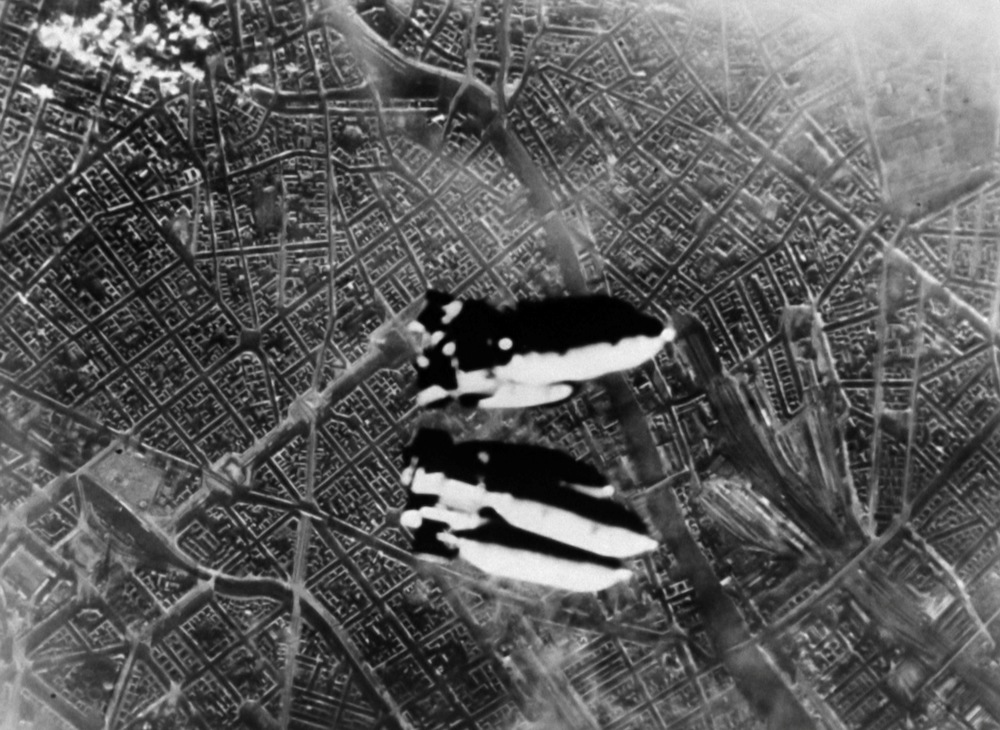
Farocki would work on what was probably his key film, Images of the World and the Inscription of War (1989), for twelve hours a day over the course of two years, largely at the editing table. The piece would become his magnum opus, his definitive interrogation of whether something can be found in an image without being sought. How should one portray victims? Farocki returned to this question time and again in different films. He made a film about Auschwitz-Birkenau that avoided images of bodies: he believed only aerial footage could create a great enough distance to show the line leading into the gas chamber.
In Still Life (2007) Farocki analyzes footage that a Jewish prisoner filmed, on SS orders, of newly arrived prisoners being sorted at the Westerbork transit camp. He avoids cinematizing the footage, using no music or any other sounds. Nor does he give any commentary: “Words can be made and remade much more cheaply than images and are used to fill the gaps.” Farocki’s choice to forego words in this film contains a political and ethical dimension. Analyzing events in detail, frame by frame, the director isn’t conducting research, but rather restoring dignity to victims for whom being filmed and broadcast could be yet another mode of destruction.
***
The chief theme in most of Farocki’s films is labor, the advent of it as a sort of structuring and exploitation of reality. Labor seen and unseen. Society’s transition away from material labor – which comes through not just in what the camera films, but in how it views work.
Most of the documentary footage Farocki uses has no artistic value. These are scraps of utilitarian products: educational films, instructionals, footage for internal use. Not meant to be saved, they exist outside of any aesthetic categories or studio copyrights (making them wonderfully suited to a minimal budget), and outside of history. Still, he believed that if you “rub them against the grain”, some “residual meaning” comes out.
“Technical images don’t just interpret the world; they try to change it.” It was perhaps for this reason that in the 1990s and 2000s, Farocki took a particular interest in images made with military technology – the avant-garde that shaped the future of civilian technology. “Industry has destroyed manual labor. Now we’re looking at a technical replacement for the work of our eyes.”
Farocki’s main workplace was not the archive or the film set, but the editing table: “The editing table is the place where work meets power. It’s not hard to imagine how that meeting ends.” Selecting a single image from the stream, figuring out its context becomes a political act, an act of criticism. For Farocki, cinema cannot exist without this critical stance, without acknowledging the automatism in our interpretation of the visual.
At the same time, Farocki felt weighed down by the need to be an author, someone who forms new knowledge with old material. Perhaps this is what sets him apart from the poet-demiurge, Jean-Luc Godard. Farocki’s cinema is democratic, and therefore open, rickety, incomplete. It invites the viewer to disbelieve, to collaborate, to reconfigure. This may make him one of the most important contemporary political film directors.
Farocki provides tools instead of instructions. His teaching at the Berlin film academy consisted of slowing films down and analyzing them, frame by frame, at the editing table. In his view, every director needed to learn to see films in motion “without killing them.”
***
Farocki’s major film of the 1990s was probably How to Live in the German Federal Republic (1990), where people train and prepare for life in all its facets, across forty-six scenes featuring therapy groups and instructional classes. If most social interactions can be turned into games for training purposes, then how do we know they aren’t just games in real life? “In documentary film,” Farocki explained, “I look for situations where people mask, where they play roles.” How to Live in the German Federal Republic was shown in around thirty theaters at the time of its release. Yet three years later, another of his films, Videograms of a Revolution, premiered at two movie theaters, with one person at each screening.
Farocki had foreseen a paradigm shift already in 1988: “Photography and film, along with their photochemical apparatus, are leaving the mechanical era, where images are imprints of real, material objects. That time is ending.” The melancholy inherent in Farocki’s worldview deepened with the end of the 1980s: “I’m watching the rapid development of technology that will cut me out of the process of image creation. I’m making films about the industrialization of thought.”
Thanks to multiple retrospectives of his work in the 1990s, Farocki started to feel again that documentary cinema had a future. Yet this hope had faded by the end of the decade. “Television producers all realized suddenly then that documentary films could be shot for a tenth of what fiction films cost. A few more years went by, and they realized it would be even cheaper just not to make documentaries.”
***
After 2001, having begun a series of works about intelligent weaponry – the installations Eye/Machine I, II, and III, and the film War at a Distance – Farocki started to gravitate towards galleries and art institutions as a space for his ideas. Installations were a wonderful medium for his signature concept of the “soft montage,” wherein images coexist outside the traditional, authoritarian order of “before and after” and “now and later.”
From then on, Farocki’s video works would be kept in gallery archives, carefully protected by various contract conditions: the art world views them as unique artifacts. “I’ve been trying to share my work for decades, and now I’m forced to hide it away!”
At the same time, Farocki was becoming a star theoretician. English-language publications were flush with interviews and articles about his films. He seized the moment to move into teaching and curating in Berlin, Vienna, and Berkeley. The geographic reach of his subjects expanded to American prisons and military bases, and to African villages. “I began to collect ideas and wait for opportunities,” he said of that stage of his career. “Opportunities” meant ad hoc, unstable financial arrangements with curators, cultural funds, and television, which, in the new era, have more control over the form and the existence of documentary cinema.
Farocki’s last work before his unexpected death in July 2014 was a curatorial project, Labour in a Single Shot (2011-2014), which gathered material from local documentarians in fifteen countries. Its rules were simple – one place, one shot, one job – as if to take us back to one of the first films ever made, Workers Leaving the Lumière Factory (1895).
***
Generative AI has now mastered the production of hyperrealistic visuals, and is gradually but fundamentally changing the meaning of work. One wants to ask Farocki: “Where to now?” We can find his answer in a 1987 essay:
Those working in film today need to look for an area that the machinery of word-images has not destroyed, at least not yet. They need to unite words with images, words with words and images with images so that sense cannot catch the logic of expression. If they want to keep their job, if they acknowledge modernity; if they don’t want, like many of us, to work as a stoker on an electric locomotive.
Is that all?
Perhaps Farocki would also recall the opening words of his 1989 film Images of the World and the Inscription of War. “When the sea surges against the land, irregularly, not haphazardly, this motion binds the gaze without fettering it, and sets free the thoughts.”
Translated from Ukrainian by Katharine Quinn-Judge