Lee Miller’s wars
Lee Miller (1907-1977) lived many lives: fashion model, art photographer, companion of the surrealists, and fearless war correspondent. She witnessed defining upheavals of the 20th century with a camera in hand. A remarkable retrospective traces the path of this celebrated American photographer. It shows how she documented history at its most brutal before retreating into silence, her vast archives hidden for decades in an attic.
It is impossible not to be deeply moved by the life and work of the American photographer Lee Miller (1907-1977). I recently visited the superb retrospective dedicated to her at London’s Tate gallery. The exhibition will continue in Paris starting in April, and then, in the fall, will be shown at Chicago’s Art Institute. What an extraordinary life journey this woman of character had!
Lee Miller was born in 1907 in Poughkeepsie, New York, with so much curiosity and openness that she abandoned all the comforts of a career in art and fashion to cover, as a war reporter, the Allied landings in France, and then onwards across Europe until the fall of Nazi Germany and its allies. She then put away her Rolleiflex camera and her negatives in the attic of her peaceful home in the English countryside, where they remained untouched for the last twenty years of her life.
The exhibition documents in detail the striking transformation of the stunning 1920s model with movie star looks – whom Jean Cocteau immortalized in the role of a statue in his 1930 film Le sang d'un poète (The Blood of a Poet). It describes her stays in Paris, then the capital of the arts and the avant-garde, where she learned photography alongside Man Ray, who was not only her partner but also her artistic collaborator. Lee Miller kept company with surrealist poets and painters. Picasso painted a memorable portrait of her.
But what resonated with me the most, in this exhibition, were the photographs she took while "embedded" with the US Army during World War II. The horrors she saw, and their resulting trauma, cannot but echo some of what we witness today with the now four-year-long Russian full-scale war against Ukraine.
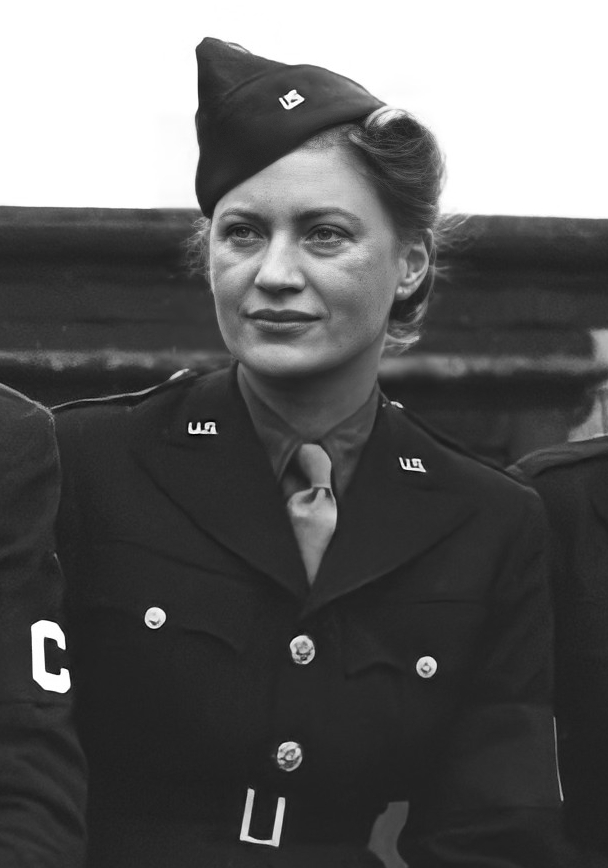
Accredited in 1942 by the US Army as a correspondent for Vogue magazine in England, Lee Miller covered the Blitz, but also sent fashion photos to show to American women that British women remained elegant in the face of bombing. She had a uniform made for herself, which she wore until the end of the war.
But it was in 1944 that a real turning point occurred. Having landed on August 12, 1944, at Omaha Beach in Normandy with the Allied troops, she hitchhiked to the seaside city of Saint-Malo the next day. She was on a mission for the US Army Information Service, which wanted her to show a liberated city.
She was then one of the army's first female photographers. She was tasked with documenting a return to normalcy. But she soon discovered this was far from the case: Allied bombers were still pounding a strategic section of the Atlantic Wall, particularly the old fortress site of Alet, where the German colonel von Aulock had entrenched himself in a gigantic bunker with 8000 men, still in control of Saint-Malo and determined to resist to the end.
Lee Miller stayed there for four days, alongside the GIs, documenting the siege of the city, the flight of refugees, the wounded, the dead and the destruction, the use of napalm and phosphorus bombs, and then the German surrender. By then she was accepted as one of their own by the soldiers with whom she shared living conditions, and she did not content herself with simply taking photographs. She also wrote articles in the first person, describing the experience.
Here is an excerpt, about Saint-Malo: "Huge chimneys stood alone, spewing smoke from the burning rubble of the buildings at their base. Lonely, miserable cats prowled around. The carcass of a horse had not provided sufficient shelter for the American who died behind it. (...) I took shelter in a German trench, crouching under the ramparts. My heel sank into a severed hand… And I cursed the Germans for the appalling and sordid destruction they had unleashed on this once magnificent city.”
On 17 August 1944, after the city was finally liberated, she even served as an interpreter during interrogations of people suspected of having collaborated with the enemy.
She continued her journey through Europe to Romania and Hungary, where the Soviets were moving against Hungarian fascists troops and their Nazi allies, who had taken refuge in the ancient fortress of Buda during a seven-week siege. She documented the execution of the former Hungarian fascist prime minister, László Bardossy.
In April 1945, together with the photographer David Scherman and the US Seventh Army, Lee Miller photographed the liberation of the Dachau and Buchenwald concentration camps. She produced a striking reportage on the fallen guards, beaten up by their former prisoners. Vogue did not publish those photos.
The women's magazine preferred a photo that would be seen around the world: Lee Miller sitting in Hitler's bathtub, with her muddy shoes in the foreground, on the bath mat. She later found out that the Nazi dictator had committed suicide in his bunker.
Antony Penrose, the only son of Lee Miller and of the painter and art historian Roland Penrose, recounts that after his mother's death in 1977, his own wife, who had been looking for photos of him as a child, discovered 60,000 negatives in the attic of the family home, along with several typed pages recounting in detail the siege and subsequent liberation of Saint-Malo.
When his father showed him the corresponding issue of Vogue, Antony Penrose discovered that the same text, in print, was signed: “Lee Miller, the only photographer and reporter on the scene, present under fire.” His mother had never mentioned this to him.
Author of a fascinating biography of his mother, Antony Penrose describes the physical transformation of Lee Miller, who continued her career as a reporter for Vogue for some time. He also quotes from a letter she wrote to her husband after the war but never sent, in which she describes her unease, her insomnia, and her suffering.
This is what she wrote: “When the invasion occurred – the impact of the decision itself was a tremendous release – all my energy and all my pre-fabricated opinions were unleashed together; I worked well and consistently and I hope convincingly as well as honestly. Now I’m suffering from a sort of verbal impotence – when there was a necessity for stopping being afraid (like you knew how cowardly I was during the blitz) I could and did. This is a new and disillusioning world. Peace with a world of crooks who have no honour, no integrity and no shame is not what anyone fought for. (...) Really great groups of humans are suffering the same shock symptoms caused by peace that I’m combatting – and I don’t in the least mean the boys going back home to find that they’ve become dependent upon a benevolent maternal army — that they have outgrown their wives or become socially unfit or drunks or misanthropes.”
Such descriptions clearly showed post-traumatic stress disorder in response to Nazi horrors and the destruction she had witnessed, and her inability to return to normal life. But she seemed to manage to do just that. After her son Antony was born, in September 1947, she married his father Roland and settled down with him in Farleys House near Chiddingly, East Sussex, England. (The house has since been converted into a museum and archive by her son).
After resuming some fashion photography assignments for Vogue, she soon complained about the routine, feeling depressed. To which, according to her son, her friend and doctor Carl H. Goldmann replied: “It’s not your fault, but the world can’t stay at war forever, just to stir up emotions in you.” She then became a passionate cook while her husband’s career took off, as co-founder and director of the Institute of Contemporary Arts in London. He also wrote books about artists she had been close to, Picasso, Man Ray, and Tapiès.