My sea of exhaustion. Being a combat medic in Ukraine
As a combat medic, the author of this essay spends his days waiting for the radio call indicating someone has been wounded. Between shifts on the frontline and psychology classes away from the fighting, he reflects on exhaustion, duty, and the impossibility of rest in wartime. This deeply personal text explores the emotional weight of caring for others while trying to hold on to oneself.
I’m sitting on a couch covered with donated American military blankets, mustard-brown, in a room paneled floor to ceiling in wood, with the windows boarded shut and the shutters tightly closed. Directly across from me is another corner couch. For some reason it’s empty, though my driver usually sits (or lies) there. The couch has a “beautiful” sweeping curve, the kind that’s supposed to make the house look expensive. I can’t say for sure what time of day it is, let alone what season it is outside. The room is flooded with an ugly bluish-white light from the ceiling fixture. My attempts to dull it so it would not sear the back of my eyes ended with me wrapping every bulb in unbleached V60 coffee filters. I schlep my coffee gear with me everywhere I go, if only to feel just a tiny bit like home. And then, there’s no way I’m drinking the swill they issue us in the Armed Forces.
I’m staring at the couch across from me when a cat jumps onto it. She was evacuated from the village where we used to have a position, now torn apart by enemy drones, but no one ever gave her a name, or maybe I’ve simply forgotten it because it was something banal like Murka, and I decided she was better off as simply Cat. She pads along the couch’s sweeping curve, settles on its highest point, and squints at me. I get up and stroke her. Cat arches her back affectionately, her tail straight up. Then she nips me and wanders off on her own business. I sit back down and keep waiting. The nauseating sadness washes over me again.
This scene came to me during an active imagination exercise (one of the core techniques of Jungian analysis) in a master’s-level clinical psychology course at the Ukrainian Catholic university. As I described it to the group, a tearful lump kept rising in my throat. I wrapped up by saying a few words about the terrible exhaustion of waiting. I’m embarrassed to admit it because I know how exhausted the people I’m there for are. Waiting to be wounded. When you’re on position, you rarely notice your fatigue. Constant stress, tension, danger, and check-ins every two hours, day and night, keep it under lock and key. There’s a lot of caffeine, very little sleep, the occasional modafinil, an endless stream of content on the driver’s phone, and attempts to study and write (mostly coursework; sometimes it feels as if they’re training us to become writers rather than clinical psychologists). But in a place removed from the realities of war, those defenses come down.
***
In fact, this is how I pass most of the time during my shifts: sitting on the couch, watching what happens on the couch across from me. I’m in uniform. The cargo pockets of my combat pants with removable plastic knee pads hold non-latex gloves, a marker, and a multi-tool. On my battle belt are a pair of trauma shears, a first-aid kit, a couple of spare tourniquets, ammo pouches (empty, to make me more mobile), and a dump pouch. Sleeping with all that gear on is uncomfortable. To the right of the couch I’m watching are a camp cot and an IV stand with a holder. This is someone’s dacha in the combat zone, now serving as our aid station.
I’m a combat medic with a CASEVAC team. My job is to wait for things to go bad. I show up when everything is going down the shitter. To my brothers and sisters in arms, I represent only suffering, pain, amputations, and the smell of iron and blood that won’t wash out of your clothes, lingers in your nostrils, hangs in the background, troubling you, nagging at you. I don’t make things better. I only try to keep the negative balance from becoming irreversible. No one is glad to see me. I’m not glad to see them, either. “Have a boring shift,” they tell me. As I come on duty, I ask them not to make me work. When I see the fighters restock their first-aid kits or hang IV bags, I joke about death, and they wave me off superstitiously
I’m exhausted by all this waiting. In a way, I’m even glad when it finally ends, because the waiting ends only with someone’s pain, someone’s wound. And it always ends.
***
When I come to Lviv for classes and unpack my duffel bag which I’m forever packing and repacking for different scenarios like “deployment” or “civilian clothes for a city in the rear,” I start to feel that, despite the somewhat performative minutes of silence and the like, people here are already living in a bright, happy future where we’ve won the war, where all those “waiting couches” and trench bunks no longer exist, and where I don’t have to wait for someone’s pain anymore but can finally deal with the aftermath, treating PTSD, moral injury, and depression.
That’s when the exhaustion really hits.
Every time I return from the university to my unit, my colleagues look at me with a hint of disapproval and ask, “So? Got some rest? Feeling refreshed, huh?” A little envy, a little resentment, the same exhaustion. Yet over those few days of “rest,” filled with tiring but fascinating classes and conversations, the sea of exhaustion only comes into sharper focus, announcing itself: “I exist. You’re not getting rid of me that easily. Can’t scoop me out with a teaspoon of days in which you have to cram in even more than you do at the front.” There’s only one way out of that sea, and we all know it. On duty, I come for those whose time has come to leave.
In the city in the rear, I sleep worse, even if I sleep longer. I never seem to get enough. I wake before my alarm rings because I’m used to waking up for check-ins: has everyone reported in? Sometimes it feels as though three ninety-minute sleep cycles are enough to leave me rested. In reality, I’ve just grown used to it. My body doesn’t consider any alternatives, and it’s only after twenty-four hours or so without sleep that it finally allows itself to sleep properly. Those sweet seven and a half hours. Most of the time, though, the body makes do with exactly as much sleep as I can spare it.
***
It is especially hard to catch some sleep on duty when you know the crews are out working. People don’t sleep: they head out under shelling, rotate units under Russian observation and fire, all while you spend hours waiting for the names of the villages and towns they have to pass through to pop up in the chat, one after another. Every delay of a few minutes makes you anxious. You text, you call, you pester senior commanders or the crews nearby. Then someone finally checks in, and you let out a breath. And then it all starts over again.
It’s nothing to complain about. I simply sit on a couch in an old dacha or on a camp cot in a basement and wait for other people to get wounded: the ones who have it harder, who are more frightened, in greater danger. And they will get wounded. Sure as hell.
That’s why I’m in no hurry to go on leave. For one thing, there aren’t many of us combat medics. It takes a long time and a great deal of effort to train us, send us abroad for courses, get us operational, and keep our skills sharp. Every time one of us drops out, the others get less of a chance to catch their breath. They recover less, show up to evacuations not as fresh, and they’re more likely to make mistakes. And medics get wounded, too. When one of them gets a blast concussion or when accumulated blast concussions send their regards in the form of a stroke or irrevocable neurological damage, the other medics end up working longer, more frequent shifts, and rotations become rarer.
So my leave gets pushed back. People don’t seem to be in any hurry to come relieve us. It’s been a long time since I’ve seen a line outside a recruitment center. Online and in conversations with friends, I keep hearing things like, “The draft squad grabbed him,” to which I press my lips together and try to change the subject. Or I stop talking to that person altogether. I’m too tired to argue. The blind and the deaf make poor companions. There’s work to be done; I’ll rest later. And while I’m waiting for someone to get wounded, I might as well study to become a psychologist, or a paramedic, like some of my sisters in arms. So that, if my service is comparatively easy, I could do a better job of helping those whose service is harder.
***
I tried to think of a place where I actually rest, rather than just wait for something, or feel so exhausted that I want to return to that waiting, to the basement or to the old dacha. Paradoxically, my only safe space is the liminal space between places: no signal, a fixed amount of time on the road, my movements constrained.
Those intervals turn out to be the most fruitful. I can finally read something I’ve been putting off for ages. I can let my thoughts drift. These past few years, reading has been my greatest loss. It has come to seem the least necessary of all activities unless it can be applied to a specific problem, like a client’s case in psychological counseling, or tactical medicine training. Just reading about things that interest me, fiction, poetry.
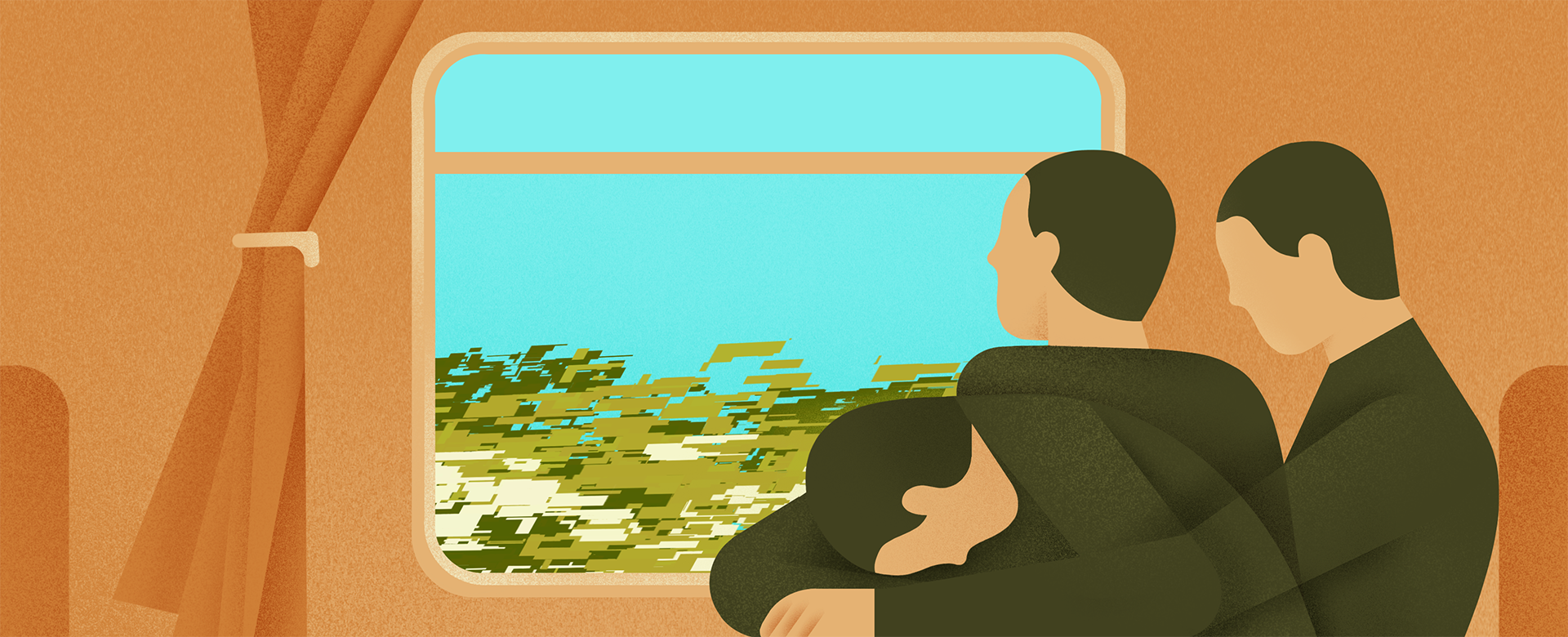
Or I can write something, an essay, a poem. Most of this year’s poems (though I’ve never written much poetry to begin with) were written on the shuttle bus between Sumy and Kyiv or on the train to Lviv. On the one hand, that’s where I rest. On the other, it’s work too. Either way, it’s on the road that I feel most in touch with myself, with my needs, my thoughts, and my feelings.
***
Yet overall, as you’ve probably gathered, I have to dissociate a lot. Facing my feelings while I’m on duty is, to put it mildly, demoralizing. And if I allow myself to regress, someone, including me, could pay for it with their life or their health. Part of our job as combat medics is not to create extra trouble, because we’re the ones who’ll have to deal with it later.
What saddened me most was getting a bunch of birthday messages, where the idea came up more than once that without me, early summer in Kyiv felt incomplete. What really saddened me was coming home and, every single time, having to choose how to spend those few precious days. Catch up on sleep. Get a medical check-up. Spend time with my loved ones. Hole up in bed. Deal with the household problems that, in my absence, have turned into a tangled mess, frustrating in its sheer immensity.
Every trip home only drains me further as my schedule grows even more packed, knowing that I can’t hug everyone I want to or spend time with them all demoralizes, and the distance between me and the people I love becomes impossible to bridge. And once again I want to go back to my basement, to the woodlice and the spiders, the constant hum of the Webasto heater, the darkness and the damp, the broken sleep, the buzz of FPV drones, the roar of glide bombs, my driver’s snoring and smacking.
Right now I’m sitting in an armchair on the dacha’s balcony. It opens up a view on a picturesque ravine on the outskirts of Sumy. From the ravine, interceptor drones with a stupid name regularly lift off. From the woods surrounding the dacha community, a machine gun regularly fires at Shahed and Molniya drones, and they crash nearby, concussing my colleagues and the kittens born to Cat, our nameless evacuee. It could have been a wonderfully restful break, but sitting on the balcony, I’m waiting for the crews I support to check in every two hours: “All ok,” “4.5.0,” “We’re good.” Just as much, I’m waiting for a call: “Teren, we’ve got one man down. Get over here.”
Translated from Ukrainian by Hanna Leliv
Illustration: Anna Gavryliuk