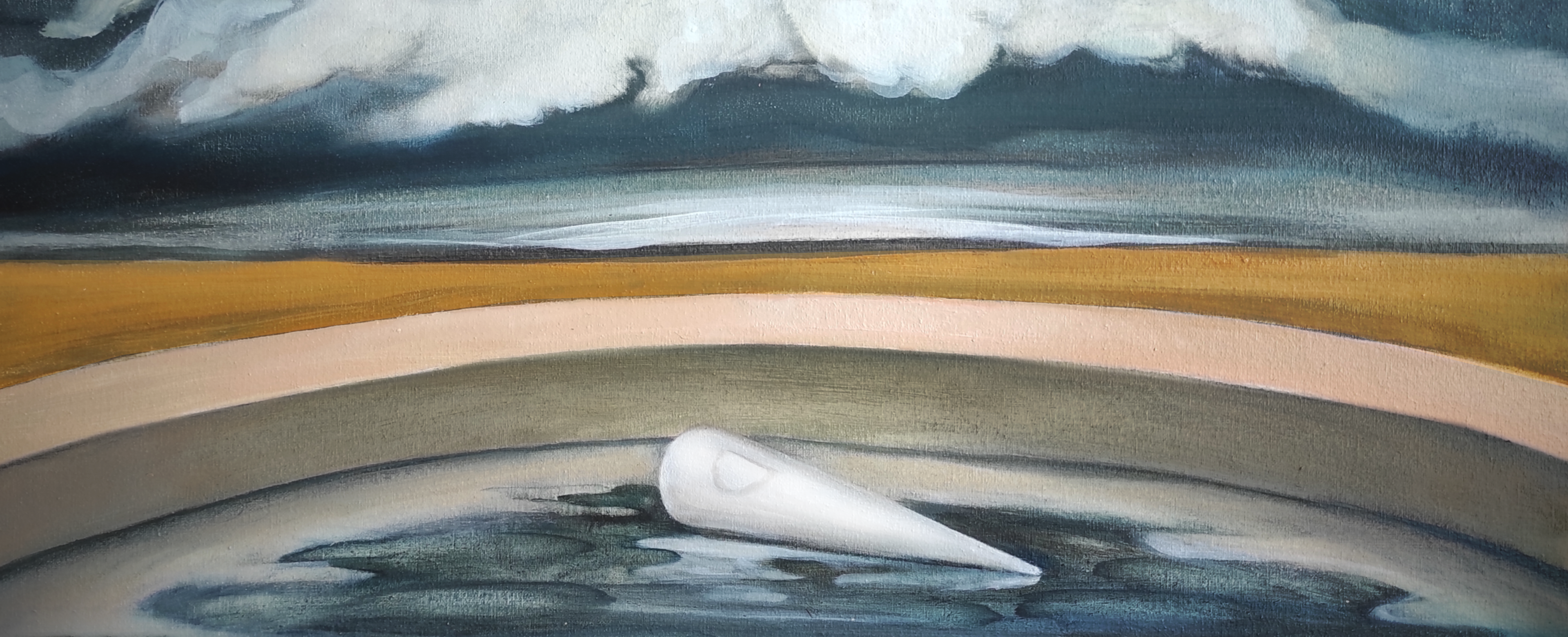
Shame on me
Shame can be both a personal feeling and a legacy shaped by displacement, war, racism, and silence. Drawing on the author's family history of migration from Japan to Brazil, this essay explores how shame can be produced and passed down across generations. It also links it to systems of colonialism and imperialism. Rather than remaining a burden, shame can become a way to expose silenced histories and rethink identity.
There was a time when I was ashamed of my Japanese heritage. I was an adolescent living in São Paulo who could barely use chopsticks and did not speak Japanese. This felt natural to me, since I believed I was not Japanese. I was born in Brazil, and I wanted to be seen as Brazilian. In a country where race profoundly shapes one’s social position, though rarely acknowledged as such, I did not want to be seen as Japanese.
I write this piece from a deeply personal position to reflect on shame as an individual affect that, in its entanglement with specific collective experiences, can become a critical lens for confronting certain historical silences produced by past and ongoing forms of violence. Writing this text is, for me, a two-way gesture, one that moves between my family’s entanglements with war and displacement and the violences unfolding today.
By tracing the afterlives of state violence and war in my own family’s history, I resist the notion that these experiences belong solely to the past, placing them instead in dialogue with the present. At the same time, attuning this to contemporary conflicts allows me to read my family’s silences as part of broader and recurring structures of violence and exclusion.
Thus, I begin with my personal experience of not taking pride in being seen as Japanese. In Brazil, being Japanese means being cast as a kind of alien, someone who will never fully belong. And in my teens, I longed to belong to the country where I was born. At the same time, being Japanese is often subsumed into the estranging category of the “Oriental,” alongside other Asian nationalities such as Chinese and Koreans. A common saying in Brazil holds that Japanese, Chinese, and Koreans are all the same. As a teenager in the 1990s, to be “Oriental” meant being seen as a nerd, an unappealing bookworm lacking standout leadership or physical prowess. For girls, it translated into images of compliant sweethearts with no breasts or curves. For boys, into images of weak, unathletic youths whom no one wanted to befriend.
To distance myself from these images, I avoided forming close friendships with people of “Oriental” background and refused to attend parties or events organized by “Oriental” groups or associations. I even withdrew from intimate relationships with relatives, especially cousins my age. Instead, I developed a deep interest in Brazilian popular culture, learned more about the history of Brazilian popular music, and became deeply involved in samba school dancing. I can say that I acquired meaningful knowledge of Brazilian culture, and I feel this is integral to who I am. Yet, I myself never felt I was “more” Brazilian afterwards. And in the eyes of much of Brazilian society, despite all my efforts to be Brazilian, I remained merely a “different kind of Japanese.”
It took me a long time to revisit this first sense of shame. I was only able to do so after spending years researching the presence of international migrants in São Paulo, first focusing on the lives of those born in Bolivia, Paraguay, South Korea, and China. Then, it took me another lengthy period to finally turn to the meanings of Japanese migration to Brazil as a subject of inquiry. I learned more about the historical conditions under which my grandparents came to Brazil, and I gradually realized how that first sense of shame, the denial of my own inheritance, was intimately connected to my grandparents' and parents’ own sense of shame. It was unsettling to trace this unsuspected inheritance.
My maternal grandparents left Japan in the 1920s, when their family's small plots of land in Ehime and Hokkaido could no longer sustain a household filled with many siblings and their respective nuclear families. My paternal grandparents, along with my father, departed later from Wakayama, during the difficult years following the end of World War II. In both cases, they carried the weight of sustaining their respective family’s honor in times when it was barely possible to survive. Within their own families, they had little place and were regarded as a burden.
Meanwhile, for the Japanese government, they were demographically considered a surplus population, a problem that could be alleviated through migration policies promoting mass resettlement abroad. As already devalued subjects, they became emigrants, carrying with them the quiet shame of not having been able to remain in their own country. They all departed with the hope of one day returning to Japan with enough wealth to redeem the shame of having left as second-class citizens.
However, in Brazil, they were further disenfranchised by a society that, drawing on western forms of racialization, came to see them as a distinct and inferior population, as “yellow people.” During World War II, this subalternization deepened dramatically when Brazil joined the Allied side and issued a series of decrees prohibiting Japanese migrants from speaking their native language in public, gathering in groups, or traveling without official authorization. The government also expropriated the assets and properties of Japanese companies operating in the country.
For my maternal grandparents, and for my mother and her siblings, this was the moment when, once branded a “yellow peril,” my grandfather moved the shrine of the family ancestors from the living room to the bedroom, while my grandmother hurried the daughters to church. From then on, none of the children could attend Japanese lessons anymore. As for my paternal grandparents and my father, who migrated to Brazil after World War II, this aftermath took the form of a forceful pressure to assimilate. They were no longer overtly labelled “yellow,” yet they remained inscribed as “permanent foreigners,” even as they learned Portuguese and conformed to Brazilian customs and laws.
From this double process of subalternization shaping my family’s trajectories, in Japan and in Brazil, I now understand that the shame I once felt as a teenager is a transformed inheritance of the shame my predecessors bore in the face of historical events that were later silenced. To this day, these events have not been fully acknowledged in Japan or Brazil. They remain suppressed from their respective national imaginaries. I relate this process to what Michel-Rolph Trouillot calls “silencing the past.”
Not only were these events collectively and institutionally erased from the public consciousness, but also from the memory of families of Japanese migrants and their descendants in Brazil. On one hand, many first-generation migrants decided not to share these traumatic experiences of the past, since they only bring what they believe to be dishonor and humiliation. As they pass away, so does the memory of these experiences. On the other hand, second- and third-generation children like me do not often question, for instance, why we do not speak Japanese.
It was no accident that our families let their language fade in Brazil. In the effort to belong, they traded words for silence, hoping that showing willingness to integrate would soften the edges of a hostile world. Thus, shame has sustained this silence across generations of families of Japanese heritage in Brazil. Yet silence is not absolute void, it is a low-level interference, like a transmission that cannot fully emerge. What was not said did not disappear, it returned instead as a sort of distortion, never erasing completely what it seeks to hide.
For those of us who inherit such silences, absence becomes another kind of memory that does not hold a coherent narrative, but it is a fragile field of partial transmissions, shaped as much by interruption as by what could not be spoken and refuses to disappear. In exploring these silences within my own family, I have reflected on the complex and uneasy forms of belonging that come with inheriting troubled histories and the shame underpinning them.
My father was born in Japan and migrated to Brazil as a child. In the 1990s, after spending nearly his entire life in Brazil, he returned to Japan as a dekasegi, a temporary laborer in a manufacturing plant, only to discover that he was no longer regarded as Japanese there. Inheriting his father’s, my grandfather’s, shame of not returning in wealth, he was placed together with other foreign workers. Although he never renounced his Japanese citizenship, he chose to spend the rest of his life in Brazil.
I, on the other hand, was born in Brazil, but in Brazil, I am often seen as Japanese. I am not allowed to be fully Brazilian, nor can I ever be Japanese; in Japan, I am surely not regarded as such, especially since I do not even speak the language. The shame of holding a Japanese heritage, I have already described above, but knowing that this feeling is actually founded on overlapping histories of war and violence also changed the way I consider Brazil. My father and I, therefore, share this experience of not fully belonging anywhere. Both of us were stripped of the possibility of relying on a clear identity.
As a scholar of migration studies in Brazil, I learned from interlocutors from countries such as Bolivia, Paraguay, China, and South Korea living in the city of São Paulo that it is possible to hold complex forms of belonging that go beyond a fixed notion of “identity.” Through their life trajectories, they have shown me, instead, that it is possible to think in terms of “immensity,” in which belonging is an ever-going process of life transformation and subjective experimentation that transcends any form of ethnic or national categorization. It is through their encouraging examples that I allow myself to be “immense” as well, existing without necessarily being either Brazilian or Japanese.
However, as a subject inheriting silenced histories, to be immense and reinvent myself in new terms, I also have to be “responsible for the histories I inherit,” just as the author Gabriele Schwab exhorts all those who in any way have ties with nations that perpetrated historical violence.
To take responsibility for the silences I have inherited, I must recognize Japan’s imperial ambitions and Brazil’s nation-building aspirations during the 19th and 20th centuries. In both contexts, modernity produced distinct expressions of the coloniality of power, a perspective inspired by the works of Walter Mignolo and Aníbal Quijano. In Japan, the same “civilizing” efforts that subalternized my grandparents’ families as surplus population also played out in the wartime campaigns to “civilize” other nations across East and Southeast Asia and the Pacific. In Brazil, the same racial framework that marked my grandparents’ families as “yellow” also served to justify the discrimination against Afro-descendant populations and the genocide of Indigenous peoples in the name of becoming a white and “civilized nation.”
To take responsibility for these histories, I must be mindful not only of the violence inflicted upon my own family, but also of the systemic violence endured by other peoples and groups; those affected, in very different ways, by the shifting manifestations of imperialism and colonialism. As the scholar Michael Rothberg urges us to reflect, through his idea of “multidirectional memory,” we should not compare our wounded histories in competition over which is most painful. So, I take responsibility for the histories I inherited by developing responsibility as response-ability.
While responsibility often implies obligation, duty, or blame for past actions, response-ability, in the sense of Donna Haraway's formulation, refers to our capacity to respond thoughtfully, choosing how we engage with what confronts us. In this vein, my response-ability impels me to stand in solidarity with those affected by the violent actions of Japanese forces in East and Southeast Asia and the Pacific, and with those affected by the racism and violence of Brazilian authorities and society.
For this reason, I am in solidarity with the histories of the “comfort women” forcibly conscripted into sexual slavery, particularly the Korean; I am in solidarity with the histories of Chinese civilians subjected to massacres such as the Nanjing massacre and the victims of Unit 731's biological experiments; the histories of the Filipino communities devastated by brutal occupation and the Manila massacre; the histories of the Indonesian forced laborers and communities under harsh colonial rule; the histories of the Pacific Islander communities whose lands became battlegrounds and who suffered displacement, violence, and exploitation. In Brazil, I extend my solidarity to the originary peoples subjected to genocide and land theft, Afro-Brazilians who endured centuries of slavery and continue to face structural racism and police brutality, and other migrant communities who have experienced discrimination and marginalization.
My efforts to build solidarity align with the notion of “thick solidarity,” which Roseann Liu and Savannah Shange describe as a deep, complex connection built on recognizing and honoring the unique, incommensurable experiences of different subalternized groups without pretending to fully share them. It moves beyond simplistic empathy to value each group's distinct struggles, creating powerful, messy, yet resilient alliances for justice.
In this movement, I seek to reconfigure the shame that my family and I have carried across generations. Rather than approaching shame as a paralyzing sentiment that leads to silencing, I want to transform it into an opening, an invitation to interrogate the webs of historical and structural violence that produce it.
As James Baldwin urges us to reconsider in his book The Fire Next Time, shame is never a private matter, since it is forged in unequal relations of power, recognition, and exclusion. In this way, to attend to shame is to trace its conditions of possibility, to ask how it is made, and who it serves. In doing so, perhaps shame can be displaced from a burden silently borne, and be made into a critical resource: one that allows us to name violence, to unsettle inherited hierarchies, and to imagine other forms of belonging not predicated on exclusion.
In exploring this critical dimension of shame, and drawing on Eve Sedgwick’s notion of its performativity, I understand shame not as a closed or self-contained affect, but as an open and unfinished process. If shame is this transformative field of resonances in which meaning is carried unevenly, between the self and the collective life, always at risk of distortion, what has been inherited as a burden may become a site of articulation. At this sensitive point, silenced histories can begin to surface and the conditions that produced them be critically engaged.
In this line, solidarity emerges not as identification, but as an attentive practice, one that listens across distances, recognizes uneven vulnerabilities, and remains accountable to how past and present violences continue to shape possibilities of belonging. I hope this may resonate with other experiences of inherited silence, where the weight of unspoken histories continues to shape how people inhabit belonging, memory, and loss across generations.
Illustration: Nina Savenko