Yesteryear: the show will not go on
Yesteryear, the 2026 bestselling novel by American author Caro Claire Burke is a time-machine story about an online “tradwife” influencer who suddenly wakes up in the 19th century. Her conservative, pseudo-nostalgic view of gender roles collides with the harsh realities of the past. The novel also exposes the deep clash between our real lives and the digital personae we create online.
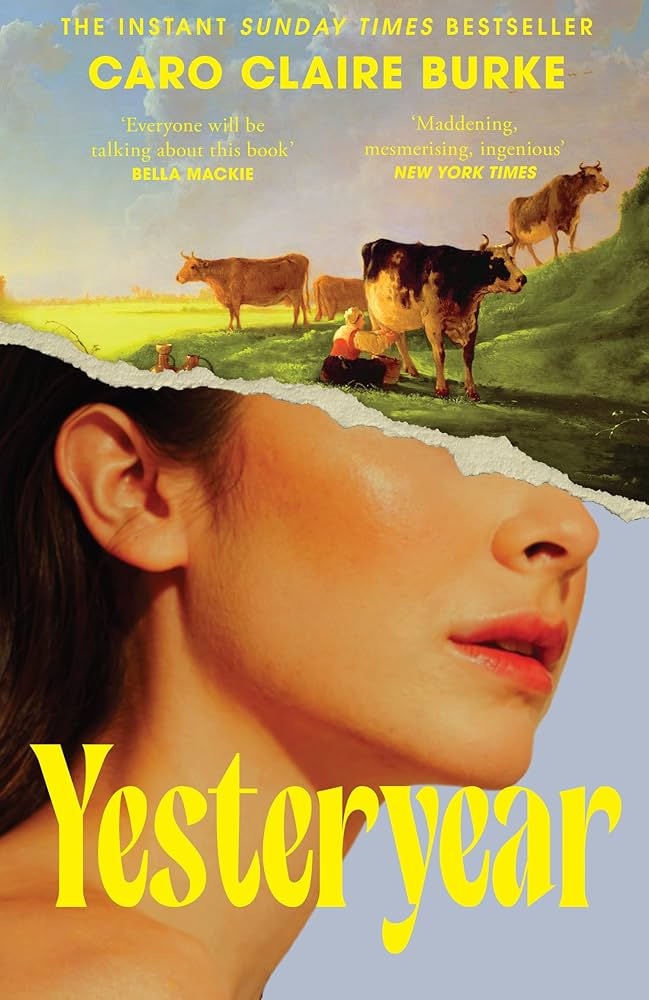
What would happen if people who romanticize the past found themselves thrown into it? That’s exactly what happens to Natalie, the main protagonist of Caro Claire Burke’s 2026 novel Yesteryear. Natalie suddenly wakes up in the year 1855 and is far from happy, which is hardly surprising: the 2026 Natalie is a “tradwife” social media influencer. Burke’s novel mixes satire and suspense: stranded in 1855, Natalie has to live the traditional life she once glamorized on her blog but never actually experienced.
The story unfolds across several timelines: the present, 1855, and the future. The past partly mirrors the present, and partly distorts it. Natalie is still in her own house, but it is decorated differently; her children look like her and her husband Caleb, but they are definitely not her own; Caleb looks like an aged version of himself. The location is the same; the era is different. Natalie tries to figure out what happened, and, above all, she wants to return to the present.
The buzz around this novel built up even before it was published. Movie studios were already competing for the film rights. Anne Hathaway was set to both produce the film and star in it, which stirred even greater interest in the forthcoming book. The publisher put a significant budget into promoting the novel, expecting it to succeed with readers. Where did that confidence come from? Burke has closely observed the real-life phenomenon of “tradwives”, who trigger strong and polarized emotional reactions among audiences. Do these women really live the way they appear on social media? Do these bloggers even believe in the values they promote? Burke says a mix of fascination and revulsion toward “tradwives” prompted her to write the novel. The book echoes her distrust of such influencers and is also marked by a dose of schadenfreude: let the main character, with her conservative views, live for a while in her cherished past.
In the opening pages of the novel, Natalie reflects on how perfect her life is and how grateful she is to God. We meet her family: her daughters, who look like her, her sons, who look like her husband, and her employees, who are like family to her. Natalie regards herself as a “flawless Christian woman”, “the mother every woman wanted to be, and “the wife every man wanted to come home to.” She describes herself more as an idea than as a specific person. After all, this idyll has been carefully constructed for the sake of millions of outside observers.
Natalie is an unreliable narrator: she seems way too happy, way too energetic. Her manner of speech betrays her almost immediately: her inner monologues, scathing and ironic, are out of tune with the image she builds on social media. Aware that she is being watched, Natalie wants to look perfect — before God, before her followers, her employees, and her family.
Natalie partly takes that desire from her mother. Exhausted after giving birth, she wonders how her mother managed to handle a job and household chores while raising two children. Her mother says she simply imagined an audience watching and encouraging her. Like her mother, Natalie imagines a response to her actions, but it is not approval. It is the reaction of “Bad Women”, her label for emancipated women who criticize her blog posts celebrating traditionalist ideas about women’s role. Often, they question whether the life Natalie shows on her blog is truthful at all. Natalie builds her identity in opposition to “Bad Women”, so she must prove she has the upper hand: her life has to appear better than theirs.
Natalie first meets “Bad Women” at Harvard. She enrolled at that elite university not only out of ambition but also because she wanted to study far from home. In her conservative town, she stood out among other women for her lack of gentleness and extraversion. On the university campus, however, Natalie again feels she doesn’t fit in. Her peers are much more liberal than she is, and Natalie either cannot or will not get along with them. She judges them. She believes these women are bitter at the entire world and refuse to live the way their mothers and grandmothers did. Her obvious social ambition hardly fits with the traditionalist values she professes, but she will never acknowledge that women can be discriminated against, because that would mean acknowledging her own vulnerability.
A performance of the perfect wife and mother needs a matching husband, so Caleb must be a “perfect husband” as well. Yet he is not masculine enough, he “still wore his masculinity so roughly and unnaturally, as if it were an ill-fitting sweater [Natalie] had forced over his head.” When Caleb wants to become a kindergarten teacher, Natalie sees this as an obstacle to the “respectable life” she dreams of: a man in a stereotypically feminine job will neither meet outside expectations nor command respect. At the same time, Natalie admits their marriage doesn’t conform to traditional gender roles. “Suddenly it was so obvious: Caleb should’ve been born a woman, and I should’ve been born a man.”
As an exemplary wife and mother, Natalie needs other people’s gaze. Her femininity is a performance for an audience. Social media gives her, as an influencer, a controlled environment where she can choose what to show and how. Her carefully thought-out online presence goes hand in hand with distancing herself from potentially unpleasant real-life experiences. This is why the researcher Zoë Hu calls fantasies about “traditional life” agoraphobic.
Yesteryear Ranch, which Natalie’s family buys once she debuts as a blogger, is also an agoraphobic idyll, a safe space. Pretending to live a perfect life is easier at a distance, too. One day Natalie bumps into one of her followers at a supermarket and ruins her social media image with awkward comments that expose her imperfection. Later she compares her online and real selves, and the real one comes off worse.
Choice is an important theme in the novel. Burke does not strip the protagonist of agency nor justify her behavior solely by her environment. Natalie’s decisions are shaped by outside influence as much as by personal choice. Her sister Abigail, for example, was brought up in the same manner and in the same environment, yet she refuses to stay in an unhappy marriage. Their mother questions her own beliefs and tries to be honest not only with her daughters but with herself. Natalie has always had the chance to act differently, but she actively chooses her path.
The content Natalie publishes is also her own choice. These seemingly innocent photos of her ranch and her family, with feel-good captions, do not exist in a political vacuum. The lifestyle “tradwives” romanticize echoes conservative and far right beliefs. When Caleb mentions Natalie’s Instagram account on manosphere forums, the reaction there is telling: “This is the kind of woman who is going to get our country back on track. None of that city-woman, equality-of-the-sexes bullshit. No. This is ‘a wholesome, traditional Aryan wife.’”
Natalie tries to stay out of politics and is not exactly eager to help her father-in-law, a senator, during his election campaign. But he sees her online popularity as a powerful instrument and her audience as potential voters. He quotes her seemingly apolitical posts in his speeches, and they serve his political goal.
The aesthetics that “tradwives” draw on is also deeply politicized, it is modeled on the 1950s. That period saw white American women pushed out of the workforce after their husbands returned from the war, while the media of the time actively promoted the image of the perfect, happy housewife (who arguably never existed). “Tradwives” are a kind of extension of that 1950s ideal, only their agency is not taken away from them. They give it up voluntarily, and not for free. The monetization of submission is one reason “tradwives” provoke such mixed reactions: their performance always has a concealed business motive.
For Burke, the very idea of selling submission feels ironic. At the same time, in an interview, she says she hasn’t invented anything new in American literature. She names Margaret Atwood’s The Handmaid’s Tale and Ira Levin’s The Stepford Wives as two examples. It is curious, though, that in 2025–2026 a whole range of publications portrayed the “tradwife” as a kind of trope. These include three novels by Saratoga Schaefer, Sarah Langan, and Michelle Brandon, all titled Trad Wife, Maia Chance’s The Ravine, and Jo Piazza’s Everyone Is Lying to You. They are mostly genre fiction, primarily horror and thrillers.
Books of this type, where satire plays a significant role, owe their popularity to the political climate in the United States. Mentions of actual “tradwives” in these texts are a wink at readers who most probably know who is being referred to. Often, readers have made up their minds about female characters before they even read the book. Their dislike of real-life bloggers is easily transferred onto the protagonists.
All these texts share another thing: a fascination with the dissonance between how characters want to appear and who they actually are. In plots like these, something sinister lurks behind fake perfection. Even in Yesteryear, where the protagonist-slash-narrator tries to convince readers that her life is exemplary, the mention of a trial related to violence on the ranch surfaces almost immediately (Who’s done it?). So these novels mostly meet readers’ expectations: the female protagonists are indeed hiding something.
If “tradwives” are primarily an American phenomenon, turning yourself and your family into content for online observers is far more universal. Natalie’s eldest daughter, Clementine, is the first of the children to ask her mother not to film her. Yet no one in the family asks the children for their opinions. Natalie looks at her family dynamics through the eyes of an outside observer. Even after discovering that Caleb has cheated on her, she keeps wondering how she can present this to her followers in a way that would win their sympathy. What can’t win sympathy stays out of the frame: farm animals dying from neglect, chemicals in allegedly organic vegetables. The ranch’s dozens of employees and two nannies don’t fit the lifestyle Natalie wants to project either. Everything needs to be inspiring and seemingly accessible.
If at first Natalie’s performance was aimed at viewers, a turning point comes when it becomes a goal in itself. After a scandal, Natalie and Caleb isolate themselves completely from the outside world, and Natalie deletes her blog. Now they are trying to convince themselves, rather than others, that they are a perfect couple and perfect parents. Yet even with the audience gone, their children still pay a high price for it, and will for years to come. The older children were exposed online to millions of strangers, while the younger ones are cut off from the rest of humanity entirely.
Natalie will not repent or acknowledge her impact on her loved ones. Resistant as she is to change, she is not a static character: she actively chooses to keep pretending, whatever the cost to others. Her former producer, Shannon, writes in her resignation letter that Natalie is not so much a bad person as a lost one. Natalie’s choices could be explained in many ways, yet what truly matters is that her children understand how horribly their parents have acted. The show will not go on.
Translated from Ukrainian by Hanna Leliv