Moving through motherhood
What does being a mother feel like from the inside? How is motherhood really experienced? This essay reaches for answers in a novel (The Heart, by Malin Kivelä), a memoir-essay (The Argonauts, by Maggie Nelson), and two photoseries, by Jenny Lewis and Lydia Goldblatt. They all resist the idea of a single, universal experience.
My generation came of age in the 2010s, when Ukrainian society still thought of a woman primarily as a wife and mother. Motherhood was routinely perceived as a biological need, much like the need for water.
In recent years, I’ve looked for a point of entry into comprehending motherhood, through literature, art, social media, and conversations. I have discovered many different experiences: sometimes painful, sometimes joyful, sometimes altogether unexpected. Like puberty, motherhood knocks some off their feet but passes almost imperceptibly for others; it’s an individual and always unpredictable experience.
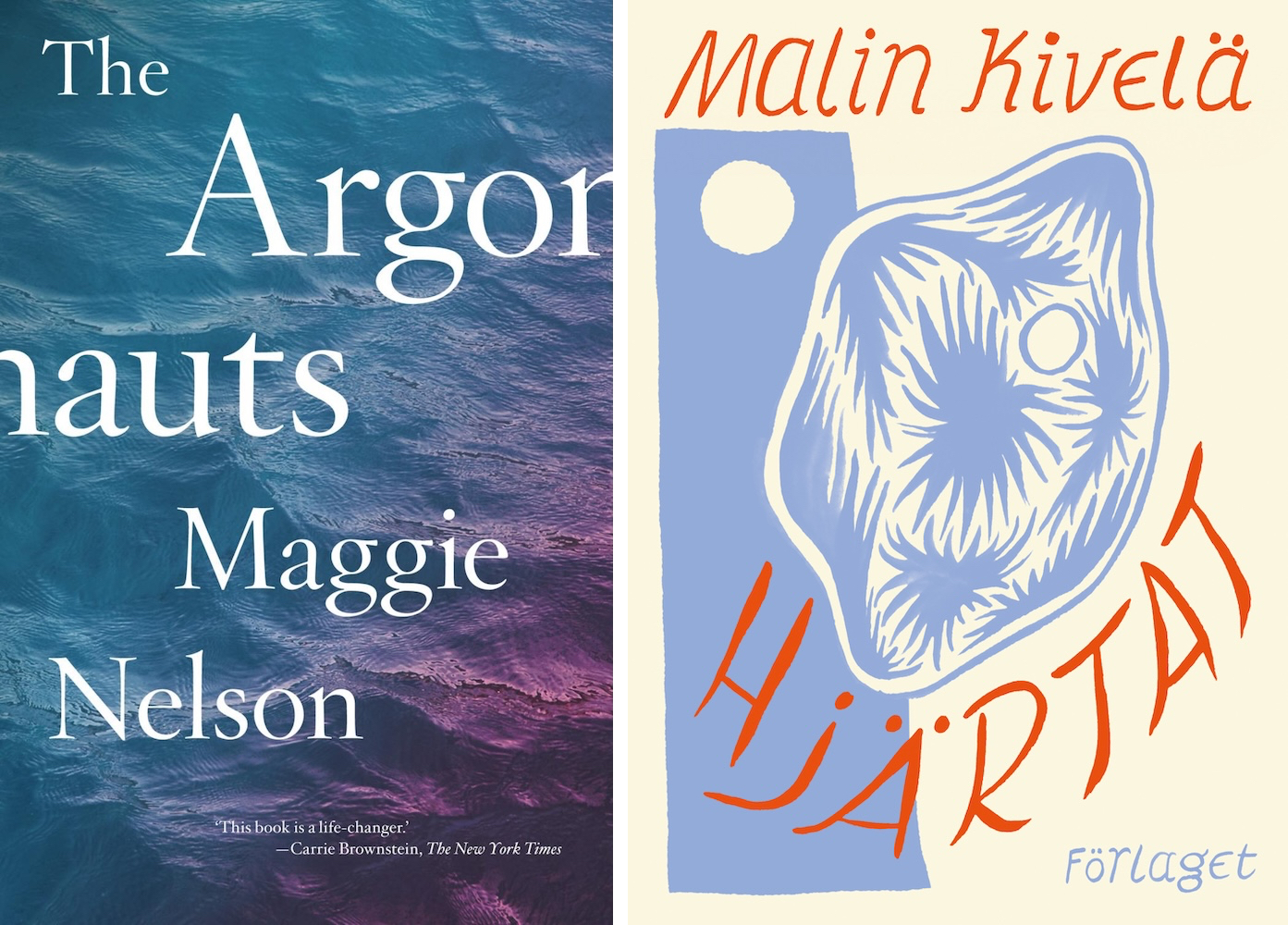
Two books and two photo series helped me think some of this through. The books are Hjärtat (The Heart, 2019), by the Finnish writer Malin Kivelä, and The Argonauts (2015) by the American writer Maggie Nelson. The photographic works are by British photographers Jenny Lewis and Lydia Goldblatt.
In all of these works, I found something important: examples of comprehending and experiencing motherhood as a process in which a woman does not disappear and does not become secondary. Above all in her own attention, though not only there, a woman’s desires, fears, sensations, and body remain central, as does the long, complicated process of distancing herself from who she once was, and approaching who she is becoming. All these authors offer complex, unconventional ways of talking about motherhood. Without trying to define it once and for all, they leave room for contradictions: longing and joy, closeness and loneliness, self-abnegation and self-expression, including sexual.
Hjärtat (The Heart), a novel by Finnish writer Malin Kivelä, is partly autobiographical. It tells the story of a woman whose baby was born with a heart defect. Mother and child spend their first days together in the hospital waiting for surgery. The narrator compares herself to a vessel through which time flows. It flows at different speeds, which determine the rhythm of the story.
Great attention is paid to details bordering on anxiety: we read about the mother’s feelings, about objects in the hospital room, water dripping from a tea bag, or the way water streams from a shower, and we see the view outside the window. We follow the mother’s gaze lingering on objects, as if trying to hold on to the present moment. We feel her sense of fragility and radical loneliness.
As she waits, there is a great deal of sleep, and a great deal of wakefulness. Someone is always with her in the room, medical staff, her parents, her friends, her partner. But in her thoughts she keeps returning to her own intimacy and her relationship with the baby. Other people can run tests, offer explanations, sit with her, but they can never take her place, share her condition, or loosen, even for a moment, the exhausting, relentless pull of paying attention to her baby. In Kivelä’s novel, motherhood is an incredibly lonely and self-contained experience, walled up in the body and mind of the woman experiencing it.
In her memoir-essay The Argonauts, the American writer Maggie Nelson looks at social notions that seek to classify, standardize, and simplify motherhood. Here, we step away from the private feelings of a mother finding herself isolated from the outside world. Nelson’s book points to a paradox: motherhood, a most fundamental human process, remains one of the most heavily policed and stigmatized. Motherhood is too varied to be universalized, too intimate to speak of aloud, too natural to speak of at all. And yet also too socially significant for women to be left in peace.
Nelson recounts her experience as a queer person through pregnancy, labor, and motherhood. This experience is not abstract; it makes itself felt all at once in her mind, body, sexuality – that is, everything that’s usually left out of the way motherhood is described. She insists on freedom: in reproductive rights, in corporeality, in maternal feelings, on the possibility of developing her own approach and becoming an agent of this process rather than its function. For Nelson, it is crucial to have not merely freedom of choice, but the freedom to not fit into the molds this choice comes with. Again and again, she accepts this experience in all its contradiction and ambiguity, without forcing herself to decide what exactly she “must” feel as a mother.
At the beginning of the book, Nelson raises a very timely question that has been brewing for decades: why has such an individual, deep, transformative experience – the act of giving birth to another person from your own body – become in social imagination a necessity and a marker of a woman’s “normalcy”? At one point, Nelson describes the considerable sexual arousal she felt while breastfeeding her son. She immediately cites a passage from a popular childcare book explaining that after birth a woman is basically “hormonal soup,” and that since breastfeeding activates the same hormones as sex, it’s no wonder the body gets confused. For Nelson, this only raises further questions: “But how can it be a mix-up, if it’s the same hormones? How does one go about partitioning one sexual feeling off from another, presumably more ‘real’ sexual feeling? Or, more to the point, why the partition? It isn’t like a love affair. It is a love affair.”
With this example, Nelson seeks less to provoke than to question the very need to assess whether pleasure is genuine and appropriate, and to classify it. She leads readers down an unexpected path of sensation and interaction, liberating the woman’s body from the strict regimen and functionality it “must” take on after childbirth. She restores to it contradiction, sensuality, desire.
Photography offers a more direct way of talking about motherhood. I found two photo series that explore the subject unconventionally.
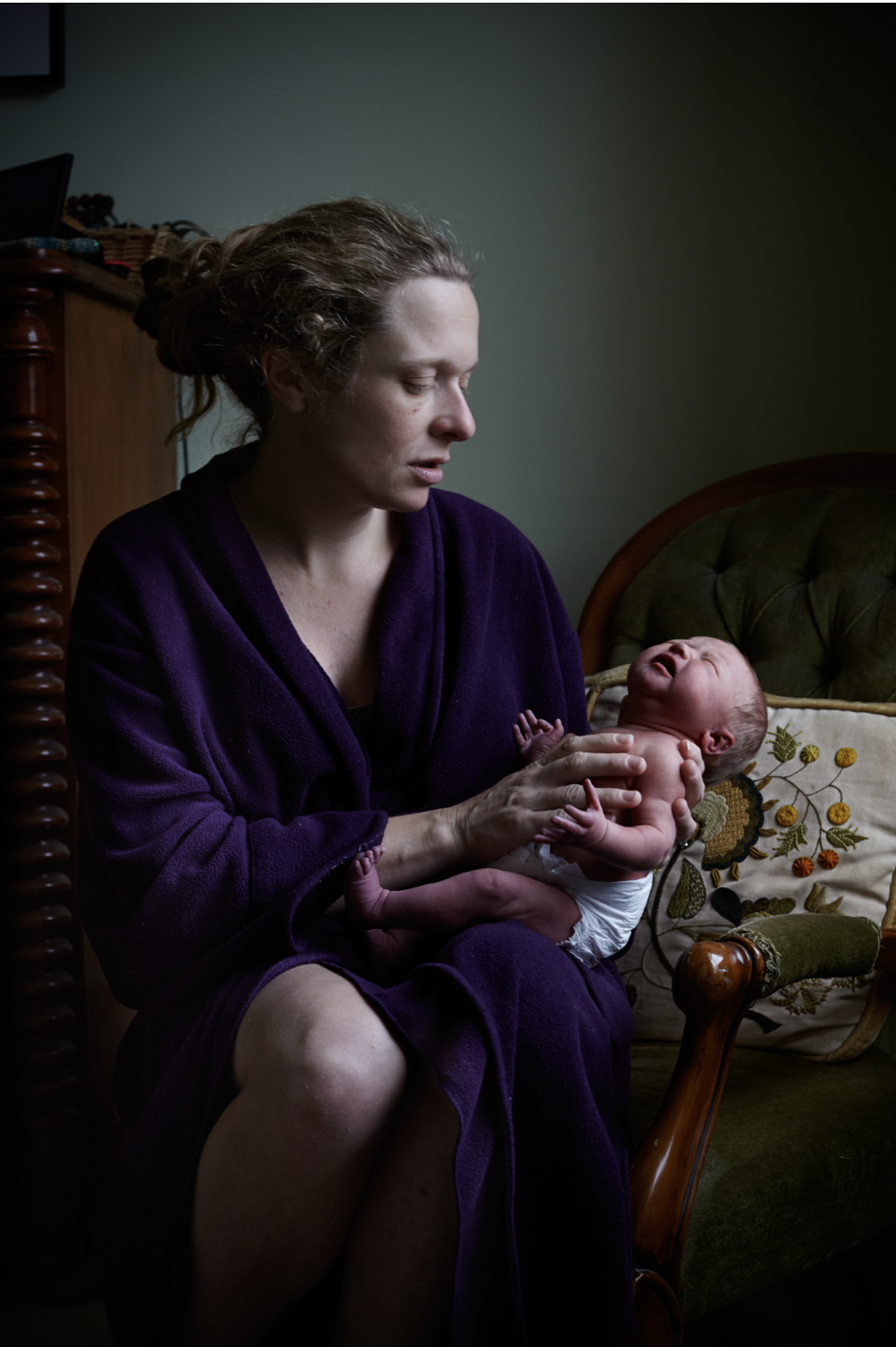
Jenny Lewis spent five years putting up flyers around her East London neighborhood, looking for volunteers who’d accept being photographed: women willing to invite her into their home and let her portray them with their newborn baby within the first twenty-four hours of their shared life. This is how her project One Day Young, which included portraits of 140 women, came into being. A book featuring a selection of forty photographs followed in 2015.
These images are quite straightforward: a woman with a baby in her arms sits or stands before the camera. Tired or smiling, the women in the photographs assert nothing about motherhood, they neither explain nor attempt to define it.
What matters is that the photographer was invited into their personal space. It is not a gaze from the outside, it takes shape in an atmosphere of empathy, trust, and equality. What could have been an intrusion, the transformation of an intimate moment into a spectacle, is instead a shared decision to be seen exactly in this specific way. On its own, each photograph could sit among dozen others in a family album, but together, the portraits create a story about choice and agency.
Lewis described her One Day Young series as a counterargument to the notion of motherhood as a painful ordeal. She shows motherhood as joy, love, and triumph. Looking at these photos, you hesitate to contradict her vision.
Another British photographer, Lydia Goldblatt, created Fugue, a project at the intersection of several radical life changes: the Covid lockdown, her own new experience of motherhood, and the loss of her mother. The photos in this series vary widely; some are abstract, others nearly weightless. There are barely noticeable reflections in a window, snippets of nature, scraps of everyday life, portraits of her children and partner, but almost never the author herself. Quiet, repetitive everyday routines that feel like a loop and unfold within the limited space of just a few rooms in the house and a few surrounding streets. Slipping away from them, Goldblatt speaks of motherhood as a constant pulling away and returning.
In visual art, just as elsewhere, the image of a mother often hovers somewhere between a picture of love and care and a portrayal of self-sacrifice bordering on the sacrosanct. Goldblatt avoids these extremes, trying to capture the experience of motherhood in its instability and incompleteness, in a place where a woman changes but never vanishes.
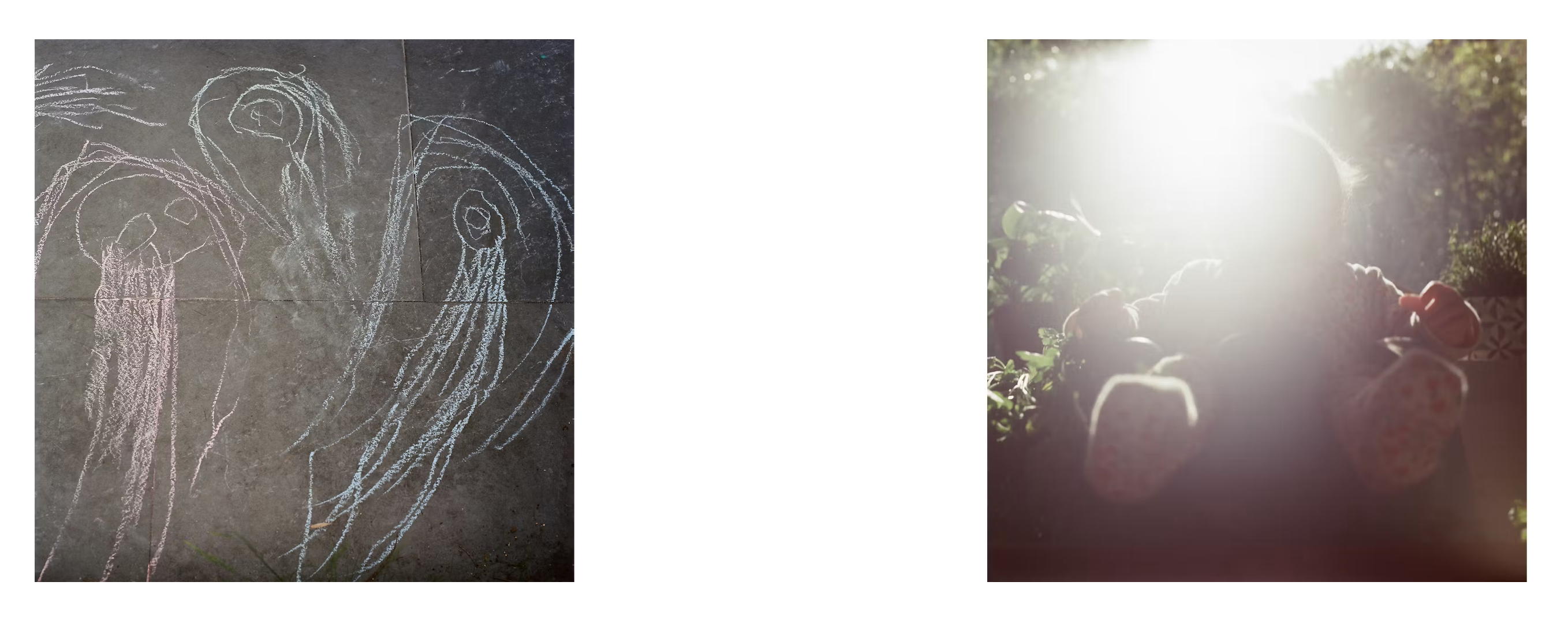
Goldblatt offers a rare form of empathy: for a woman who is not fighting with all her might for her place in the family but seeks to carve out a space of her own while caring for others. This project does not pit the roles against one another; it lets them coexist, leaving room for grief, exhaustion, tenderness, and loneliness. Goldblatt says, “I wanted to be honest about what I was struggling with, about the feelings of claustrophobia and rage, as much as intimacy and love. These are feelings so often hidden by mothers, so often silenced as unacceptable.”
There are surely more conversations around motherhood now, but not always enough room for the complexity of the experience itself. There is still too much focus on what a mother should be like: her behavior, her appearance, how well she fits the role. Too little space remains for comprehending what actually happens to her: to her body, identity, sexuality, loneliness, fears, desires, and sense of agency.
Translated from Ukrainian by Hanna Leliv