Swingin’ on Nothin’: dancing, community, and war
Born in Harlem, New York, in the 1920s, swing dancing crossed the ocean and found a home in Ukraine. For the author of this personal essay, it became a way of moving through the world, with music, with others, and with trust. Then came the full-scale war. Some dancers went to war, and some never returned. What remains is rhythm, memory, and homage.
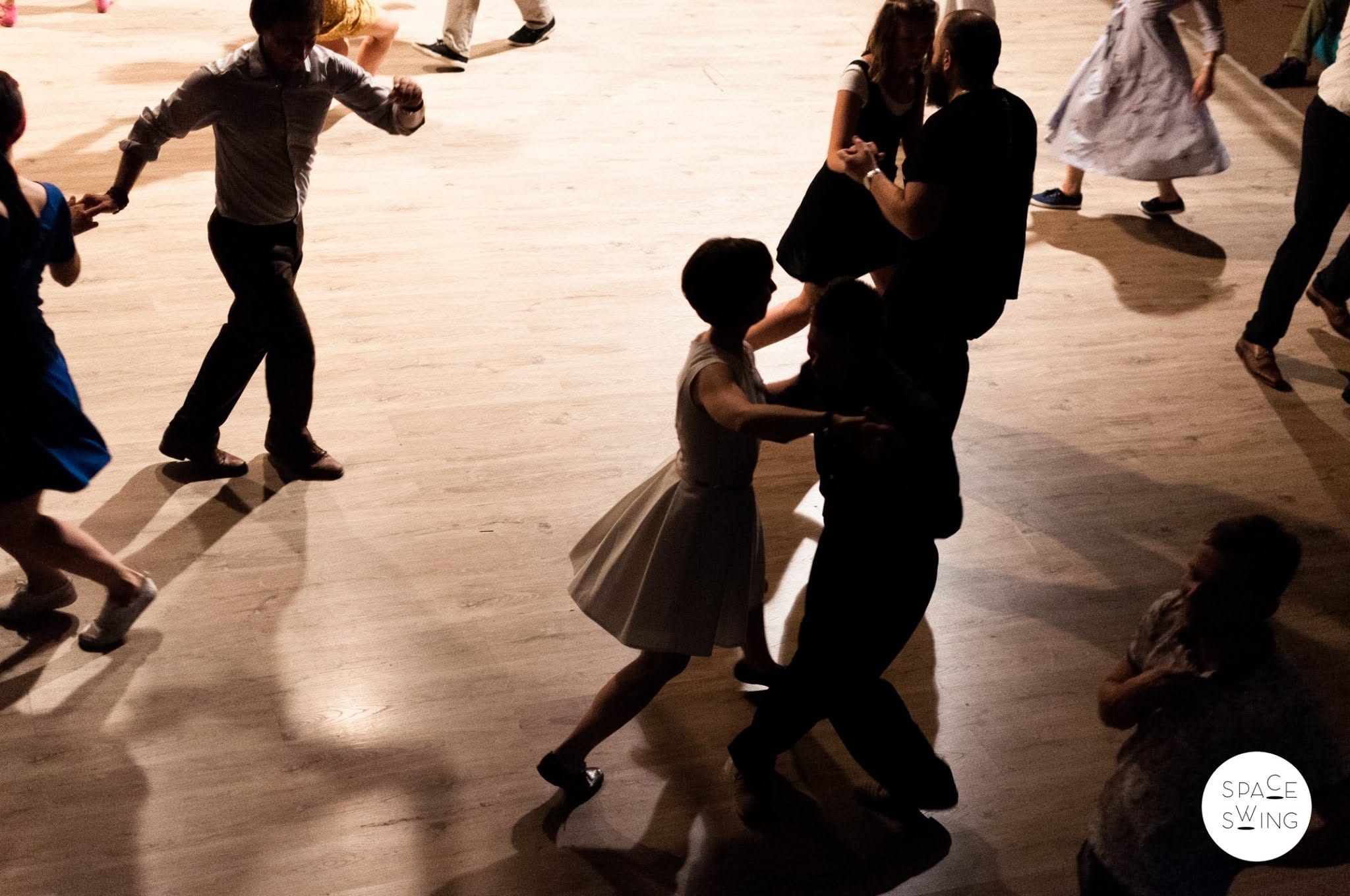
This is a photo from another life: It’s 2019, the inaugural Space Swing festival in Dnipro, and my first out-of-town dance festival. I would return the following two seasons.
The lively, acrobatic couples dance with girls in twirly skirts, today broadly known as swing, was born in Harlem, New York City, in the era of big band jazz music and made its way to Europe in the years before World War II. By the early 2000s Ukrainians were part of the dance’s worldwide revival.
Ukrainians take their swing dance seriously (like everything else they do): learning technique, studying the dance’s history, dressing appropriately, and throwing parties with live music that last into the wee hours of morning. When I discovered this community in Kyiv in the late 20teens I was hooked.
Dancing for me was about pleasure, the pleasure of moving through space, changing direction, tempting and avoiding collision, your senses aroused to catch all the events happening in several dimensions at once. The speed and momentum were thrilling.
The invisible common ground between you and your partner, shared by everyone in the room, is rhythm: the rhythm of the music, the rhythm in your body and in your partner’s. Synchronicity feels like magic—when you hit the beat or match your partner’s moves exactly without planning ahead. You are surprised by your own readiness to be exactly where you need to be in this moment.
We trained in various techniques to move in rhythm, tune to our partners, fulfill our respective roles (lead / follow) to make the partnership work. Connection was more a matter of physics than psychology: remember to keep your lower abdomen, your center of gravity, turned toward your partner’s no matter what moves you’re dancing.
The way the dance structures your physical and social relationship with your partner is liberating. I could find intimate delight in a dance with somebody 20 years younger or older, man or woman, somebody else’s husband or my teacher, or swap partners every few measures.
I rarely chatted with my dance partners and I liked it that way. Nor was I all that interested in what the people in my dance community did in the outside world.
You show up to a dance to see and be seen. You get to know people gradually, first through peripheral vision, then up close. Trust and affinity grow through repeated contact. Community is a visceral phenomenon. The electric energy in the room is the result of each person’s contribution. Enjoying it is the reward for your efforts to stay connected.
I remember the first dance I went to after Russia’s full-scale invasion on a patio in Lviv in July 2022. I remember the first terrible winter when I dragged my shattered soul to Patefon, the local swing hangout in Kyiv, to listen to familiar jazz music in the company of my people dancing. I remember dancing with a young man who’d flown in from New York to train Ukrainian soldiers to fire Javelin anti-tank missiles. I remember dancing with Sasha, Maks, Sasha, Anton, Vitalik, Sasha, and Kolia: now they are scattered around Ukraine, defending us from Russia’s ongoing slaughter.
**
This winter, January 2026, I went to a small gathering at a friend’s apartment in Kyiv.
Some women and a few men from the swing dance community sit around a sandwich-laden table, sipping wine, laughing and catching up. One young man talks about how hard it is to get an appointment with the military medical commission for his obligatory annual physical while legally avoiding conscription. A young woman I used to take classes with, whose husband went missing in action during his first combat mission a couple years ago, has a new job, plus a defense-related side project she can’t discuss in detail. Our hostess is getting ready for another road trip to deliver a vehicle to friends serving outside Izium.
The taciturn young man sitting across from me looks familiar, though my memory travels slowly through the past several years of full-scale war. He’s a musician, a drummer who played at many of our large parties. I’d approached him at least once during a set break and he gently declined my invitation to dance.
Now I ask if he’s still playing music. “No,” he says, “I don’t have time for that these days.”
I nod with understanding and add that I rarely dance anymore. I’d like to, but there are always so many other urgent things to do. I’m advocating for Ukraine, promoting our culture to folks abroad, and fundraising for my friend’s military unit . . . “What’s keeping you busy?”
“Military service.”
“Oh. Wow. I didn’t know. Thank you. Are you on leave?”
“Yes.”
Upon parting, I give him an extra hug, wish him well and say with stubborn conviction, "Do zustrichi!" It’s a Ukrainian phrase that roughly means “See you soon!”
I was remembering that evening when I started writing this piece in August. A few days later a message appeared in the Ukrainian swing dance community’s Telegram chat: On August 15, 2026, Anatolii Tkach was killed defending Ukraine against the Russian invasion.
Tolik, as we called him, was the drummer of Ruky’v Briuky, a rockabilly band known throughout Ukraine and Europe. From a post by Ukrainian media outlet NV, I learned that Tolik had been serving in the 79th Separate Air Assault Brigade after joining the Armed Forces of Ukraine in July 2024.
In memory of Tolik, Yurchyk, Sasha, and Roma, bright Ukrainians with whom I had the pleasure of sharing many evenings playing with movement and rhythm.