Who laughs last, laughs best
Who gets to laugh, and who must stay silent? Croatian poet Monika Herceg grew up during the 1990s Balkan wars. Here, she explores how social class and gender shape humor. Challenging classic comedy theories, this essay asks when women finally laugh last.
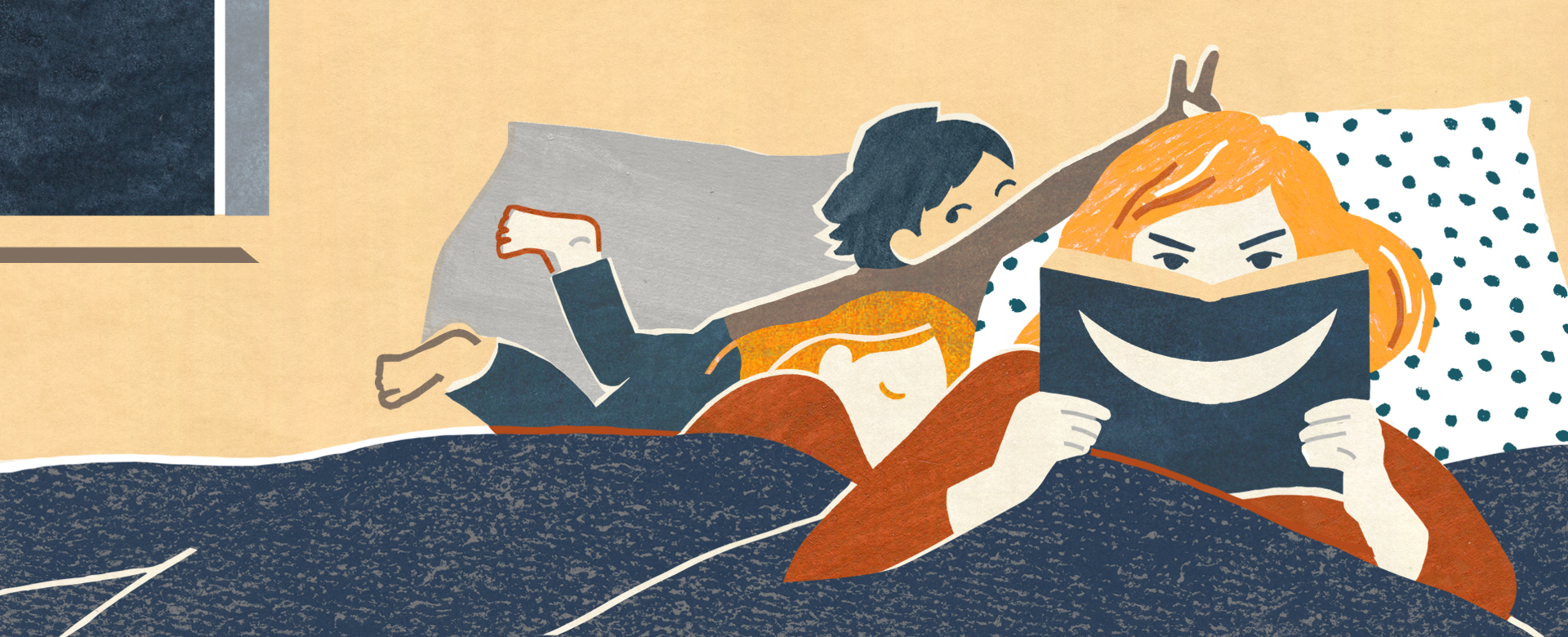
The evening has stretched on and on, and we are still nowhere near bed. Everything takes longer with children; time follows a different course through the routines of motherhood. Laughter sounds different, too, when it has to find its way through sleeplessness, exhaustion, the unending vigilance of care, through cries of “Mum!” that can come twenty times a minute. My mother tells me: Don't let them gnaw you down to the bone. She allowed us little freedom herself. She had neither the resources nor the room for it; poverty set the boundaries of her life. Even now, when she talks about her grandchildren, she insists that nobody is going to walk all over her. She has another saying, too: “Don't laugh. You'll end up crying.” My eight-year-old son is curled up beside me in bed. I still lie down with the children until they fall asleep, knowing that, in the years to come, these moments of closeness will grow fewer. Of course they will. Small human beings want to take flight; they want to leave us behind. “You have no sense of humor at all,” he tells me. “No, I don't,” I say. “But that's all right.” I accept the role he has given me. I am the serious mother who doesn't know how to make a joke. “You always tell the same ones,” he adds. “True,” I agree.
And so we fall asleep: my children, me, and my lack of a sense of humour.
At eight and nine, my son and daughter are already little satirists, full of jokes and wisecracks. Watching them, I keep coming back to the same questions. How, and when, do we cultivate humor? Who gets to laugh? What if our childhoods have been radically different? What if I never had the chance to develop a sense of humor? When, then, am I supposed to learn?
I tell my children little about my childhood, though they know we were poor, that it took us ten years to return home, that I went without so much of what they now take for granted. My parents did not look like people with much of a sense of humor. What was funny about a life without an indoor toilet, with only an outhouse? About not knowing what your children would eat the next day? My mother was the more intriguing of the two. Now and then, when she could let down her guard, we would catch her laughing. But rarely. When you are trying to feed your children on flour soup, living with an alcoholic husband who is also a war veteran with severe PTSD, and caring for frail elderly relatives, one of them an abusive old alcoholic himself, how is anyone, especially the woman on whom all that invisible physical and emotional labor falls, supposed to show a sense of humor?
And yet, when time finally made room for it, when the people who had kept her trapped died, however cruel that sounds, my mother began to reveal an astonishingly tenacious, irrepressible sense of humor. Perhaps she had carried it all along from the countryside she left at fourteen to work as a waitress, with only eight years of school behind her. As for me, I use the claim that I have no sense of humor as a little shield, smiling to myself behind it. Mine is sometimes twisted, certainly dark, and often reaches deep into the pathologies of my family. I have tended to believe that, rather than making a joke at someone else's expense, I should make myself its subject.
And immediately I stumble. Women are so often taught to laugh at themselves to put everyone else at ease, to make sure they are not taken too seriously. Self-mockery is not always freedom. Sometimes it is a form of consent to our own diminishment. Is that what I am doing, too? Where is the fine line between a woman with a sense of humor and a woman who keeps making herself smaller — diminishing her discomfort, her seriousness, her achievements, anything at all, with a joke, so that everyone around her can feel more comfortable?
Humor is shaped by class, too. I grew up in a house where the only pressing questions were what to wear and what to eat. Whatever humor there was came from the most basic things, from what lay within reach. Still, nobody could deliver a barb quite like my mother. My father did not like that one bit. Because whenever we talk about humor, we are also talking about who is allowed to be funny, and who gets to decide what is funny.
As a woman, I have always known that humor can be an instrument of oppression. Sexist jokes and misogynistic remarks are part of Balkan culture, for instance. Think about how many blonde jokes you have heard. It is the most banal example imaginable.
***
This was supposed to be a simple essay in praise of humor. Humor to carry me through dark times, to keep us afloat on the surface of deep, cold water. Humor emerging from darkness, surviving even when life becomes almost unbearably hard.
But I wouldn't be myself if I stopped at a hymn to humor. It is more complicated than that. When bombs are falling around you, when you spend the night in a shelter, sometimes you can laugh and sometimes you cannot. Sometimes you are too exhausted. There is nothing left to draw on. And sometimes a sudden flash of light. I mean that it is good when we can laugh, but it is also all right when we cannot. Humor is far more complicated than the old refrain that laughter is the best medicine. Perhaps it is. But so much depends on the conditions: so much fertile soil, so much favorable weather, to tend that small plant called humor.
For Freud, humor is one of the mind's ways of refusing to be entirely overwhelmed by misfortune. Though, whatever his contributions to psychoanalysis, I remain deeply skeptical of a man who earnestly theorized female frigidity, adding his voice to the long history of pathologizing women's sexuality.
In On Humor, the British philosopher Simon Critchley considers laughter a way of confronting our imperfections, of seeing ourselves from the outside and recognizing our own absurdity. Yes, perhaps we can recognize how ridiculous we are. Humor need not take us away from reality; it can bring reality more sharply into focus. But who can afford that kind of distance? Can a woman laugh at her circumstances while she remains trapped inside them? Can she laugh at what has humiliated her for decades? And what happens when, one day, she begins to laugh at the very thing that once demanded her obedience? How much can we laugh at our own homelessness in exile? At our own poverty?
In his essay Funny, but Not Vulgar, George Orwell calls every joke a tiny revolution: humor, he suggests, sets out to overturn the established order. He also describes a joke as a brief rebellion against virtue, one that reminds us of the indignities already imposed upon us. But what if I no longer want to be humiliated? I ask as a divorced woman, a mother whose chief possession is a mortgage with thirty years left to run, a woman who doesn't even drive. (No doubt a few jokes about women drivers have already occurred to you.)
What if some jokes are the opposite of revolutions, little guardians of the existing order? What if humor becomes an extension of violence?
Take those blonde jokes. Even if we agree to set political correctness aside, why is there no equivalent genre about handsome men, jokes in which a man's beauty supposedly implies an equally preposterous lack of intelligence? Why are women the targets of this particular kind of bad taste? Every country, I imagine, has its stock of jokes about minorities and neighbouring nations. We sustain our nationalist stories, too, by making other people smaller with crude humor.
An ex-boyfriend once also told me I had no sense of humor after mocking something I had said, not getting the joke he made. So I shall do something quite radical and draw up a list of what decent humor ought to contain: empathy, self-criticism, goodwill, and intelligence. Why should we accept anything else served up to us as funny? Why is the burden so often shifted onto women when we refuse to laugh at a plainly offensive joke?
Which brings me to Sara Ahmed and The Feminist Killjoy Handbook. Humor is very much a feminist question. Ahmed shows how women are deemed oversensitive when they refuse to laugh at an offensive joke. I'm sure you can recall several occasions when something wasn't funny to you at all: it was sexist, perhaps, or insulted someone in a thoroughly infantile way. You probably laughed anyway. You didn't want to make a fuss. Now imagine withholding that laugh and saying, “This isn't funny.” Suddenly you've spoiled everyone's appetite around the table, haven't you?
My ex could produce television shows, stand-up comedians, and pop-cultural references at will. He laughed at everything I didn't know. Yet no joke was ever permitted at his expense. I was a girl from the countryside who carried homelessness like a passport. If you begin life as a refugee and remain one until you are ten, it is hard to think of any place as a secure home. The fear that your existence might be upended never quite leaves you. None of this stirred his empathy. My habits, my fears, the limits of my experience became material for ridicule instead.
My father died when I was fifteen. My mother, who had no paid job, was left a widow with two children in a village in the middle of nowhere. I enrolled at university entirely at my own risk and worked constantly to keep myself there. I had no time to stop and laugh, not even at myself. You see where I'm going with this?
***
Sometimes I can still hear my mother's voice from childhood: “Don't laugh. You'll end up crying.” We grew up in constant fear of joy, as though laughter could only be followed by punishment, as though tears were waiting just beyond it. With my children, laughter comes like an endless shower of delight. They want things to be funny. They dig jokes out of whatever happens to them as they find their way through a complicated world they are only beginning to understand.
Learning the paths towards humor, learning what is funny, learning to laugh at ourselves — all of this takes time, perhaps the greatest resource of all. Like art, humor needs a certain amount of leisure, a certain amount of rest. And yet it can also be a form of stubborn endurance. It appears in the darkest places and allows us, for a moment, to laugh at our circumstances. I remember being little, growing into the war. Born in 1990, I grew up in those war years knowing only that there was a war somewhere and that we had no home of our own. There were no books in our house for me to read. Nobody read to me. Not once. My children now read funny comics and watch cartoons full of jokes.
If time is a luxury the poor cannot afford, along with so many other resources that make possible the experiences from which humor might grow, how much time do we need before we learn to laugh? When I was working myself into the ground to get back on my feet with two children and nobody to fall back on, I felt I had no room for humor. Sometimes I still feel that way.
Let me tell you a story that has little to do with humor, but a great deal to do with what we assume about other people. We are at an airport in northern Europe, halfway through a long journey with several connections. A fellow writer tells me that this was the first airport she ever visited with her parents as a child. She was about ten. I tell her I first flew when I was twenty-nine, already a mother of two. I was taking my children to a poetry festival. She is astonished. How is that possible? How did we travel, then? I look at her, unable to understand the question. We didn't travel. I was poor. Even Slovenia and Serbia, our neighboring countries, were places I first visited only a few years ago, on literary trips. How limited our perspectives can be. What can we possibly know, then, of someone else's sense of humor?
In On Humor, Critchley sets out three major philosophical accounts of humor: incongruity, in which laughter arises when expectation collides with reality; relief, associated with Spencer and Freud, in which humor releases psychological tension; and superiority, in which we laugh at other people's weaknesses because it makes us feel above them. Each is interesting. But what happens when a whole group is kept in a position of subordination? Who gets to laugh, and at whom? Can the unexpected ever be entirely free of context? Am I advocating the sort of political correctness that will have the privileged happily putting me on their list of difficult people, because apparently not even humor is safe territory anymore?
In Rise Up in Mirth, Emma A. Jane writes about feminist humor charged with anger, humor that can transform experiences of violence and humiliation into social criticism. In The Uses of Anger: Women Responding to Racism, Audre Lorde considers the anger of Black women and other women of color in response to racism, and the possibility of transforming that anger into a source of energy for political change.
But what if laughter is sometimes the expression of our deepest rage? What if, for a woman who has spent her life being obedient, patient, polite, a cutting joke is the first way she can finally say, “No more”?
***
I return to the children with whom I began. They are laughing so loudly, cracking so many jokes, that we can barely get through dinner. With them, I am learning to laugh out loud. Through humor my children are learning confidence and quickness of mind, but above all they are safe in their laughter. Much of my childhood was spent walking on eggshells, careful not to make anyone angry. Laughing openly at anything, let alone at someone, was almost unimaginable. Today my son and daughter can tease both me and my mother. Even she has become as playful as they are. My children challenge my authority with jokes, and they are not punished for it. They are loved.
My mother cracks jokes now, and the children and I laugh aloud with her. I once wrote a poem in praise of her, about the different life she tried to imagine for us, finding food, toys and clothes under impossible conditions. In one line, I wrote that she never brushed her teeth. I was trying to understand what poverty does to our ability to care for our own bodies.
My mother came to visit me and the children in the city one day. And there she was, carrying a toothbrush. The children practically fell over laughing: Grandma had brought a toothbrush! “Well, now the three of us can brush our teeth together,” she said. “I read that poem of yours, and I thought I'd better make sure you can't say you've never seen me brush my teeth.” We laughed until we cried, all four of us: my mother, me, and her two grandchildren. Who laughs last, laughs best.
Illustration: Polina Doroshenko