A hard pleasure: art, exhaustion, and the Venice Biennale
For all its glamor, the Venice Biennale can be an experience of visual overload and emotional exhaustion. Behind its celebrated image lies a vast network of precarious labor. Traveling from wartime Ukraine to cover the event, the author reflects on her impressions, and argues for more care in the world of contemporary art and its institutions.
Art history knows practically no boundaries between work and non-work: you get to know artists, discuss their practices, visit exhibitions, read books and articles. There are no fixed work hours, and you work from home, in archives, libraries, on trains, and in airports. The creative search is always on, as are research, experimentation, and lab work. I often think of something Henri Cartier-Bresson said in an interview: that his field wasn’t so much work as dur plaisir, “a hard pleasure.”
So why am I exhausted?
Brimming with pleasant excitement, I’m going to the Venice Biennale for work, as an art critic. In preparing to view all the art at the Biennale, I read dozens of critical texts, thinking this might help me comprehend the scope of visual information that I’d need to process.
Yet none of the texts conveyed the true scale of that visual density. On the first morning of the press preview, I stepped out on my hotel balcony and watched the Venice street below to adjust my eyes to the visual code there. Obviously that wasn't enough for Venice, an extraordinarily saturated city, to become a neutral background for contemporary art.
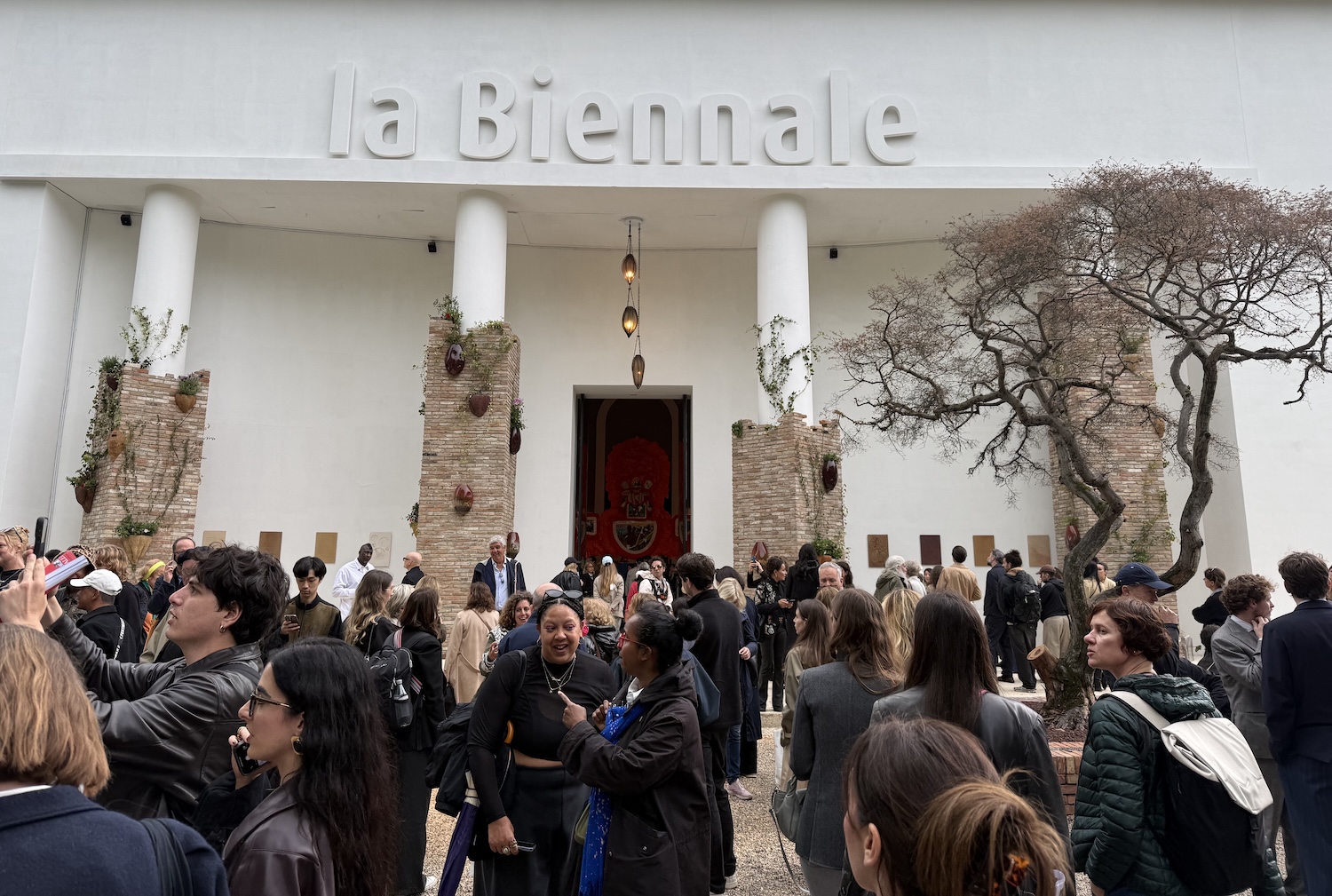
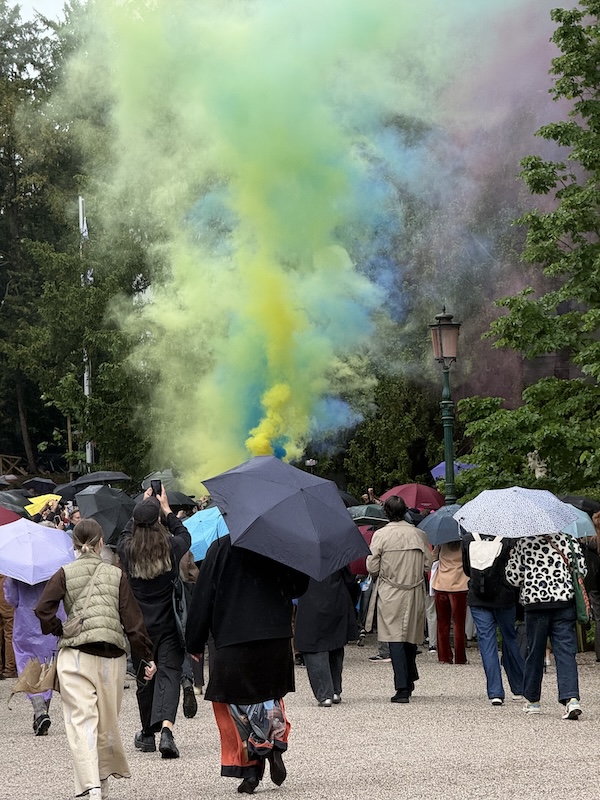
I had a clear plan for how to view the Biennale. On the first day I only visited the national pavilions (I did not get to the Austrian pavilion because of the crowds: no other line could compare to the throng patiently waiting in the warm, persistent May rain for Florentina Holtzinger’s performance.) The next day I went to the main exhibition in the Arsenale and began to realize that my brain was failing to comprehend the overload of images.
It wasn’t just my personal reaction to an excess of sensory stimuli. The very logic of art institutions produces this excess. The concepts of both national museums and the Venice Biennale emerged in the 19th century, during the rise of the modern nation and the height of European imperial power. The historical model of representing the world sorted the diversity of cultures into a single narrative and, in doing so, determined who was granted visibility – and on what terms. The Venice Biennale reproduces this model through a system of national pavilions where countries symbolically compete for visibility and recognition.
At the same time, this order is based on a specific, imperial view that sees territories, natural resources, and human bodies as objects to be managed, cataloged, and mastered. In this approach, culture also becomes a resource that produces symbolic capital for states, cities, and institutions. One consequence of this logic of accumulation is a surplus of artworks created, collected, and represented that exceeds the limits of human capabilities. To endlessly produce new objects, this logic demands endless, increasingly cheap labor to support production – in particular installation, security services, mediation, curatorial work, translation, and design – so the scope of work expands at the cost of temporary, low-paid or unpaid positions.
Gigantic museums and events such as the Venice Biennale also devour people’s attention, which they must constantly fight for. This leads not only viewers to exhaustion, but also everyone connected to the infrastructure. Behind the façade of art representation, human labor, a significant portion of which is unstable, poorly compensated, and vulnerable, remains in the shadows. Why does the art world recognize the intellectual significance of artworks, but say practically nothing about the physical and emotional effort that their production and reception cost?
I suspect my fatigue is related not only to my workload, but also to the chronic stress of war.
This is no random coincidence. The same imperial logic that in the 19th century determined whose territories and bodies were subject to appropriation and subjugation, defines the framework of the ongoing war: Russia denies Ukraine its right to sovereignty just as colonial regimes deny subjugated peoples the right to their own representation. The difference is that instead of symbolic appropriation, we’re experiencing outright destruction.
I must admit that I came to the Biennale with a personal need to turn my attention away from constant air raids: after all, who would resist the temptation to call traveling abroad to an art event a vacation? Yet changing location does not quiet the mind. I constantly asked myself: who actually sees the war and who chooses to look away? I was interested in the Ukrainian pavilion’s visibility – and the visibility of the war in the eyes of the international community – though I understood that literally nothing could satisfy this somewhat existential need of mine.
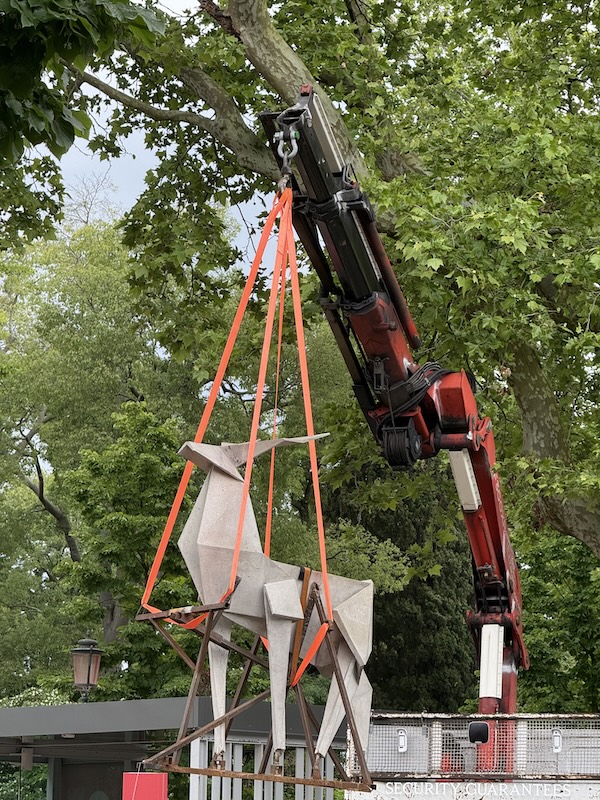
This year, a project titled Security Guarantees from the Ukrainian national pavilion was presented in two locations, which established a precedent in the rules of the Biennale. Near the entrance to the Giardini was a truck that held Zhanna Kadyrova’s sculpture Origami Deer suspended from straps. The sculpture was initially made for a park in Pokrovsk, which is located in the Donetsk region. This levitating object served as a metaphor for security guarantees that exist only on paper. It alludes to the 1994 Budapest memorandum, which proved incapable of protecting Ukraine from Russian aggression. The conceptual portion of the project and video documentation of the deer sculpture’s journey from the frontlines in Pokrovsk to Venice, a route that made the artwork a witness to war, were presented in the Arsenale.
I came to see the Biennale from a country in the middle of a war and my fear of death is not metaphorical: the threat of dying trapped under rubble after a missile or drone strike is very real. The war is exhausting my network of professional and personal connections literally as well: my friends and colleagues are dying on the frontlines. I cannot talk about these losses in the past tense, I’m afraid they’re not over. My mentor died in the war, but my conversations with him continue in my imagination.
I was moved by the subject of loss developed around Koyo Kouoh’s theme In Minor Keys. The Cameroonian-Swiss curator did not live to see her project realized; she died of cancer and her team, relatives, and friends completed her exhibition. One of the project’s “undercurrent priorities,” Shrines, was dedicated to artists who were Kouoh’s guides, among them the Senegalese artist Issa Samb, her mentor for many years, who died in 2017. It was thanks to a meeting with him that Kouoh founded RAW Material Company, an art and educational community in Dakar. In this double loss, death is not the end of the dialogue. The conversation is passed on to the intellectual network of people who spread and produce new knowledge. Samb speaks through Kouoh, who in turn speaks through her community: the voice never falls silent. Perhaps this was why a line from an Etel Adnan poem quoted in the exhibition resonated with me: “We came to transmit the shimmering”.
I tired of looking at the expositions; at some point everything merged into an unfathomable and endless visual stream. I knew what I was getting into. I had wanted this concentrated experience. Ultimately, the pavilions shuttered by an employees’ strike led me instead to the Strange Rules exhibition at Palazzo Diedo. I liked Trevor Paglen’s piece Voyager – an immersive, interactive AI experience. I lay down on a soft cot, put on headphones and a pulsometer, and listened to a warm, supportive voice. My body began to relax; my attention shifted to my breathing. In a few minutes I was crying.
The Ukrainian feminist and manager Yosh once wrote that it is not always best to avoid difficult experiences as they can expand our view of the world. Yet for such experiences not to become traumatic, she suggests the practice of “aftercare,” a practice borrowed from the BDSM community, might be useful. Aftercare refers to the intentional care taken after an intensive interaction to attend to the participants’ emotional well-being. In BDSM, roles are allocated according to an agreement between adults based on trust, respect, and safety. I think it’s a fair model precisely because it has no unspoken rules. Interactions are openly discussed beforehand.
The world of art is different. Hierarchies exist, but go unnamed, and discussing labor conditions is unacceptable. There’s another difference: in BDSM, people can leave the game. In the precarious economics of art, this isn’t always possible: it’s not that simple to remove yourself from the source of your income, or visibility and professional recognition. In the art world, as a rule, female artists or curators don’t negotiate their conditions. They simply accept what’s on offer since the only alternative is losing an opportunity. Today in the art world we have what my friend Natalia, an ornithologist, called “aesthetic abuse.”
In Thomas Mann’s Death in Venice, an unrestrained obsession with beauty deprives the main protagonist of the ability to care for his own safety and life. Aschenbach’s lethal attraction to beauty is aesthetic abuse in its most extreme form: beauty exhausts whoever consumes it without limits. By the same logic, institutionalized across an entire industry, hundreds of thousands of people sustain the art industry with their attention and bodies, without any ritual allowing them to say “stop” and recover.
One of the central themes of the art presentations which Koyo Kouoh curated is the importance of belonging to a network of relationships. European modernity has cultivated a tradition of radical individualism and atomization placing an individual above the world around them. But there is also another way of thinking about the self – one in which people see themselves as integrated in a network of connections with others.
In modern individualism, immortality is pursued through exceptionality – the attempt to leave a mark on history. In a networked view of identity, immortality lies in taking part in long-lasting processes that began before you and will continue after you. The main ideas in this essay did not emerge from my mind alone, but grew out of a network of connections and conversations I had.
In the precarious world of art, fatigue seems to be treated as the norm, disguised as a privilege and passion. As long as the cultural sector fails to recognize aftercare as a structural necessity, care will remain the responsibility of informal, grassroots networks grounded in solidarity rather than hierarchy. These networks must be nurtured; they’re liable to be exhausted. People are relational beings. As long as we’re here for each other, care will endure.
Translated from Ukrainian by Ali Kinsella