A life of dreams and cinema. Maya Deren (1917-1961)
Born in Kyiv, Maya Deren emigrated as a child to the United States, where she became a leading figure of avant-garde cinema in the 1940s and 1950s. She made dreamlike films on tiny budgets. She danced, wrote, studied Haitian ritual, and challenged rules. While she rejected linear narrative on screen, she lived a life whose adventures could have graced any Hollywood screenplay.
Things in life become intertwined, often in fairly unexpected ways. I left my hometown of Kyiv in 2017. Exactly a century earlier, a girl was born in that same city who was destined to spend her whole life on a journey. Yet she never saw it as hardship, but instead found inspiration in constant movement and endless change – perhaps the only constant in her life. Her parents named her Eleonora, in honor of the Italian actress Eleonora Duse, adored around the world and beloved by the poet Gabriele D'Annunzio.
It was as though the passion that filled the Italian diva’s heart had been passed on, along with her name, to the little girl from Kyiv. Eleonora Derenkovska might have frequented a pastry shop on Khreshchatyk and admired the lilacs in bloom in May, although, if you were born in 1917, you were far more likely to smell gunpowder than spring flowers. War and revolution spared no one; they brought out the beast in people. Eleonora’s parents made the difficult decision to emigrate. Painful as it was to leave Kyiv, they wanted to live. Eleonora was five years old then, and loved to sing. The years would go by, and those songs would remain probably her only keepsake from her hometown. Her family moved to New York and, over time, turned into respectable US citizens: psychiatrist Derenkovskyi became Dr. Deren.
Since then, a little over a hundred years have passed. Kyiv is at war. Many of its residents have to make difficult decisions. Everyone wants to live. I am in Rome. I’m standing beneath an Italian stone pine, sheltering from the July sun, and thinking about Maya Deren. She changed her name, but she and Duse still shared a sensitivity to the world where every detail could become a source of inspiration. Maya threw herself into her studies. She took interest in literature, political science, journalism, history, art, and dance. As a student, she wrote a research paper on the influence of the French Symbolist poets on English and American poetry.
Deren studied humanity’s cultural heritage with the attentive gaze of a poet seeking to experience and reimagine what had been created before her time while discovering her own voice, her own unique way of describing the world’s beauty and horrors, its contradictions and harmony. As a young woman Maya was interested in politics, and for a time the ideas of Leon Trotsky were close to her heart. Between discussions and meetings with like-minded people, she met her first husband, who shared her political views.
How do you write about Maya Deren? No word can ever be precise and comprehensive enough. It is like writing about the wind: you feel as though you understand everything about it, yet it laughs at you, hugs you, and the very next moment it is already far away. The wind, unstoppable, constantly changes things while changing itself too. Maya Deren was just like that. Perhaps her nature can best be described by borrowing Jean Cocteau’s words from Le Grand Écart, where he writes of a man “whose excessive nature perceived no acceptable middle ground.”
Here is Maya dancing, taking photographs, singing, sewing a brightly colored skirt, joining rallies, writing poems, studying American literature, getting married, divorcing, editing manuscripts, spending her last money on cat food, moving, working as a choreographer’s assistant, making her first films, becoming an auteur and embodiment of American avant-garde cinema, moving again. The truest story of Maya Deren would consist of nothing but verbs. Yet even verbs, dead, living, or borrowed, would not suffice to describe the life of someone for whom movement was both the meaning of life and the only possible form of rest.
The outside observer might think that Maya did not know what she wanted, but that was not the case. She knew exactly what she wanted, it was just that each time she wanted something different. As she gazed intently at the world around her, she never looked away from what was terrible, and rejoiced wholeheartedly whenever she encountered beauty. Deren shot her short movies on 16mm film and said of her works, “I am not greedy. I do not seek to possess the major portion of your days. I am content if, on those rare occasions whose truth can be stated only by poetry, you will, perhaps, recall an image, even only the aura of my films.”
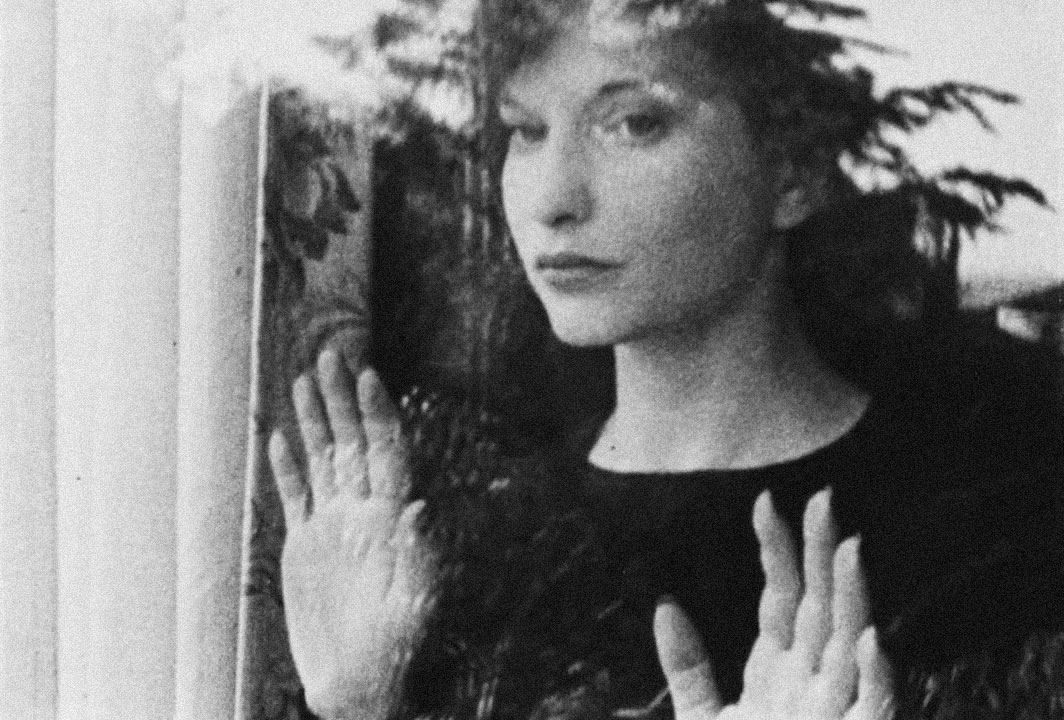
The sun is merciless. I stand as though engulfed in flames, with Emperor Nero grinning at me from the depths of the centuries. I almost press myself into the trunk of the Italian stone pine seeking shade. Soon I doze off, and my imagination is overtaken by Maya Deren’s films. Summer. Meshes of the Afternoon (1943). In my dream I do not think about the fact that this remarkable cinematic experiment won an award at the Cannes Film Festival. I do not remember that Maya made this film together with her second husband, the photographer and cinematographer Alexander Hammid. As Morpheus rocks me in his arms, I do not think, either, about the fact that Deren made all her films not merely on a low budget, but at times on a micro budget. (As she once quipped, “I make my pictures for what Hollywood spends on lipstick.”) Just like Maya Deren’s films, dreams have no linear narrative. So it is only objects and images from her movies that surface in my imagination.
Before us is a key. How many things it can unlock. How many times Maya must have locked the door of her house with it as she moved from place to place. Then a knife appears, sharp, capable of cutting through anything, even time and space. After all, we can slice time like a sandwich, and then eat it. A kind of lunch made from the most precious thing of all. But perhaps there is meaning in that: death, just as life, is best approached on a full stomach.
Can you hear this sound? Yes, the film is silent, and yet, can you hear it? It is as though the sand were dancing the tarantella on a wooden floor. It is Maya climbing the stairs. Then a stranger looks at us: his mirror-like face reflects all our worries, hopes, and frustrations. Suddenly the mirror shatters. Beyond the infinity of reflection lies another boundlessness: the sea.
Every object in Deren’s films is a true protagonist. Not a single one remains in the background. The key, the knife, the chessboard, the mirror – they all are like brightly colored tesserae in Deren’s surrealist cinematic mosaic. Each object in the frame seems to float above its own essence, taking on new meanings. It carries within it the wealth of artistic interpretations left by past generations of artists, while at the same time giving the film director space for her own artistic expression, one that provokes a powerful response in the viewer.
This comes naturally to the Surrealists: to endow an object with multiple meanings, to build a myth around it, to grant the viewer the freedom to interpret it while at the same time creating a series of vivid cultural associations. Sometimes it can be irritating: a firm reference to artistic memory may seem like an imposition, an appeal to the rational mind that feels all too direct. But the Surrealists never missed an opportunity to unsettle or even infuriate their audience. Usually they valued a passionate, even scathing response to their works over quiet approval.
That said, the imagistic structure of Maya Deren’s films, though it follows the laws of Surrealism, simply cannot irritate. In the shifting flow of images, objects, and shapes in her films one senses the syncopated rhythm of life. Viewers respond to this endless dance not because they know how to dance or want to. It is just that, perceiving its rhythm on an almost physical level, they simply cannot help answering it with an imagination suddenly set free.
Today, as we live through the tragic experience of war, the once somewhat overbearing polysemy of a Surrealist image is perceived in a totally different way-- as fullness, as self-sufficiency. The connection between an image and humanity’s cinematic, literary, and archeological heritage creates a sense of security: the viewer recognizes what is familiar, yet still has room for interpretation. In moments of vulnerability, one can lean on this polysemy that grows out of cultural memory.
And so Maya Deren’s protagonist and I walk together along the seashore. Our feet sink deeper and deeper into the sand, but we do not stop. It is a journey beyond time and space, from At Land (1944). Everything we encounter along the way seems to exist all at once. The shapes flow into one another, and the harmony is born not from the perfection of a new shape, but from the endlessness of transformation.
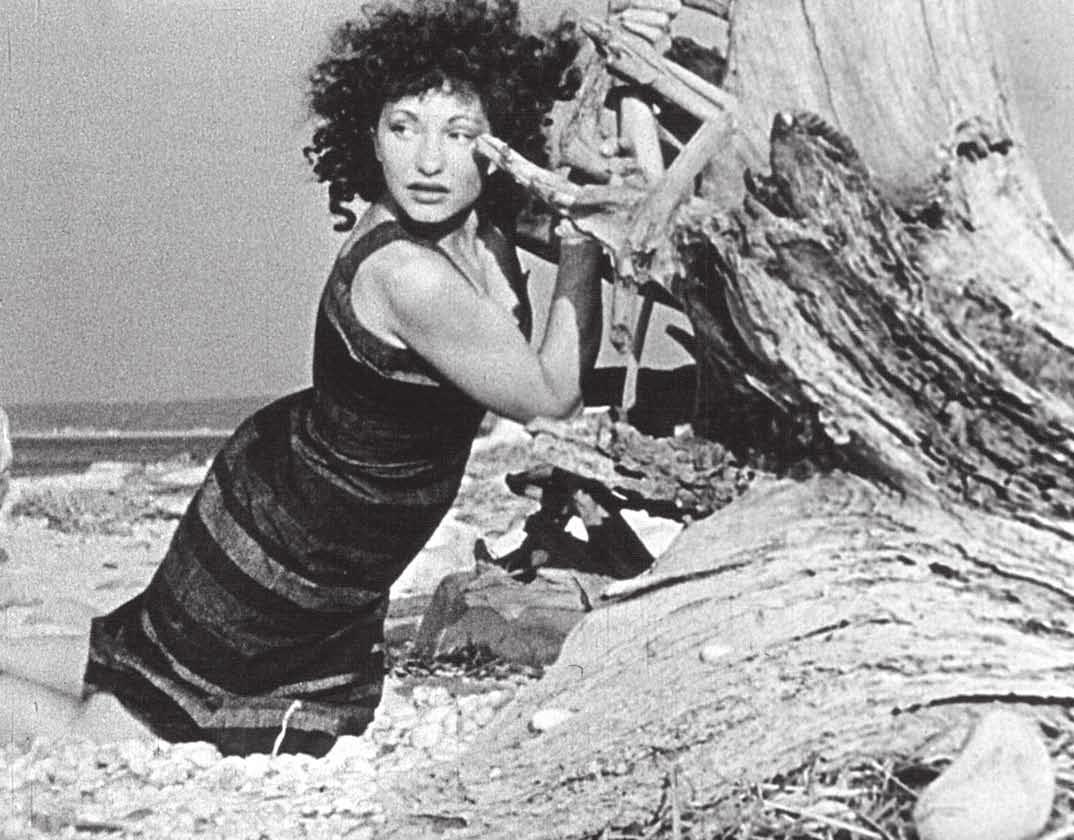
Maya Deren was the director, screenwriter, actress, and editor of her own films. She collaborated fruitfully with others, but above all she herself embodied her own works – deep on-screen experiences that viewers do not so much watch as live through. Maya was remarkably cinematic. It was as though her face and body had been created to one day become fully fledged elements of the language of cinema.
Deren said that her films embodied a woman’s gaze upon the world. She believed that a man lives in the present moment, while a woman is always anticipating what is to come, whether joy or grief. A woman looks toward the future, where one mise-en-scène gives way to the next. Watch At Land to fully experience this fluidity and the inescapability of anticipation.
Deren’s protagonist crawls across a table… finds herself by the sea… watches a game of chess, then joins it herself, the wind tossing her hair… What an ungrateful task it is to retell Maya Deren’s films. Words seem to strip the scenes and images of their depth. Better to surrender to the boundless freedom of interpretation, to perceive what you see as a sensual, emotional experience. It is as though you begin watching someone else’s dream, only for it to slowly transform into your own: the details of the film intertwine with the details of your dreams, your memories, your emotions, and with the ancient Greek myths you read with fascination as a child.
Herein lies the answer to why Deren’s films have had such a profound influence on filmmakers across generations, and why they continue to be studied in film schools. It is not only a matter of editing, camera movement, and striking visual details; nor is it simply that one sees the experiments of the French avant-garde filmmakers – Luis Buñuel and Jean Cocteau – reflected in the iris of Maya’s protagonist. It is that, for Deren, cinema is the only and the most accurate way of expressing a thought, a state of being, a feeling. Her poetry finds its most comfortable home in visual images, producing what seems an impossible effect. It is as though figurative painting and abstraction have suddenly become one, forever resolving art’s eternal question – the coexistence of point and line on the plane, and the instantaneous transition from stillness to movement.
It is as though beauty does not need new forms of embodiment, having already found the most expressive ones – even if this beauty is inseparable from violence, as in Meditation on Violence (1948). Tension gradually builds within the frame. Relief is only momentary, almost an illusion. Tension never disappears; it is merely re-channeled. Deren’s cinematic meditations feel especially poignant today, amid the war’s constant tension and anticipation of terror as we strive to survive, to keep our sanity, and to live to see the aggressors justly punished.
As a filmmaker, Maya Deren entered into an aesthetic polemic with the American film industry. It was a remarkably bold move in the Golden Age of Hollywood. Only someone fearless, utterly free, could declare in the 1940s and 1950s that a narrative with classical structure and dramaturgy need not be the cornerstone of a film. Maya was a truly independent filmmaker. She shot her films outside Hollywood’s studio system and always spoke her mind. She was someone who knew the true value of freedom and the right to choose.
Fascinated by the unknown, Maya Deren plunged into new experiences without hesitation – in her work, in art, in her personal life. While she rejected linear narrative on screen, she lived a life whose adventures could have graced any Hollywood screenplay. Filming in her own home, traveling, raising money, arguing with the producer, love affairs, marriages, divorces, the controversial behavior of her colleagues and friends, inspiration found once and for all in cinema, fascination with the dances and rituals of Haiti, falling in love with the young Teiji Itō, who became her third husband and later composed the music for her silent films…
Every scene in Maya Deren’s life blurred the divide between real life and cinematic dreams. Reality and fantasy melted ceaselessly into one another.
I wake up. The stone pine, proud and silent, remains my only shelter. Across the road, the museum is hosting a major exhibition of Hokusai. Having waited in line beneath the scorching sun, visitors now stand gazing at the mesmerizing serenity of Mount Fuji. Maya Deren died at the age of forty-four. Teiji Itō scattered her ashes over the Fuji River. It was his tribute to the story of their love: Maya set out on her eternal journey from one of the most majestic places on earth, where boundless tranquility embraces inexhaustible beauty.
Things in life become intertwined. In death, they shatter into tiny fragments of grief and tesserae, only to come together one day as a colorful mosaic of memories.
Translated from Ukrainian by Hanna Leliv
Proofread by Katharine Quinn-Judge