The weirdness of wartime memes
Wartime memes on social media are a widespread phenomenon in Ukraine. Here, writer Viktoria Grivina dissects one celebrating national unity, tracing its roots to a 2021 American painting about the paranormal. Lighthearted humor can highlight complex regional contrasts alongside the grief of Russian occupation. But should jokes really be analyzed?
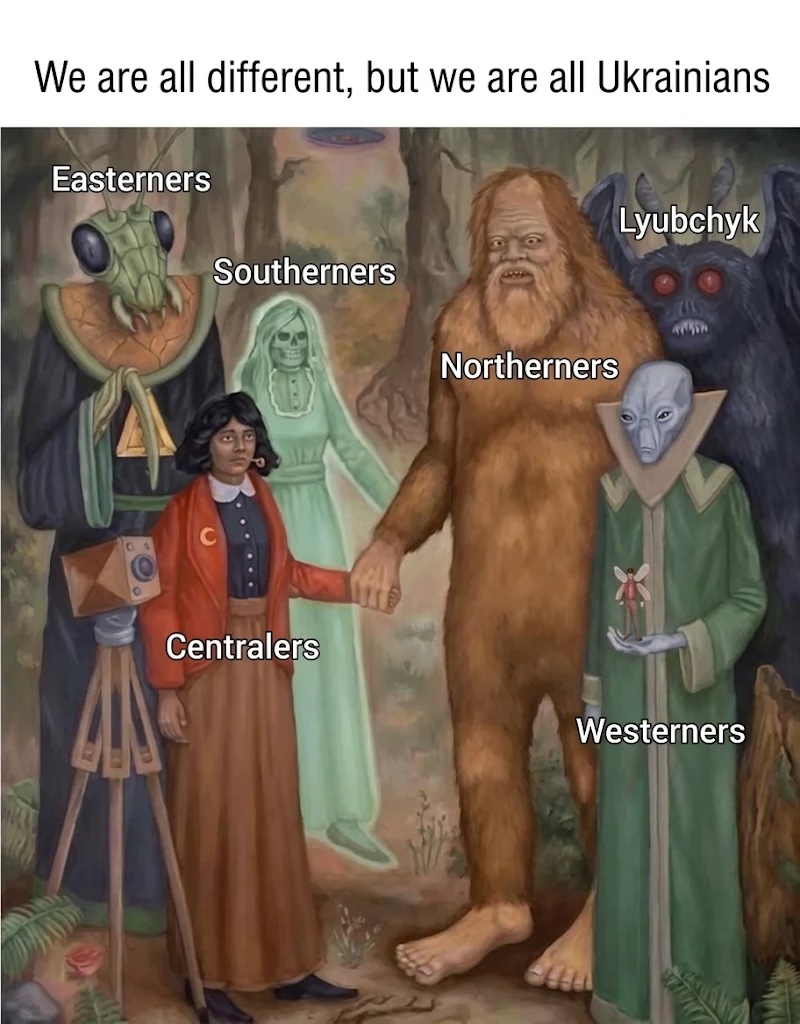
Writing about visual humor during a war is weird. So much so that, having written dozens of humorous essays sprinkled with memes about my life inside the experience of war and inside Ukraine, I struggle to analyze any of those memes, produced in response to Russia’s full-scale invasion of my country.
The moment I start writing about a joke, placing it under the lens of scholarly analysis, it just stops being funny. Wittgenstein was right to say that language needs speed to make sense, and humor is funny only when it’s not slowed down by detailed explanations. No high-brow theory, not even Wittgenstein’s Tractatus, can make a meme “funnier.”
Yet here it is. I present to you a wartime meme, a most innocent, all-encompassing, and loving meme, meant to display in an exaggerated manner the unity of various Ukrainian regions. This meme is best known under the title “We are all different, but we are all Ukrainians.”
The picture can be described as an ultimate, liberal democratic vision of the country, an anthem of diversity and tolerance for all, be it Easterners, Westerners, Central Ukrainians, representatives of North and South, and, of course, Lyubchyk, who I imagine must be either an illegal alien or indeed the all-beloved Chupakabra, the legendary monster that appeared on Ukrainian TV to fill in the empty airtime. Since the full-scale invasion began, we haven’t heard of Chupakabra, though. I miss Chupakabra.
I digress intentionally, because I don’t want to go where the unity meme wants to take us. It’s going in the same direction redundant, emphatic statements usually go. Insisting on seemingly obvious facts again and again paradoxically produces a doubt. Like all excessive repetitions, it says, “Houston, we have a problem.” Do we indulge in repetition for self-assurance?
When I first tried writing about this meme, I joked to myself that at least the Easterners and the Westerners look the same. As an Easterner, I am always uncomfortable entering such discussions, scratching an old dividing line promoted for decades by Russian media, talking of “drastic contrasts” between us. I feel particularly uncomfortable because I have written and worked for “Westerners” a lot (both western Ukrainians and western Europeans), and have always tried to blend in. As if I were trying to pass for a human.
Biases work silently, and you can never be too careful in hiding your otherness. I realized the East-West take could offend. As it turned out, the problem was that I didn’t know the story of the original image itself.
The original is an oil painting from 2021, Paranormal Investigator, by an American artist, Mike Rogers. The piece presents a recurring character in Rogers’ artwork, Hattie Hibbs, a paranormal investigator, envisioning “entities she made contact with over the years”, as Rogers put it. So there is Hattie (the central Ukrainians), the Mantis on the left (eastern ones, which is also myself), the Zeta Reticulan Gray Alien in the front right (western Ukrainians), the Bigfoot (Northerners), and the Mothman (Lyubchyk). Catching sight of the ghost at the back, I realize it is marked “Southerners” in the Ukrainian meme. I start to flat-out weep, recalling the recent evacuation from the ghost town of Oleshky, all the deserted, ruined, lost lives, the scorched earth, and the occupied Sea of Azov. The notion of a southern ghost seems to be a grim truth.
Just as I said, you should never analyze a meme. Especially in wartime. Especially a meme that appears to be about yourself.